
In This Article
Stand in any UK pet shop’s “natural chews” aisle and you’ll find two rival contenders staring back at you: the pale, gently ridged deer antler, and its chunkier, denser cousin, the elk antler. Both promise hours of quiet contentment, cleaner teeth and that particular kind of doggy bliss that only comes from gnawing something that fights back a little. But when it comes to elk antler vs deer antler for dogs which is better, the honest answer is “it depends” — and the details of that answer could save you a vet bill.
An antler, in the simplest terms, is a fast-growing, mineral-dense bone structure that deer, elk and moose shed naturally every year and regrow from scratch. Unlike horns, they don’t stay attached for life, which is precisely why they can be gathered from the ground rather than taken from an animal. That single fact makes antler chews one of the more ethically comfortable options in the natural chew aisle — nobody’s antlers were harmed in the making of your dog’s afternoon.
This guide walks through the real biological and practical differences between elk antler dog chews and deer antler dog chews, breaks down genuine density data, and reviews seven real products you can actually buy, from gentle fallow deer offerings through to the toughest moose and elk splits on the market. We’ll also flag exactly where vets get nervous — because “long-lasting” and “safe” aren’t always the same word.
What Is an Elk Antler vs Deer Antler Dog Chew?
An elk antler chew is a piece cut from a naturally shed elk (wapiti) antler — large, exceptionally dense, and prized by owners of powerful chewers. A deer antler chew comes from smaller cervids such as red or fallow deer, and tends to be lighter, slightly softer, and better suited to average or gentle chewers, puppies and small breeds. Both are natural, long-lasting, and rich in calcium and phosphorus.
Quick Comparison Table
| Factor | Elk Antler | Deer Antler | Moose Antler |
|---|---|---|---|
| Relative hardness | Very high | Medium-high | Medium (softer marrow) |
| Typical lifespan per chew | Weeks to months | Weeks | Weeks to months |
| Best suited to | Aggressive/power chewers, large breeds | Average chewers, small-to-medium breeds, puppies | Strong chewers wanting a slightly gentler hard chew |
| Typical UK price band | £10–£25 | £5–£20 | £6–£15 |
| Tooth-fracture risk | Higher | Lower to moderate | Moderate |
| Best For | Determined XL chewers | First-time antler buyers, smaller dogs | Owners wanting elk-level durability, slightly softer bite |
Reading across that table, the real story isn’t “elk beats deer” or vice versa — it’s that hardness and durability are almost the same axis, and that axis runs directly against dental safety. The harder and longer-lasting a chew is, the more force your dog’s teeth are absorbing every time they bite down, which is exactly why the RSPCA’s guidance on dog dental health flags large, solid chews as a fracture risk for energetic chewers rather than a default safe option. Deer antler suits the majority of pet dogs; elk antler is a specialist tool for a specific type of dog.
💬 Just one click — help others make better buying decisions too!😊
Top 7 Elk and Deer Antler Chews: Expert Analysis
Coverage below spans budget to premium, elk through to moose, and whole through to split formats, so whichever end of the spectrum your dog sits on, there’s a genuine option here rather than a generic recommendation.
1. Antos Antler Natural Dog Chew — reliable everyday deer antler at a fair price
The standout here is consistency: Antos has been producing pet chews since 1989, and its antler range draws on Red and Fallow deer, much of which comes from Scottish highland herds. Each medium chew weighs roughly 75-150g, with sharp points removed before sale.
Because it’s naturally shed and minimally processed, this chew avoids the boiling and chemical treatment that can strip nutrients from cheaper alternatives. What most buyers overlook is that the “medium” grading is really a proxy for chew duration rather than difficulty — a determined Labrador can still get through one in a few weeks, while a spaniel might make it last months.
Aggregated review sentiment across UK pet retailers consistently highlights good value and low odour as the main draws, with occasional feedback noting that natural size variation means some pieces are noticeably chunkier than others — inherent to a genuinely unprocessed product rather than a manufacturing flaw.
Pros:
- ✅ Consistent supply from an established, long-running brand
- ✅ Low odour and minimal mess as it wears down
- ✅ Good entry point for dogs new to antler chews
Cons:
- ❌ Size and shape vary piece to piece, being a natural product
- ❌ Less dense than elk, so heavy chewers finish it faster
Sitting in the £6–£10 range for a medium, this is a fair-value pick and a sensible first antler to test whether your dog even takes to the format before spending more on a premium option.
2. Green and Wilds Original Antler Dog Chew — premium, fully traceable Highland deer antler
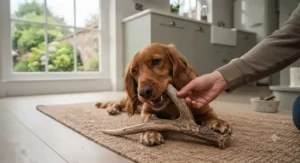
The standout feature is provenance: every antler is Grade A or AA Red Deer, sourced, hand-washed, hand-cut and hand-sanded in the UK, with traceability back to the Scottish Highlands.
Because the smoothing process removes sharp edges by hand rather than machine, the finished chew tends to have fewer rough splinter points than mass-processed alternatives, which matters more than it sounds for dogs who chew with their back molars. Based on the spec comparison with budget deer antlers, the extra hand-finishing justifies part of the price premium, though the underlying antler density is broadly similar to other red deer products.
Reviewers on independent UK pet retailer sites consistently praise the brand’s customer service and the “no fillers, no bulkers” positioning, with several long-term buyers noting their dogs have worked through multiple sizes as they’ve grown.
Pros:
- ✅ Full UK traceability back to Highland deer herds
- ✅ Hand-sanded edges reduce sharp splinter points
- ✅ Comes in Easy, Original and Fallow grades for different chewers
Cons:
- ❌ Sits at the premium end of deer antler pricing
- ❌ Availability by size can be inconsistent depending on the season’s shed
Prices generally fall in the £12–£20 range depending on size — a reasonable premium for buyers who specifically want Highland-sourced, hand-finished stock over an anonymous supply chain.
3. Artisan Gift Co Naturally Shed Deer Antler Chew — small-dog friendly starter multipack
The standout feature is sizing: this comes as an XS multi-unit pack with a minimum pack weight around 70g, specifically aimed at smaller breeds rather than a one-size-fits-all offering.
Because small dogs have proportionally more delicate jaws and teeth than a Rottweiler or Malinois, giving them a chew scaled to their size — rather than a chunk sawn off a large elk antler — meaningfully reduces the chance of them getting a whole antler wedged across the roof of the mouth. Here’s what to weigh: multipacks like this let you rotate a fresh piece in regularly, which keeps interest high without any single chew being gnawed down to a dangerously small, swallowable fragment.
Because this is a smaller-scale seller rather than a household name, verified aggregated review data is thinner than for the bigger brands; what feedback is available flags good value for a multipack format and suitability for toy and small breeds specifically.
Pros:
- ✅ Genuinely scaled for small breeds, not a cut-down large antler
- ✅ Multipack format supports regular rotation
- ✅ 100% natural with no chemical processing
Cons:
- ❌ Smaller pieces wear down and need replacing more often
- ❌ Independently verified review volume is limited compared with major brands
Typically available under £10 for the pack, this is a sensible, low-risk way for owners of Jack Russells, dachshunds and similar breeds to try antler chewing without committing to a size mismatch.
4. Wild Antler Elk Antler Chews, Large 3-Pack — serious durability for dedicated power chewers
The standout feature is sheer density: each antler in this pack weighs 120g–180g, sourced specifically for medium-to-large breeds with genuinely powerful jaws.
Elk antler marrow is measurably harder than deer marrow, and this is where that matters most in practice — a 30kg German Shepherd that demolishes a deer antler in a fortnight can often be occupied for two to three times as long with elk. Reviewers consistently note that the antlers arrive with points already blunted, and several buyers of multiple large-breed dogs specifically mention buying in this 3-pack format to avoid reordering every few weeks.
The trade-off, and it’s worth being honest about it, is that elk antler’s extra hardness is also what makes it a higher-risk chew for tooth fractures than deer or moose — a point we return to in the safety section below.
Pros:
- ✅ Three antlers per pack, ideal for multi-dog households
- ✅ Genuinely tough enough for XL power chewers
- ✅ No added chemicals, preservatives or bleaching
Cons:
- ❌ Higher relative fracture risk due to extreme hardness
- ❌ Overkill (and wasted expense) for average or gentle chewers
Expect to pay roughly £15–£25 for the three-pack, working out cheaper per antler than most single-unit elk purchases — solid value if your dog genuinely needs elk-level toughness.
5. Amazon Basics Elk Antler, Whole XL — budget-friendly elk for large dogs
The standout feature is straightforward value: a whole (not split) XL elk antler measuring roughly 9.5–10.5 inches, positioned for dogs over 45lb (around 20kg), sold through Amazon’s own budget pet range.
Because it’s a whole antler rather than split lengthways, dogs have to work harder to reach the softer marrow centre, which on paper means a longer chew life than a pre-split piece of similar size — useful if your dog tends to go through chews at an alarming rate. What most buyers overlook is that “whole” formats are generally considered a gentler introduction to elk hardness than split antlers, since there’s no exposed, harder-edged cut face for teeth to catch against from day one.
Aggregated feedback on this Amazon Basics range is generally positive for large-breed owners, with the main recurring theme being genuinely long chew duration for the price point, alongside occasional notes that individual antler shape and thickness vary since it remains a natural product.
Pros:
- ✅ Competitive pricing for a genuine XL elk antler
- ✅ Whole format extends chewing time versus split pieces
- ✅ Prime delivery convenience for repeat ordering
Cons:
- ❌ Shape and girth vary noticeably between individual units
- ❌ Still carries elk’s higher hardness-related fracture risk
Sitting around £15–£25, this is one of the more accessible ways to try genuine elk antler on a large dog without paying boutique prices.
6. Antler Chew Co Natural Moose Antler — the middle ground between elk toughness and deer forgiveness
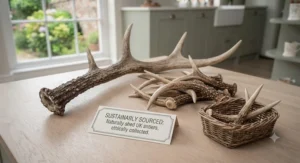
The standout feature is the marrow itself: moose antlers combine a slightly softer bone density than elk with higher natural moisture content, which on the spec sheet reads as a subtle but real reduction in bite-back hardness.
Reviewers consistently note it’s marketed as “nearly indestructible” for chew life while still sitting a notch below elk on the hardness scale, and it’s typically sold split or side-opened, giving dogs faster access to the nutrient-rich marrow than a whole piece. What the marketing copy won’t tell you outright, but industry commentary on moose chews increasingly acknowledges, is that this softer density is a genuine safety upside for owners nervous about elk’s fracture risk, even though moose is still firmly a “hard chew” category rather than a soft one.
Because moose antler chews are a smaller UK niche than deer or elk, verified review volume is thinner, though what feedback exists is consistently positive on longevity relative to price.
Pros:
- ✅ Slightly softer marrow than elk, without sacrificing much durability
- ✅ Split format gives quicker access to marrow for engagement
- ✅ Rich in the same core minerals as deer and elk antler
Cons:
- ❌ Harder to source consistently than mainstream deer or elk lines
- ❌ Still classed as a hard chew — not suitable for weak or damaged teeth
Priced around £6–£15 depending on size, moose antler is worth seeking out specifically for owners who want elk-level chew life with a marginally gentler bite profile.
7. Green and Wilds Easy Antler / Fallow Deer Chew — the gentle option for puppies, seniors and softer chewers
The standout feature is softness: this range uses Premium Fallow Antler specifically because it’s a noticeably softer material than Red Deer or elk, aimed at puppies from around 12 weeks, older dogs, or dogs who simply don’t chew with much force.
Because puppy teeth and ageing jaws are both more vulnerable to damage than an adult dog in its prime, matching chew hardness to life stage is one of the simplest, most overlooked safety decisions an owner can make. Here’s what to weigh: a soft chewer given an elk antler often just avoids it, while the same dog given a Fallow deer chew will actually use it, meaning the “safer” softer option frequently delivers better real-world dental benefit than a supposedly superior hard chew nobody touches.
Aggregated sentiment specifically praises this line for puppies teething and for older dogs who’ve “gone off” harder antlers as their teeth have aged, with several reviewers switching down from Red Deer or elk products after a vet flagged wear on an ageing dog’s teeth.
Pros:
- ✅ Genuinely softer bite profile, ideal for puppies and seniors
- ✅ Reduces fracture risk versus Red Deer or elk options
- ✅ Suitable from 12 weeks of age per manufacturer guidance
Cons:
- ❌ Wears down faster than harder antler types
- ❌ Not tough enough for confirmed power chewers
Typically £6–£12 depending on size, this is the antler to reach for whenever hardness itself is the safety question, rather than durability.
Antler Density Comparison: Elk vs Deer vs Moose
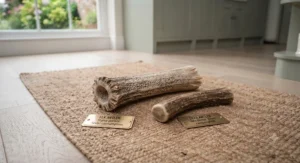
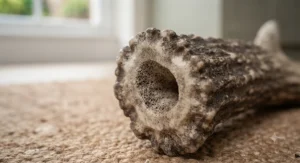
If there’s one number that actually answers “which is better,” it’s density. Structurally, antler is a close cousin to long bone, and a peer-reviewed mechanical study of North American elk antler found that antler and limb bone share a similar microstructure, with a dense outer layer of compact bone surrounding a spongier core running through the main beam, and that the material’s bending and compressive strength were consistently higher along its length than across it — which is exactly the direction a dog’s jaw applies force when gnawing a stick-shaped chew.
In practical terms, elk sits at the top of the hardness scale, moose comes in just beneath it thanks to a softer, more moisture-rich marrow, and deer — particularly Fallow deer — sits lowest, making it the most forgiving material for average and gentle chewers. This ordering matters more than any single spec sheet number, because chew duration and fracture risk both scale directly with density: harder material lasts longer between replacements, but transmits more force back through the tooth on every bite.
The analysis also cuts against a common assumption that “biggest is toughest.” A large but soft Fallow deer antler can actually be gentler on teeth than a small, dense elk offcut, which is why size alone is a poor proxy for safety — density and species matter more than dimensions.
How to Choose Between Elk Antler and Deer Antler for Your Dog
What is elk antler vs deer antler for dogs which is better? In short: deer antler suits the majority of pet dogs as a lower-risk, still long-lasting chew, while elk antler is best reserved for confirmed power chewers whose owners actively monitor chewing sessions and accept a higher tooth-fracture trade-off for extended durability.
- Assess your dog’s chewing style first. A dog that gnaws steadily is a very different candidate to one that clamps down hard and tries to crack chews in half — the latter is a poor fit for elk regardless of size.
- Match density to age and dental history. Puppies with developing teeth and seniors with worn enamel do better on Fallow deer or moose than Red Deer or elk.
- Size the chew to the dog, not the price tag. A chew small enough to be swallowed whole is a choking hazard regardless of species — always err larger than your dog’s mouth width.
- Start with deer if you’re unsure. It’s cheaper to “waste” a deer antler on a dog that turns out to be a determined chewer than to risk a fractured tooth testing elk first.
- Watch for splintering, not just size. Antler that’s cracking into shards, rather than wearing smooth, should be removed immediately regardless of how much is left.
- Rotate species and hardness over time. Many owners successfully alternate deer, moose and elk depending on mood, boredom levels and how recently their dog has had a dental check.
- Always supervise. No antler, however well-reviewed, replaces active supervision during a chewing session.
Top 7 Products: Specs & Value Comparison
| Product | Species | Format | Price Range | Best For |
|---|---|---|---|---|
| Antos Antler Natural Dog Chew | Red/Fallow deer | Whole | £6–£10 | Everyday chewers, first-timers |
| Green and Wilds Original Antler Dog Chew | Red deer | Whole | £12–£20 | Buyers wanting UK traceability |
| Artisan Gift Co Deer Antler Chew | Deer | Whole, multipack | Under £10 | Small breeds, puppies |
| Wild Antler Elk Antler Chews (3-Pack) | Elk | Whole | £15–£25 | Multi-dog, power-chewer households |
| Amazon Basics Elk Antler Whole XL | Elk | Whole | £15–£25 | Large dogs on a budget |
| Antler Chew Co Natural Moose Antler | Moose | Split | £6–£15 | Strong chewers wanting a gentler bite |
| Green and Wilds Easy/Fallow Antler Chew | Fallow deer | Whole | £6–£12 | Puppies, seniors, gentle chewers |
Scanning across this table, the clearest pattern is that price tracks provenance and processing far more than raw durability — the Antos Antler Natural Dog Chew and Green and Wilds Original Antler Dog Chew cost quite differently for broadly similar deer density, with the gap explained by hand-finishing and traceability rather than chew life. Meanwhile, elk options like the Wild Antler Elk Antler Chews and Amazon Basics Elk Antler Whole XL sit in a similar band to each other, suggesting species and size, not brand prestige, are the real price drivers once you’re shopping in the elk category specifically.
✨ Don’t Miss These Exclusive Deals!
🔍 Take your dog’s chew routine to the next level with these carefully selected antler picks. Click on any highlighted item to check current pricing and availability. These natural chews will help create the calm, contented afternoons your dog — and your furniture — deserve!
Elk Antler vs Deer Antler for Heavy Chewers
For genuinely determined chewers — think working breeds, adolescent Labradors, or any dog that’s demolished a “indestructible” toy in under an hour — the calculus shifts noticeably. Standard deer antler, even from a reputable brand like Antos Antler Natural Dog Chew, often gets reduced to a stub within days by this category of dog, which isn’t just a cost problem; a heavily worn-down antler with exposed rough edges is itself a hazard.
This is where elk earns its reputation. Products like the Wild Antler Elk Antler Chews and Amazon Basics Elk Antler Whole XL are specifically graded for larger, stronger jaws, and their density means a session that would flatten a deer antler barely dents the surface. Based on the spec comparison, heavy chewers given appropriately sized elk antler typically get two to four times the chew life of the equivalent deer antler, which meaningfully changes the cost-per-week even though the upfront price is higher.
That said, “best for heavy chewers” isn’t the same as “safest for heavy chewers.” Dogs that chew hardest are, mechanically, also generating the most force against their own teeth, so heavy chewers are simultaneously the group that benefits most from elk’s durability and the group most exposed to elk’s fracture risk. The pragmatic middle path many experienced owners land on is the Antler Chew Co Natural Moose Antler — durable enough to satisfy a determined chewer, with a marginally softer bite than elk.
Antler Mineral Content and Nutritional Value for Dogs
Antler isn’t just structural filler — it’s genuinely nutrient-dense. A breakdown of deer antler mineral composition from the National Deer Association points to a University of Georgia study that detected eleven different minerals in deer antler, with calcium and phosphorus the two most common, together making up roughly 30–35 percent of a mature antler’s weight, alongside smaller amounts of magnesium, sodium and trace elements including iron, zinc and manganese. Separately, laboratory analysis across three deer species found calcium concentrations in a similar 22–23 percent range with broadly comparable mineral profiles between species, reinforcing that this mineral density isn’t a one-species quirk — it holds across deer, elk and moose antler alike.
In practice, this means every antler chew is quietly supplementing calcium and phosphorus, both important for bone and dental health, alongside trace minerals that support normal metabolic function. It’s worth being precise here: antler chews are not a replacement for a complete, balanced diet, and the mineral content shouldn’t be oversold as a health supplement in its own right. Rather, think of it as a genuinely useful bonus that comes attached to a chew your dog was going to want anyway — real value, just not the headline reason to buy one.
One nuance worth flagging: because growing (velvet) antler is roughly 80 percent protein and comparatively low in minerals, while fully hardened, naturally shed antler is closer to an even split between protein and minerals, the shed antler used in dog chews is meaningfully more mineral-dense than antler harvested earlier in the growth cycle — another reason “naturally shed” labelling, seen across products like Green and Wilds Original Antler Dog Chew and Antler Chew Co Natural Moose Antler, is worth checking for rather than assuming.
Getting Started: Practical Usage Guide for New Antler Chews
The first thirty days with a new antler chew set the pattern for how safely and successfully your dog uses it long-term, and a few small habits make a real difference.
Introduce gradually, supervised. For the first few sessions, cap chewing time to 15–20 minutes and stay in the room. This lets you spot whether your dog is a gentle gnawer or an aggressive cracker before leaving them unsupervised with anything harder than the Green and Wilds Easy/Fallow Antler Chew.
Check for the right size weekly. As antler wears down, reassess whether it’s small enough to be a choking risk — a common first-30-days mistake is leaving a shrinking antler in rotation too long simply because the dog still seems interested.
Rinse, don’t soak. Antler doesn’t need washing like a fabric toy, but a quick rinse under warm water every week or two removes accumulated saliva residue and keeps things hygienic, particularly for multi-dog households sharing chews like the Wild Antler Elk Antler Chews three-pack.
Store dry, between sessions. Keeping unused antler in a cool, dry spot away from direct sunlight prevents it drying out and becoming brittle faster than normal wear would cause.
Watch the marrow centre. Once a whole antler like the Amazon Basics Elk Antler Whole XL wears down to expose a significant length of soft marrow, chewing accelerates rapidly — this is normal, but it’s the point to start planning a replacement rather than waiting until it’s gone entirely.
Real-World Scenarios: Which Antler Suits Your Dog?
The adolescent Labrador who destroys everything. At eight months old and 28kg, this dog goes through soft toys in minutes and needs genuine durability. The Wild Antler Elk Antler Chews three-pack, correctly sized and supervised, matches the chewing intensity — though regular dental checks are non-negotiable given elk’s fracture risk at this chewing force.
The senior Cavalier with mild dental wear. At eleven years old with some existing gum recession, this dog needs mineral benefit and mental stimulation without added bite force. The Green and Wilds Easy/Fallow Antler Chew fits perfectly — soft enough not to stress ageing teeth, still long-lasting enough to be worthwhile.
The budget-conscious first-time antler buyer with a medium mixed breed. Around 18kg, average chewing intensity, no known dental issues. The Antos Antler Natural Dog Chew is the sensible starting point — affordable enough to “test” whether antler chewing suits the dog before investing in premium or elk-grade options.
Benefits vs Traditional Chew Alternatives
| Factor | Antler Chews | Rawhide | Nylon/Synthetic Chews | Real Bones |
|---|---|---|---|---|
| Digestibility risk | Low (worn down, rarely swallowed whole) | Higher (can be swallowed in chunks) | Low, but non-digestible fragments possible | Moderate to high |
| Odour/mess | Minimal | Can smell, gets slimy | Minimal | Greasy, can smell strongly |
| Tooth-fracture risk | Moderate to high (species-dependent) | Low | Moderate | High |
| Longevity | Weeks to months | Days to weeks | Weeks to months | Days |
| Natural/additive-free | Yes (when unprocessed) | Often chemically treated | No — synthetic material | Yes, but often cooked/processed |
The analysis here reinforces why antler has become such a popular category: it consistently beats rawhide on mess and digestibility, and beats real bones on odour and fragment risk, while broadly matching synthetic chews for longevity without the non-biodegradable downside. The one area where antler doesn’t clearly win is tooth-fracture risk, which scales directly with hardness — a caution that applies most strongly to harder species like elk, and least to softer options like Fallow deer.
Common Mistakes When Buying Elk or Deer Antler Chews
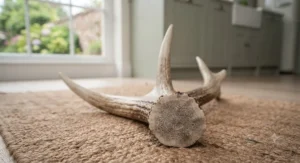
Even well-intentioned owners fall into a handful of predictable traps. Buying purely on price is the most common — a cheap elk antler that’s the wrong size for a small dog is worse value than a correctly sized deer antler, because it either goes unused or becomes a choking risk once worn down. Skipping the “species check” is another: not every listing clearly states deer versus elk versus moose, and buyers who assume “antler” is a single generic category often end up with something far harder or softer than they expected.
A third mistake is ignoring your dog’s existing dental history. A dog that’s already had a tooth extracted or shows gum sensitivity is a poor candidate for anything at the elk end of the spectrum, regardless of how enthusiastically they’d chew it. Finally, many owners leave a shrinking antler in circulation too long — the point where a chew becomes small enough to swallow whole is exactly the point it should be retired, not the point it “still seems fine.”
Safety, Regulations and Vet Guidance for Antler Chews
There’s no UK-specific regulation governing antler dog chews the way there is for, say, food additives, but general product safety and Trading Standards rules on pet products still apply, and vet bodies are consistent in their guidance. PDSA advice on dental disease in dogs specifically warns against feeding very hard chews because they can cause slab fractures, where a large chunk of tooth breaks away and exposes the sensitive inside of the tooth — antler, while not literally a bone, sits mechanically close enough to this category that the same caution reasonably applies, particularly for elk. Separately, vets advise that a dog who whimpers while chewing, paws at the mouth, has blood in their saliva or refuses food should be seen urgently, with any suspected dental disease treated only under veterinary direction.
Practical safety steps that meaningfully reduce risk: always choose a chew too large to be swallowed whole, always supervise, always remove a chew once it’s cracked or worn to a small nub, and consider erring towards softer options — Fallow deer or moose over elk — for any dog with existing dental wear, a small jaw, or a history of aggressive chewing that’s previously damaged toys or teeth. If in doubt, a quick conversation with your own vet about your specific dog’s dental history is worth more than any generic guidance, including this one.
Long-Term Cost and Maintenance: Value Analysis
Looking purely at sticker price, deer antlers like the Antos Antler Natural Dog Chew appear cheaper than elk options like the Amazon Basics Elk Antler Whole XL — but total cost of ownership tells a more nuanced story. A heavy chewer working through a £8 deer antler every ten days spends roughly £24 a month, whereas the same dog on a £20 elk antler lasting six to eight weeks spends closer to £12–£14 a month, despite the higher unit price. For average or gentle chewers, this maths reverses: a deer antler lasting six to eight weeks for a gentle chewer is simply better value than paying an elk premium that’s never actually needed.
Maintenance costs stay low either way — no batteries, no washing machine cycles, no replacement parts — but the “hidden” cost worth budgeting for is dental. Any hard chew carries some fracture risk, and a single vet visit for a cracked tooth can run into hundreds of pounds, dwarfing years of antler purchases. Factoring this in, many experienced owners find the moderate-hardness middle ground — moose, or Highland-sourced deer like Green and Wilds Original Antler Dog Chew — delivers the best long-run value once dental risk is priced in alongside the antler’s sticker cost.
Where to Buy Elk Antler Chews and Deer Antler Chews
All seven products featured here are available through UK pet retailers and Amazon.co.uk, typically with free delivery over a minimum spend and, for the major brands, subscribe-and-save style repeat-order options. When buying elk antler chews or deer antler chews online, check three things before adding to basket: the stated size band matches your dog’s weight and jaw strength, the listing specifies species clearly (elk, Red deer, Fallow deer or moose), and the seller states the antler is naturally shed rather than harvested. Reputable UK sellers, including the brands featured above, are generally upfront about all three — a listing that’s vague on species or sourcing is worth treating with a little more scepticism.
✨ Don’t Miss These Exclusive Deals!
🔍 Ready to find the right antler for your dog? Check current pricing and availability on the picks above — your dog’s next favourite chew session is just a click away!
FAQ
❓ Is elk antler harder than deer antler?
❓ Can antler chews break my dog's teeth?
❓ Which is better for puppies, elk or deer antler?
❓ How long does an elk antler chew last for a dog?
❓ Are moose antlers better than elk for dogs?
Conclusion
So, elk antler vs deer antler for dogs which is better? There isn’t a single winner — there’s a match to be made between your specific dog’s chewing intensity, age, dental history and your own appetite for supervision. Deer antler, whether the everyday reliability of Antos Antler Natural Dog Chew or the traceable premium feel of Green and Wilds Original Antler Dog Chew, suits the majority of pet dogs safely and affordably. Elk, through options like the Wild Antler Elk Antler Chews or Amazon Basics Elk Antler Whole XL, earns its keep only with genuinely determined chewers who need the extra durability and whose owners actively watch for warning signs. Moose antler, via the Antler Chew Co Natural Moose Antler, splits the difference neatly, while the Artisan Gift Co Deer Antler Chew and Green and Wilds Easy/Fallow Antler Chew cover small breeds, puppies and seniors respectively.
Whichever you choose, the fundamentals stay the same: size it correctly, supervise the first sessions, retire it once it’s worn small or starts to crack, and keep an eye on your dog’s mouth the way you would any other part of their health. Get that right, and antler — elk, deer or moose — earns its reputation as one of the more genuinely useful natural chews on the market.
Recommended for You
- 7 Best Split Antler Dog Chews UK (2026 Buying Guide)
- Are Antler Chews Safe for Dogs? Vet-Backed UK Guide 2026
- Are Wooden Dog Chew Toys Safe? 7 Picks Reviewed for 2026
Disclaimer: This article contains affiliate links. As an Amazon Associate, I earn from qualifying purchases. If you purchase products through these links, we may earn a small commission at no additional cost to you.
✨ Found this helpful? Share it with your friends! 💬🤗
