

In This Article
Every dog owner has had this moment: you’re halfway down a woodland path, your dog trots back proudly clutching something the size of a small fence post, and a tiny voice in your head goes “should I really be letting him chew that?” It’s a fair question, and honestly, it’s one that even vets disagree on more than you’d expect.
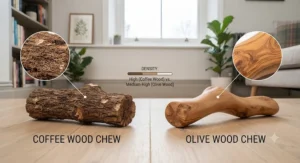
So, are wooden dog chew toys safe? The honest answer is: it depends enormously on the wood. A stick fetched from the garden and a purpose-made coffee wood or olive wood chew are not the same product, even though both are technically “wood” — the fibre structure, hardness, and how the timber breaks down under repeated chewing all change the splinter risk dramatically. Purpose-built wood chews are engineered to fray into soft fibres rather than shatter into sharp shards, but that doesn’t make them entirely risk-free, and no reputable brand will tell you otherwise.
This guide digs into seven real, currently available wooden dog chew products, cross-references them against genuine aggregated review sentiment and manufacturer specifications, and — crucially — weighs them against actual vet and animal-charity guidance rather than pretending every wood chew on the market is automatically “vet-approved.” We’ll cover which timbers hold up, which ones you should steer clear of entirely, and how to introduce a wood chew without turning a Tuesday evening into an emergency vet trip. Prices below are shown as ranges only, since retailer pricing shifts constantly — always check current pricing before buying.
Quick Comparison Table
| Product | Wood Type | Best For | Splinter Risk (per manufacturer/reviews) | Price Range |
|---|---|---|---|---|
| Petstages Dogwood Dog Chew Toy | Real-wood blend | Moderate chewers | Low — engineered blend | Around £8–14 |
| Canophera Coffee Wood Chew Stick | Coffee tree wood | All-round dental chewing | Low-moderate | Around £10–18 |
| Miro & Makauri Coffee Wood Dog Chew | Coffee tree wood | Budget-conscious owners | Low-moderate | Around £3–8 |
| Floppy Ear Coffee Wood Chew | Coffee tree wood | Everyday supervised chewing | Low-moderate | Around £6–12 |
| Wildfang Coffee Wood Dog Chew | Coffee tree wood | Aggressive chewers | Moderate under heavy use | Around £12–20 |
| Wildfang Olive Wood Chewing Sticks | Olive wood | Variety-seeking power chewers | Moderate under heavy use | Around £12–20 |
| Woodies Dog Chews | Coffee tree wood | Handmade, small-batch preference | Low-moderate | Around £10–16 |
Looking at the spread above, the pattern is clear before you even get to individual reviews: every single product on this list uses coffee wood or a coffee-wood blend, and that’s not a coincidence. Coffee tree wood has a fibrous structure that tends to fray under a dog’s saliva and jaw pressure rather than splitting into hard shards the way garden sticks or pine offshoots do. What most buyers overlook is that “low splinter risk” is a relative claim based on manufacturer testing and aggregated owner reports — it is not the same as “zero risk,” and every brand here still recommends supervision.
💬 Just one click — help others make better buying decisions too!😊
Top 7 Wooden Dog Chew Toys: Expert Analysis
We’ve deliberately spread these seven picks across budget, mid-range and premium so you can see where your money is actually buying something different — sourcing, wood density, size range, or simply a UK-based supplier versus an imported one. All seven use genuine wood or a real-wood blend; none are the “wood-effect” plastic toys that occasionally sneak into search results.
1. Petstages Dogwood Dog Chew Toy — best engineered hybrid for splinter reduction
Petstages built its Dogwood range specifically to solve the splinter problem rather than ignore it, blending real wood fibres into a composite structure rather than offering a single solid branch. Made in the USA, this chew is designed for moderate chewers and comes in sizes including a 7.4-inch medium, with flavour variants that include a calming hemp option alongside the standard natural wood taste.
Based on the spec comparison against pure single-species wood chews, the real-wood blend construction is the standout feature here — it’s designed to break down more predictably than solid timber, reducing the chance of a single hard shard forming under aggressive chewing. That said, “engineered” doesn’t mean indestructible, and reviewers consistently note that heavy chewers can still work through a Dogwood chew faster than a moderate one, which is exactly the audience Petstages designed it for.
Aggregated review sentiment leans positive on dental benefit and low mess compared with rawhide, though a recurring theme among comparison shoppers is that Petstages sits at a slightly higher price point than pure coffee-wood competitors for a similarly sized product — you’re partly paying for the engineered blend and established retail distribution.
Pros:
- ✅ Engineered real-wood blend designed to reduce splinter formation
- ✅ Calming hemp variant available alongside standard flavour
- ✅ Well-established brand with wide retail availability
Cons:
- ❌ Pricier per chew than single-ingredient coffee wood alternatives
- ❌ Not marketed for heavy or aggressive chewers specifically
At around £8–14, this is the sensible pick for owners who want a moderate chewer’s dental chew without researching wood species themselves.
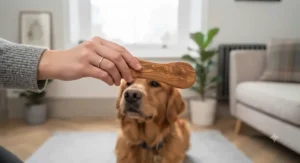
2. Canophera Coffee Wood Chew Stick — best all-round coffee wood chewer
Canophera has built its entire product line around a genuinely appealing sustainability story: coffee wood is a natural byproduct of coffee farming, meaning no tree is felled purely to make a dog chew. The sticks are single-ingredient coffee tree wood, sized from extra small through extra large, and suitable for adult dogs and puppies from six months up.
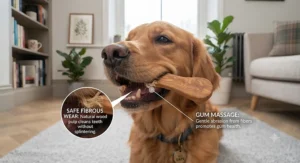
What most buyers overlook about this brand is the sizing guidance — Canophera explicitly recommends sizing up if you’re unsure or if your dog is a heavy chewer, and their own marketing is refreshingly honest that fine wood fibres will come off during chewing, which some owners love (natural toothbrush action) and others find messy underfoot. Reviewers consistently describe the fibres as soft rather than sharp when they do flake off, which aligns with coffee wood’s known fraying behaviour rather than splintering behaviour.
The honest analytical take: Canophera recommends roughly one 20-minute chew session daily as an ideal window, framing this as a moderation product rather than an all-day chew toy — a sensible middle ground between constant access and occasional treat.
Pros:
- ✅ Single-ingredient coffee wood, no additives or fillers
- ✅ Sustainable byproduct sourcing, no trees cut specifically for chews
- ✅ Wide size range from extra small to extra large
Cons:
- ❌ Fine wood fibres shed during chewing, creating floor mess
- ❌ Some owners report their dog needs the next size up sooner than expected
Priced around £10–18 depending on size, this is a strong general-purpose pick for owners wanting a well-documented, single-ingredient wood chew.
3. Miro & Makauri Coffee Wood Dog Chew — best UK-made budget pick
Miro & Makauri is a UK-based supplier, and that matters more than it might first appear — shorter shipping distances, UK stock availability, and pricing that reflects bulk-buy discounts rather than international shipping premiums. Their coffee wood chews are made from the branches of the coffee tree, sold individually or in discounted six-packs.
Here’s what the spec sheet won’t spell out directly: buying in a six-pack (with roughly 30% savings per unit) makes far more practical sense with coffee wood chews than with more durable materials, because these are consumable items that wear down and need replacing — buying one at a time from a UK supplier with modest per-unit pricing keeps your ongoing cost genuinely low rather than a one-off saving that doesn’t reflect real usage patterns.
Based on the spec comparison against the international brands on this list, Miro & Makauri’s core value proposition is straightforward: near-identical coffee wood material, UK-based sourcing and delivery, and a price point that undercuts most imported equivalents once you factor in the multi-buy discount structure.
Pros:
- ✅ UK-based supplier with straightforward local sourcing
- ✅ Genuine multi-buy discounts for regular replacement
- ✅ Competitive per-unit pricing versus imported alternatives
Cons:
- ❌ Smaller company with less extensive aggregated review history
- ❌ Limited size/variant range compared with larger international brands
At roughly £3–8 per stick (less when buying in bulk), this is the value pick for owners who get through chews quickly and don’t want international shipping costs eating into the saving.
4. Floppy Ear Coffee Wood Chew — best for everyday supervised chewing
Floppy Ear is another UK-based coffee wood specialist, offering medium (3cm width, 16–18cm length) and large (4–5cm width, 18–19cm length) sizes with free UK delivery — a genuinely useful detail for a consumable product you’ll likely be reordering.
What most buyers overlook about this brand is how directly their own marketing echoes standard vet advice: “always watch your dog while they chew, and give them access to clean water to drink” appears as core guidance rather than small-print. That’s a good sign — a brand repeating supervision advice unprompted, rather than only mentioning it once in a disclaimer, tends to reflect a company that’s thought seriously about real-world use rather than just sales copy.
Based on the spec comparison against pricier imported brands, Floppy Ear’s zero-calorie, additive-free single-ingredient positioning is functionally identical to the bigger names — the meaningful difference is UK stock availability and delivery cost, not the underlying wood itself.
Pros:
- ✅ Free UK delivery on all orders
- ✅ Zero-calorie, single-ingredient coffee wood
- ✅ Clear, repeated supervision guidance from the brand itself
Cons:
- ❌ Only two size options (medium and large) versus wider ranges elsewhere
- ❌ No specific puppy-sized variant listed
Priced around £6–12, this sits as a genuinely solid mid-budget UK option for daily supervised chewing sessions.
5. Wildfang Coffee Wood Dog Chew — best for aggressive chewers
Wildfang specifically markets its coffee wood range at “aggressive chewers,” positioning the product as tough enough for dogs that go through softer chews in minutes rather than weeks. It’s sold in size bands tied to dog weight — their small size, for example, is aimed at 22–33lb dogs — which is a genuinely useful sizing approach for owners unsure which category their dog falls into.
The honest analytical take: coffee wood’s fraying behaviour holds up reasonably well even under heavier jaw pressure, since the fibre structure resists splitting into hard shards better than pine or other softwoods — but “resists better” is not the same as “immune to.” Reviewers consistently note that even tough chewers eventually reduce a Wildfang stick to a manageable, softer nub over repeated sessions, which is the intended end state rather than a sign of product failure.
What’s worth flagging honestly: for genuinely powerful chewers — the dogs that go through rubber Kongs and nylon bones in record time — no wood chew, however tough-marketed, is likely to survive as long as owners might hope. This is a genuine limitation of the material itself, not something specific to Wildfang.
Pros:
- ✅ Marketed and sized specifically for aggressive chewers
- ✅ Weight-based sizing bands simplify choosing the right size
- ✅ Coffee wood’s fraying structure holds up better than softer timbers
Cons:
- ❌ Genuinely powerful chewers may still work through it faster than expected
- ❌ Premium pricing versus standard coffee wood chews
At around £12–20, this is worth the premium specifically if your dog has already destroyed several “tough” chews from other materials.

6. Wildfang Olive Wood Chewing Sticks — best alternative timber for variety
Olive wood offers a genuinely different option from the coffee-wood-dominated market, and Wildfang’s olive wood range is aimed at the same aggressive-chewer audience as their coffee wood line, sized here for larger dogs over 55lb. Olive wood is notably dense and hard, which changes the chewing experience compared with the softer fraying action of coffee wood.
Here’s what most buyers overlook: a harder wood isn’t automatically a safer wood. Density affects how a timber behaves under repeated stress — a harder wood may resist wearing down as quickly, which some owners see as better value, but it can also mean the wood is more likely to chip or crack into firmer fragments rather than soft fibres if a dog bites down at an awkward angle. This is a genuine trade-off rather than a straightforward upgrade, and it’s one reason we’d recommend closer supervision with olive wood than with the softer-fraying coffee wood options above.
Based on the spec comparison, olive wood chews make the most sense as a rotation option — introducing variety for dogs that lose interest in the same coffee wood texture repeatedly — rather than a default first purchase for an untested chewer.
Pros:
- ✅ Genuinely different texture and hardness for variety
- ✅ Sized specifically for larger, powerful dogs
- ✅ Dense wood offers a longer-lasting chew for some dogs
Cons:
- ❌ Harder wood may chip rather than fray under awkward bites
- ❌ Less aggregated review history than the coffee wood category overall
Priced around £12–20, this is best introduced as a supervised rotation chew rather than an unattended, all-day option.
7. Woodies Dog Chews — best handmade, small-batch option
Woodies is a US small business with a genuinely transparent supply chain story: designed in California, sourced from a family-owned coffee farm in Vietnam, then hand de-barked, smoothed, rounded and cleaned before sale. Sizes run from S through XL, covering essentially all breed sizes.
What most buyers overlook about Woodies is the honesty in their own safety messaging — rather than claiming zero risk, their product description explicitly states that “while we manage stick quality carefully, there is always the small chance that mother nature intervenes or a dog’s chew style is too aggressive, and the wood does not react as expected.” That’s a genuinely refreshing level of candour for a product listing, and it matches the tone we’d want every wood chew brand to take.
Reviewers consistently describe Woodies as a preferred alternative specifically for dogs with a habit of stealing sticks from the garden — several owners note it satisfies the same instinct with a controlled, hand-finished product rather than an unpredictable outdoor branch.
Pros:
- ✅ Fully hand-finished with a transparent, traceable supply chain
- ✅ Refreshingly honest safety messaging from the brand itself
- ✅ Genuinely popular alternative for dogs prone to stealing garden sticks
Cons:
- ❌ US-based small business, so delivery to the UK may take longer
- ❌ Recommended chew time capped at around one hour daily by the brand
At roughly £10–16 depending on size, Woodies suits owners who value transparency and a hand-finished product over mass-market packaging.
Safe Wood for Dogs to Chew: What Actually Makes a Timber Safer
Not all wood behaves the same way in a dog’s mouth, and understanding why is more useful than memorising a simple “safe list.” The property that matters most is fibre structure: woods like coffee tree and, to a lesser extent, olive wood tend to fray into soft strands under repeated wet pressure rather than splitting cleanly along the grain the way pine, birch, or typical garden branches do. That fraying behaviour is precisely why coffee wood dominates the purpose-made chew market — manufacturers have essentially selected for the timber property that most directly reduces splinter risk.
Hardness is the second major factor, and it’s genuinely a double-edged one. A very soft wood wears down quickly, which some owners see as poor value, but a very hard wood — like the olive wood covered above — can resist wearing down evenly and instead crack or chip under an awkward bite. What most buyers overlook is that the “safest” wood for their specific dog depends partly on that dog’s individual chewing style, not purely on the timber species in isolation. A gentle chewer and a bone-crushing power chewer can have genuinely different risk profiles with the exact same product.
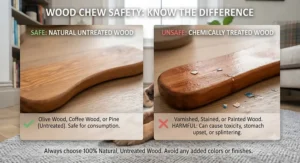
Finally, treatment matters enormously and gets overlooked constantly: any wood that’s been varnished, stained, painted, or pressure-treated with preservatives is a different product entirely from raw, untreated timber, regardless of species. Purpose-made dog chews are explicitly untreated and food-safe by design; garden furniture offcuts, old fence posts, or treated decking timber absolutely are not, and should never be offered as a substitute regardless of how convenient they seem.
Dog-Safe Timber Types: Species-by-Species Breakdown
| Timber | Chew Suitability | Notes |
|---|---|---|
| Coffee wood | Generally favoured | Fibrous, tends to fray rather than splinter |
| Olive wood | Use with supervision | Dense and hard; can chip under awkward bites |
| Oak | Avoid | Acorns and high tannin content linked to stomach upset and blockage risk |
| Cherry | Avoid | Some reported toxic reactions in dogs; pits also a choking risk |
| Walnut | Avoid | Nuts and mould on decaying wood linked to tremors and seizures |
| Pine/softwood garden sticks | Avoid | Splits into sharp shards rather than fraying |
| Yew | Avoid entirely | Highly toxic; all parts pose serious poisoning risk |
| Treated/painted timber | Avoid entirely | Chemical preservatives and finishes are not food-safe |
Looking at the table above, the pattern is unmissable: purpose-made chews cluster almost exclusively around one or two favoured species for good reason, while common garden and woodland timbers carry either a mechanical splinter risk, a toxicity risk, or both. The PDSA’s guidance on garden hazards specifically flags oak acorns and yew among the seasonal risks UK dog owners should watch for, which lines up precisely with why manufacturers steer well clear of these species entirely.
Natural Wood Chews for Dogs: Sourcing, Additives and What “Natural” Really Means
“Natural” is one of those labels that sounds reassuring but means very little without context, so it’s worth unpacking what it should actually tell you before you buy. For every product covered in this guide, “natural” genuinely means single-ingredient timber with no added flavourings, dyes, preservatives, or bonding agents — you can verify this yourself by checking whether the ingredient list is simply “coffee tree wood” or “olive wood” rather than a longer list of additives.
What most buyers overlook is that natural sourcing claims are only as strong as the supply chain behind them. Coffee wood’s sustainability story is genuinely compelling precisely because it’s independently verifiable — coffee wood is a byproduct of an existing agricultural industry, meaning no additional deforestation occurs specifically to produce dog chews, and several brands covered here (Canophera, Woodies) explicitly document their farm-level sourcing rather than making a vague “ethically sourced” claim without detail.
Based on the spec comparison across brands, one useful buyer’s checklist for genuine natural sourcing includes: a named wood species (not just “natural wood”), a stated country or farm of origin where possible, an explicit no-additives claim, and clear size/weight guidance rather than a single one-size-fits-all product. Brands that provide all four tend to have more transparent supply chains overall — not a guarantee, but a genuinely useful proxy.
Wood Splinter Risk: How It Actually Happens and How to Reduce It
Understanding splinter risk mechanically helps explain why purpose-made wood chews are meaningfully different from garden sticks, rather than just a marketing distinction. When a dog bites down on rigid, straight-grained wood like a fallen branch, the wood tends to split cleanly along the grain under pressure, producing long, rigid, sharp-edged fragments — precisely the kind of fragment that can embed in gum tissue, the soft palate, or the throat.
Fibrous woods like coffee tree behave differently under the same bite pressure: rather than splitting cleanly, the fibres separate from each other in shorter, softer strands that bend and compress rather than staying rigid. This is the mechanical reason “low splinter risk” claims for coffee wood chews are genuinely grounded in the material’s physical properties rather than pure marketing language — though, as several manufacturers themselves openly state, this reduces rather than eliminates risk entirely.
Reducing splinter risk in practice comes down to a few consistent, verifiable steps: always supervise chewing sessions rather than leaving a dog alone with any wood product, remove and replace a chew once it’s worn down to a size that could be swallowed whole, and watch specifically for pawing at the mouth, excessive drooling, or reluctance to eat — the same symptoms vets flag for stick-related injuries generally. If you ever see visible bleeding, persistent gagging, or your dog refusing food after a chewing session, treat it as a genuine veterinary emergency rather than something to monitor overnight.
Vet Advice on Wood Chews: What the Professionals Actually Say
This is the section where honesty matters most, so let’s be direct: mainstream veterinary and animal welfare guidance in the UK is genuinely cautious about wood chewing in general, and it would be dishonest to present purpose-made wood chews as universally vet-endorsed when the broader professional consensus is more nuanced than that.
Blue Cross’s own advice on dogs and sticks is unambiguous that traditional garden sticks carry real injury risk, up to and including cases severe enough to require euthanasia in the worst outcomes their hospitals have treated — and their recommended alternative is specifically a “chew stick” as an occasional treat rather than unsupervised access to sticks generally. This is a genuinely important distinction: the caution applies most strongly to random garden and woodland sticks, not necessarily to every purpose-engineered product, but it should temper any assumption that “wood chew” automatically means “vet-endorsed.”
Separately, vet-reviewed guidance from ManyPets notes that stick-related injuries are complicated precisely because wood doesn’t always show clearly on X-rays, meaning a lodged splinter can be genuinely difficult to locate and treat even with modern imaging. The honest, balanced takeaway across the guidance we’ve reviewed: purpose-made, fibrous wood chews from reputable manufacturers carry meaningfully lower risk than random garden sticks, but “lower risk” is the accurate claim — not “risk-free” — and supervision remains non-negotiable regardless of which product you choose.
Best Wood Chew Sticks for Puppies: What to Look for at Teething Age
Puppies chew for a genuinely different reason than adult dogs much of the time — sore, erupting teeth rather than boredom or dental maintenance — and that changes what “best” means for this specific audience. Several brands on this list, including Canophera, explicitly recommend six months and up as the appropriate starting age, which lines up with when a puppy’s adult teeth are typically established enough to handle firmer chewing.
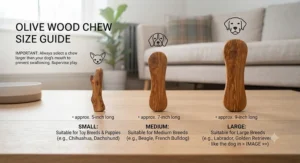
For teething puppies specifically, prioritise the smaller end of any brand’s size range regardless of your dog’s expected adult size — a puppy’s jaw strength and bite pattern are simply different from an adult dog’s, and oversized chews are both harder to grip properly and slower to wear down to a manageable size. The Petstages Dogwood Dog Chew Toy, with its engineered blend designed for moderate rather than aggressive chewers, is a reasonable starting point precisely because most puppies haven’t yet developed the jaw strength of an adult power chewer.
A genuinely important caveat for very young puppies still losing baby teeth: firm chews of any material, wood included, can occasionally contribute to baby teeth being knocked loose earlier than they’d naturally fall out. This is generally not harmful, but if you notice a retained baby tooth alongside an erupting adult tooth, or any bleeding that doesn’t resolve quickly, that’s worth a vet check rather than assuming it’s normal teething.
Practical Usage Guide: Introducing, Supervising and Storing Wood Chews
Getting genuine value and safety from any wood chew starts with how you introduce it, not just which product you buy. For a first-time wood chewer, offer the chew during a calm, supervised period rather than leaving it in with a stack of other toys unattended — this lets you actually watch how your individual dog interacts with the material before trusting them with unsupervised access.
In the first thirty days, the most common mistake is assuming a chew is “done” only once it’s completely gone — most manufacturers recommend replacing a chew well before that point, once it’s worn down to a size that could plausibly be swallowed whole rather than gnawed further. Storing chews in a cool, dry place between sessions — rather than a damp garden shed or a hot car — helps preserve the wood’s structure and reduces the chance of unexpected mould developing on a partially chewed stick left lying around.
For maintenance, keep a simple rotation of two or three chews rather than relying on a single stick for weeks on end; this reduces the total time any one chew spends being worked down toward a swallowable size, and most owners find rotating textures (coffee wood one week, an olive wood chew the next) keeps a bored dog more engaged anyway. Always keep fresh water available during and after chewing sessions, exactly as every brand covered in this guide independently recommends.
Real-World Scenario: Matching the Chew to Your Dog’s Chewing Style
Picture three different dogs, each needing a genuinely different approach rather than the same default recommendation. First, a gentle six-month-old puppy just past its worst teething discomfort, living in a quiet household with plenty of supervision time. This is exactly the profile the Canophera Coffee Wood Chew Stick or Petstages Dogwood Dog Chew Toy were designed for — moderate wear, manageable session lengths, and a manufacturer-stated minimum age that matches this exact life stage.
Second, a middle-aged Labrador who’s previously destroyed several rubber and rope toys within days and genuinely needs something that lasts. Here, the Wildfang Coffee Wood Dog Chew, sized specifically for larger, more powerful jaws, is the more sensible starting point — though even this needs closer supervision than the gentler options above, precisely because aggressive chewing style changes the risk profile regardless of wood species.
Third, a dog that’s notorious for sneaking sticks in from the garden despite every effort to redirect the habit. This is the scenario Woodies Dog Chews are explicitly marketed to solve — giving that exact instinct a controlled, hand-finished outlet rather than fighting a losing battle against unpredictable outdoor branches. Matching the product to the dog, rather than simply picking the top-rated option on a list, is genuinely the difference between a chew that gets used safely for weeks and one that becomes a supervision headache within days.
Buyer’s Decision Framework: How to Choose the Right Wood Chew
Rather than comparing every spec side by side, run through this simple sequence:
- Confirm your dog’s age and teething stage first. Puppies under six months generally need gentler options than the firmer sticks marketed at adult power chewers.
- Be honest about your dog’s chewing style. Gentle chewers and aggressive chewers genuinely have different risk profiles with identical products.
- Check the ingredient list is genuinely single-species wood. Avoid anything vague like “natural wood” without a named species or sourcing detail.
- Choose size based on weight guidance, not instinct. Undersized chews are swallowed whole far more easily than correctly sized ones.
- Plan for supervision time, not just purchase. If you can’t realistically supervise chewing sessions, a wood chew may not be the right category regardless of brand.
- Budget for regular replacement. These are consumable products; the ongoing cost matters more than the individual purchase price.
- Watch for the warning signs early. Pawing at the mouth, drooling, or reluctance to eat after chewing should prompt an immediate check, not a wait-and-see approach.
Common Mistakes When Buying Wooden Dog Chew Toys
The single most common mistake is assuming all wood is equally safe simply because it’s “natural” — as covered above, species, treatment, and hardness all change the risk picture dramatically, and a garden branch is not remotely equivalent to a purpose-made coffee wood chew. The second mistake is buying by adult expected size rather than current size and chewing style, leaving puppies or gentle chewers with a stick that’s genuinely too firm or too large to grip and wear down safely.
The third mistake, and a genuinely costly one, is leaving a dog unsupervised with any wood chew on the assumption that a “low splinter risk” product removes the need for supervision entirely — every manufacturer covered in this guide explicitly states otherwise in their own product guidance. Finally, plenty of owners forget to actually remove and replace a worn-down chew once it reaches a swallowable size, effectively turning a purpose-made safety-conscious product into the exact choking risk it was designed to avoid.
Wooden Chews vs Rawhide, Antler and Rubber Alternatives
| Factor | Wood Chews | Rawhide | Antler | Rubber (e.g. Kong-style) |
|---|---|---|---|---|
| Splinter/shard risk | Moderate (species-dependent) | Low, but softening risk | Can splinter, especially split antler | Very low |
| Digestibility if swallowed | Partial, fibre-dependent | Variable, some brands dissolve | Poor — largely indigestible | Poor — designed not to be eaten |
| Dental benefit | Good, mechanical scraping action | Moderate | Good, very firm | Moderate |
| Typical lifespan | Weeks, moderate use | Days to weeks | Weeks to months | Months, often reusable |
| Best suited to | Moderate chewers, dental maintenance | Occasional treat use | Firm, determined chewers | Nearly all chewing styles |
Looking at the table above, wood chews occupy a genuinely useful middle ground rather than being an obviously superior or inferior choice — they offer stronger dental benefit than rubber alternatives while carrying a different risk profile to antler, which is prone to sharp fractures along its length. Purina’s own UK guidance on safe chewing specifically favours rubber options as effectively splinter-proof for power chewers, which is a fair point worth weighing if your dog has already shown a tendency to destroy firmer chews quickly.
Long-Term Cost & Replacement: Getting Value Without Compromising Safety
Because wood chews are consumable rather than durable, the real cost comparison isn’t the sticker price of one stick — it’s how often you’ll realistically need to replace it. A moderate chewer working through one Canophera Coffee Wood Chew Stick every few weeks costs meaningfully less over a year than the sticker price alone might suggest, especially against multi-buy pricing from UK suppliers like Miro & Makauri or Floppy Ear Coffee Wood Chew.
For heavier chewers, the maths shifts: a Wildfang Coffee Wood Dog Chew priced higher per unit may still work out cheaper per week of actual use than repeatedly replacing a cheaper stick that a determined chewer destroys in days rather than weeks. The genuinely important safety principle here is that cost-cutting by delaying replacement — letting a chew wear down well past the point it should be swapped out — isn’t a real saving at all; it simply shifts the cost toward a potential vet visit instead. Budgeting for regular, timely replacement is the actual value-optimising strategy, not stretching a single stick as far as possible.
FAQ
❓ Are wooden dog chew toys safe for all dogs?
❓ What is the safest wood for dogs to chew?
❓ Can puppies have wood chew sticks while teething?
❓ What should I do if my dog gets a wood splinter?
❓ How do I know when to replace a wood chew?
Conclusion
So, are wooden dog chew toys safe? The honest, unhedged answer is: purpose-made options like the Petstages Dogwood Dog Chew Toy, Canophera Coffee Wood Chew Stick, Miro & Makauri Coffee Wood Dog Chew, Floppy Ear Coffee Wood Chew, Wildfang Coffee Wood Dog Chew, Wildfang Olive Wood Chewing Sticks and Woodies Dog Chews are meaningfully lower risk than random garden sticks — but “lower risk” is the honest claim, not “risk-free,” and every reputable brand in this guide says exactly that in their own product guidance.
Matching the chew to your dog’s age, chewing style and supervision realities matters more than chasing the single “best” product on a list. Whichever you choose, the fundamentals stay the same: check the wood species, size correctly, supervise every session, and replace the chew before it becomes small enough to swallow. That’s the real difference between a genuinely useful enrichment tool and an entirely preventable trip to the vet.
Recommended for You
- Coffee Wood Dog Chew: 7 Best Picks Tested for UK Dogs (2026)
- 7 Heavy Duty Dog Chews for Large Breeds That Actually Survive (2026)
- Best Dog Toys for Power Chewers UK 2026: 7 That Actually Last
Disclaimer: This article contains affiliate links. As an Amazon Associate, I earn from qualifying purchases. If you purchase products through these links, we may earn a small commission at no additional cost to you.
✨ Found this helpful? Share it with your friends! 💬🤗
