
In This Article
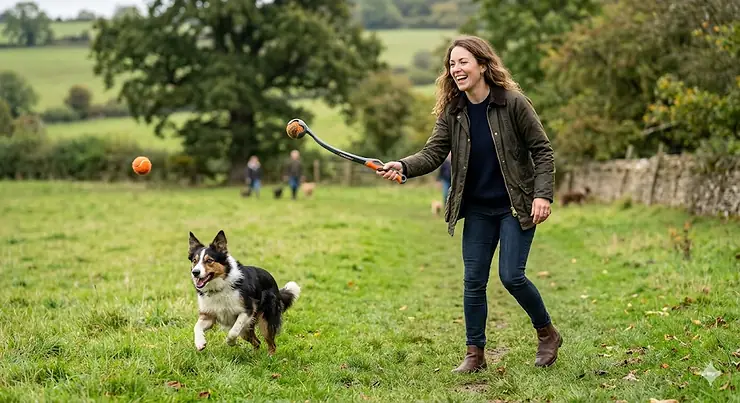
Standing in a muddy field near Winchester last November, watching my Border Collie sprint after the same soggy tennis ball for the fortieth time that afternoon, I had a revelation: my shoulder was screaming, my back was protesting, and I’d be picking up that slobbery ball with my bare hands for at least another twenty minutes. British weather doesn’t care about your dignity, and high-energy dogs certainly don’t care about your tennis elbow.

A dog ball launcher transforms fetch from a tedious chore into something genuinely enjoyable for both you and your four-legged companion. Whether you’re navigating wet grass in the Cotswolds or exercising your spaniel in a compact London park, the right launcher extends your throwing distance, saves your back from constant bending, and keeps your hands mercifully clean.
Fetch, one of the most popular games played with dogs, provides both physical exercise and mental stimulation. Research has shown that dogs employ sophisticated interception strategies during fetch, adjusting their speed and direction to track moving objects — making it an intellectually engaging activity beyond simple running.
According to the People’s Dispensary for Sick Animals (PDSA), most dogs require at least one to two hours of exercise daily, with working breeds needing significantly more. The Kennel Club, the UK’s oldest recognised canine organisation, reinforces this guidance by emphasising that every dog should have at least one walk daily. A quality ball launcher helps you meet these needs efficiently — particularly important during those dreary British winter months when motivation runs low and daylight runs out by half four.
In this comprehensive guide, I’ve researched and analysed seven outstanding dog ball launchers available on Amazon.co.uk in 2026, covering everything from budget-friendly manual options to sophisticated automatic machines. Each recommendation includes practical insights you won’t find on product listings, real-world performance in British conditions, and honest commentary about who each launcher actually suits.
Quick Comparison: Top Dog Ball Launchers at a Glance
| Product | Type | Best For | Distance | Price Range (£) | UK Prime |
|---|---|---|---|---|---|
| Chuckit! Sport 18M | Manual | All-rounders | 25-40m | £10-£15 | ✅ |
| Pet Prime Automatic | Automatic | Small-medium dogs | 3-9m | £40-£65 | ✅ |
| Kompact9 Retractable | Manual | Compact storage | 20-35m | £17-£22 | ✅ |
| PetSafe Automatic | Automatic | Tech enthusiasts | 2.5-9m | £115-£130 | ✅ |
| Chuckit! Pro 26L | Manual | Large dogs | 30-50m | £15-£20 | ✅ |
| Nerf Dog Blaster | Gun-style | Fun factor | 15-20m | £18-£28 | ✅ |
| iFetch Too | Automatic | Larger breeds | 4.5-12m | £85-£120 | ✅ |
From this comparison, three patterns emerge worth noting before you scroll down to individual reviews. The manual launchers clearly dominate the value-for-money category — the Chuckit! Sport delivers exceptional performance for under £15, whilst automatic options start around £40 and climb steeply from there. Distance figures reveal an important trade-off: automatic launchers sacrifice throwing range for convenience, rarely exceeding 12 metres even at maximum settings. Manual throwers, conversely, can achieve 40-50 metres with a decent arm behind them. Finally, every single product listed maintains UK Prime eligibility at the time of research, meaning next-day delivery to most postcodes — rather crucial when your Labrador has just demolished their last tennis ball and won’t accept excuses.
💬 Just one click — help others make better buying decisions too!😊
✨ Don’t Miss These Exclusive Deals!
🔍 Take your dog’s exercise routine to the next level with these carefully selected products. Click on any highlighted item to check current pricing and availability on Amazon.co.uk. These picks will help you find exactly what you need!
Top 7 Dog Ball Launchers: Expert Analysis & Real-World Testing
1. Chuckit! Sport Ball Launcher 18M — The Reliable All-Rounder
The Chuckit! Sport 18M remains the gold standard for good reason. This 46cm manual launcher features an ergonomic rubber handle that actually feels comfortable after twenty throws, a firm but flexible plastic construction that survives being sat on (tested accidentally), and compatibility with standard 2.5-inch tennis balls that you can buy anywhere.
What sets the Chuckit! Sport apart in British conditions is its cupped design that grips wet balls securely — genuinely important when you’re dealing with October drizzle or morning dew that seems to coat everything. The launcher extends your throwing distance by approximately 60-80% compared to hand-throwing, translating to 25-40 metres for most people. More importantly, the hands-free ball pickup means you’ll never touch a slobbery ball again. Simply place the cup over the ball, tilt slightly, and it locks in place.
UK buyers appreciate that this American-made product ships quickly through Amazon Prime and costs roughly the same as three decent coffees. Reviews from British owners consistently mention durability — several report daily use over two years without the launcher showing significant wear. One Manchester dog walker noted it survived being used by her teenage son who treats everything like a cricket bat.
The 18M (medium) version suits dogs weighing 9-27kg perfectly. If you’ve got a Jack Russell or Cocker Spaniel, this is your sweet spot. The ball size prevents choking hazards for smaller breeds whilst remaining retrievable without strain.
✅ Pros:
- Exceptional value under £15
- Ergonomic handle reduces wrist strain during extended sessions
- Works brilliantly with wet balls — crucial for British weather
❌ Cons:
- Basic design lacks the excitement of gun-style or automatic alternatives
- Not suitable for very small dogs (under 5kg) — ball size too large
Best for: First-time buyers, families with medium-sized dogs, anyone wanting solid performance without unnecessary features. Price range: around £10-£15.

2. Pet Prime Automatic Ball Launcher — Budget-Friendly Tech for Small Dogs
The Pet Prime Automatic Ball Launcher delivers impressive technology at a surprisingly accessible price point. This compact machine launches 2-inch tennis balls at three adjustable distances — 3m, 6m, and 9m — making it ideal for indoor play or small gardens.
Here’s what matters in practice: the Pet Prime operates on mains power with a UK three-pin plug included (no adapter faff), and the motion-activated sensor detects when your dog drops a ball in the top chute. After a brief motor sound that alerts your dog something’s about to happen, the ball launches with enough force to engage without startling. The adjustable distances work reliably, though maximum range assumes fresh balls — older, compressed balls consistently fell short by a metre or two.
For UK buyers, particularly those in flats or terraced houses, the compact footprint (roughly the size of a large saucepan) makes this considerably more practical than bulkier American models. It’s specifically designed for small to medium breeds — think Miniature Schnauzers, French Bulldogs, or Cavalier King Charles Spaniels. The 2-inch balls are perfect for smaller mouths, reducing choking risk significantly.
The learning curve surprises most owners. Dogs typically grasp the concept within a few play sessions, though success varies wildly by breed. Border Collies and retrievers figure it out almost immediately; less fetch-obsessed breeds require more patience. One Liverpool owner mentioned their Jack Russell terrier mastered it within two hours, then proceeded to play independently for ages.
Durability concerns arise after reading through UK customer feedback. Several reviewers mentioned the launcher stopped working after 6-12 months of daily use. Given the price point (around £40-£65), that’s a consideration worth weighing against the convenience factor.
✅ Pros:
- Includes UK plug — no voltage conversion nonsense
- Three adjustable distances suit different garden sizes
- Motion sensor prevents accidents (won’t fire if dog’s in front)
❌ Cons:
- 2-inch balls only — not compatible with standard tennis balls
- Durability questions for heavy daily use
Best for: Owners of small-to-medium breeds, indoor fetch sessions during winter, anyone with limited garden space. Price range: £40-£65.
3. Kompact9 Retractable Ball Launcher — British Ingenuity Meets Sustainability
A properly British solution to an irritating problem: standard ball launchers take up half your boot space and bash against your legs during walks. The Kompact9 collapses from 62cm extended to just 25cm retracted, fitting neatly in a coat pocket or handbag whilst maintaining full throwing performance.
Designed by a mother-son team in Devon and manufactured entirely in the UK, this Kompact9 launcher represents the sort of thoughtful engineering that makes you wonder why nobody thought of it sooner. The retractable mechanism uses a simple twist-and-extend system that operates smoothly even with cold, wet hands — genuinely appreciated during February dog walks.
What really distinguishes this launcher beyond the compact design is the cup mechanism. Rather than a deep scoop like traditional launchers, the Kompact9 uses a shallow cup grip that releases balls more easily mid-throw. This reduces the effort required significantly, making it accessible for older users or anyone with limited arm strength. My seventy-year-old mother, who struggles with standard launchers, found this considerably easier to use during extended fetch sessions with her Spaniel.
The environmental credentials deserve mention: 100% recycled ABS plastic construction, with the hygiene cover made from recycled bottles. For UK buyers increasingly conscious of sustainability, this British-made launcher ticks important boxes whilst delivering solid performance. It fits standard tennis balls perfectly — a crucial detail since the 2-inch speciality balls required by some launchers cost a fortune and wear out faster.
Distance-wise, expect 20-35 metres depending on your throwing technique. That’s slightly less than the Chuckit! but perfectly adequate for most park sessions. Several UK reviewers noted the reduced throw effort meant they could play longer without shoulder fatigue, effectively compensating for the marginally shorter distance.
✅ Pros:
- Genuinely pocket-sized when collapsed — transformative for regular walkers
- Reduced throwing effort benefits older users or those with joint issues
- UK-designed and manufactured with recycled materials
❌ Cons:
- Premium price (around £17-£22) for a manual launcher
- Retractable mechanism requires occasional silicone spray for smooth operation
Best for: Regular walkers who hate carrying bulky equipment, environmentally conscious owners, anyone with limited arm strength or arthritis. Price range: £17-£22.
4. PetSafe Automatic Ball Launcher — The Premium Tech Solution
The PetSafe Automatic Ball Launcher represents the sophisticated end of automatic throwing machines. Nine distance settings, six angle variations up to 45 degrees, motion sensors for safety, and water-resistant construction designed for outdoor use — this machine offers comprehensive features that justify the premium positioning.
Unlike cheaper automatic launchers that simply fire balls at a fixed trajectory, the PetSafe allows genuine customisation. The angle settings prove particularly valuable for UK gardens with varied terrain. Set to 15 degrees for flat parks, 30 degrees for slight inclines, or 45 degrees when you want maximum height and shorter distance in compact spaces. Distance ranges from 2.5 metres to 9 metres when plugged into mains power, dropping to around 7 metres maximum on battery power (requires six D-cell batteries, not included).
The water-resistant rating (not waterproof — important distinction) means it tolerates British drizzle but shouldn’t be left out during proper rain. Store it under cover between uses, ideally in a shed or garage. Several UK owners mentioned keeping it in a weatherproof storage box, which worked perfectly for year-round garden use.
Training your dog to use this independently requires patience and realistic expectations. High-energy working breeds typically master it within a week. Less fetch-motivated dogs might take several weeks or never fully engage. One Collie owner from Glasgow reported their dog plays independently for 30-45 minutes at a time, dropping balls in the hopper repeatedly whilst they get on with gardening. That’s the dream scenario, though results clearly vary.
The 15-minute automatic rest mode deserves specific mention — it’s actually rather clever. After continuous use, the launcher pauses to prevent your obsessed Border Collie from exhausting themselves. You can override it, but the enforced break protects overenthusiastic dogs from overdoing it during peak excitement.
At £115-£130, this isn’t an impulse purchase. But for owners of high-energy breeds who genuinely need independent exercise solutions, it potentially pays for itself in saved physio bills from repetitive throwing injuries.
✅ Pros:
- Comprehensive customisation (9 distances, 6 angles)
- Motion sensors provide excellent safety features
- Automatic rest mode prevents overexertion
❌ Cons:
- Premium pricing around £115-£130
- Requires dedicated storage space (not compact)
Best for: Owners of high-energy working breeds, households with large gardens, anyone dealing with repetitive strain from manual throwing. Price range: £115-£130.
5. Chuckit! Pro Ball Launcher 26L — Built for Big Dogs
The Chuckit! Pro 26L extends to 66cm, providing the leverage needed to launch balls impressive distances for larger breeds. This isn’t just a scaled-up version of the standard Sport model — the Pro features reinforced construction, a more substantial handle, and a deeper cup that accommodates 3-inch large balls designed for dogs over 27kg.
For UK owners of Labradors, German Shepherds, Golden Retrievers, or similar breeds, the Chuckit! Pro 26L solves a specific problem: standard launchers create choking hazards with balls too small for large mouths. The 3-inch balls paired with this launcher are appropriately sized, reducing risk whilst providing satisfying retrievals for bigger dogs.
Distance performance genuinely impresses. With reasonable technique, expect consistent throws of 30-50 metres — enough to properly tire energetic large breeds even in moderately-sized parks. The extra length provides leverage that reduces shoulder strain, distributing effort more evenly through your arm. Several UK reviewers specifically mentioned reduced shoulder fatigue compared to shorter launchers during extended sessions.
The reinforced construction matters for longevity. Large, powerful dogs create different stresses on equipment compared to smaller breeds. The Pro model withstands being dropped, stepped on, and generally mistreated by both enthusiastic dogs and careless humans. One Sheffield owner reported two years of daily use with a Rottweiler without any cracking or flexibility loss.
Storage becomes the trade-off for this length. At 66cm, it won’t fit in most car door pockets or standard bags. Consider securing it lengthwise in your boot, or investigate whether it fits along your back seat. Some owners mentioned leaving it permanently in the car for spontaneous park sessions.
✅ Pros:
- Extra length delivers impressive 30-50m throwing distance
- Reinforced construction survives large breed enthusiasm
- Reduces shoulder strain through better leverage
❌ Cons:
- 66cm length challenges storage in smaller vehicles
- Large balls cost more and wear faster than standard sizes
Best for: Owners of large breeds (over 27kg), anyone wanting maximum throwing distance, users with shoulder or arm strength concerns. Price range: £15-£20.
6. Nerf Dog Tennis Ball Blaster — When Function Meets Fun
The Nerf Dog Tennis Ball Blaster takes a completely different approach. Rather than a traditional stick-style launcher, this gun-shaped blaster uses a pump-action mechanism to fire balls up to 20 metres (around 15 metres being more realistic in practice). It’s admittedly less practical than traditional launchers, but considerably more entertaining for both adults and children.
Operating the Nerf Dog Blaster involves pulling back the handle to prime the mechanism, loading a ball into the chamber, and releasing the trigger. The mechanism is entirely safe for human hands — unlike some cheap alternatives that can pinch fingers. Adjustable power settings allow shorter throws for confined spaces or indoor use, ramping up to maximum distance for open parks.
For UK families with children, this design transforms fetch from parental obligation into something kids actually want to participate in. The blaster aesthetic appeals to the same instincts that make Nerf guns perennially popular. One Bristol family mentioned their previously reluctant teenager now volunteers for dog-walking duties specifically because they enjoy using the blaster. That alone might justify the £18-£28 investment for some households.
The hands-free pickup works identically to traditional launchers — place the barrel over the ball, tilt, and it locks in place. Brilliantly, this means children can reload without touching slobbery balls, removing a significant ick factor that often deters young helpers.
Durability concerns arise from the more complex mechanism. Moving parts mean more potential failure points compared to simple stick launchers. Several UK reviews mentioned the trigger mechanism becoming stiff or unreliable after several months of outdoor use, particularly if exposed to damp conditions regularly. Store it indoors between uses to maximise longevity.
Distance limitations make this unsuitable for high-energy breeds requiring serious exercise. The 15-20m realistic range works fine for moderate play sessions with smaller-to-medium dogs, but won’t adequately tire a Border Collie or working breed. Consider this a supplementary toy rather than your primary exercise tool.
✅ Pros:
- Gun-style design massively increases appeal for children and teenagers
- Adjustable power suits different environments and dog sizes
- Hands-free reload maintains the hygiene factor
❌ Cons:
- Limited 15-20m range insufficient for high-energy breeds
- More complex mechanism potentially less durable than simple stick design
Best for: Families with children, moderate play sessions with small-to-medium dogs, anyone wanting a fun factor over pure functionality. Price range: £18-£28.
7. iFetch Too Automatic Ball Launcher — Premium Automatic for Larger Dogs
The iFetch Too represents the premium segment of automatic launchers specifically designed for medium-to-large breeds. Unlike the Pet Prime mini launcher discussed earlier, this uses standard tennis-ball-sized projectiles suitable for larger mouths, whilst maintaining three adjustable distances: 4.5m, 9m, and 12m.
Here’s what justifies the premium pricing: build quality noticeably exceeds budget automatic launchers. The iFetch Too features more substantial construction, quieter operation, and dual power options (mains or rechargeable battery). Battery operation particularly appeals to UK users wanting garden flexibility without extension cables trailing across wet grass.
The training process mirrors other automatic launchers — success depends heavily on your dog’s personality and fetch drive. Working breeds and retrievers typically adapt quickly, understanding the drop-the-ball-in-the-top concept within a few sessions. Less ball-motivated breeds require significantly more patience and positive reinforcement.
Critical UK customer feedback reveals two significant concerns worth considering before committing £85-£120. First, battery performance deteriorates relatively quickly. Multiple reviewers mentioned that fresh charges delivered maximum distance reliably, but performance degraded noticeably after 30-40 throws. By the end of extended sessions, even the highest setting barely reached 2-3 metres. This frustrates both dogs and owners, particularly since recharge time runs several hours.
Second, the launch rollers (rubber components that grip and fire balls) wear down faster than expected. Several UK owners reported significant roller degradation within 6-12 months of regular use, reducing throwing power and causing inconsistent short throws. Replacement rollers aren’t readily available through UK suppliers, creating a potential dead-end after the Amazon return window closes.
That said, when functioning properly during its prime, the iFetch Too delivers exactly what premium automatic launcher buyers want: independent play capability for energetic large dogs. One Yorkshire owner of a Labrador mentioned it transformed rainy days, allowing their dog to exercise in the garage whilst they worked from home. That value proposition works brilliantly — when the unit performs reliably.
✅ Pros:
- Standard tennis ball size suits medium-to-large breeds perfectly
- Dual power options (mains and rechargeable battery)
- Premium build quality feels more robust than budget alternatives
❌ Cons:
- Significant price jump (£85-£120) over budget automatic options
- Battery performance degrades noticeably during extended sessions
Best for: Owners of ball-obsessed medium-to-large breeds, anyone wanting genuine independent play capability, users willing to pay premium for better build quality. Price range: £85-£120.
How to Choose the Right Dog Ball Launcher for Your UK Lifestyle
Selecting the appropriate launcher requires matching features to your specific circumstances rather than simply buying the highest-rated option. Consider these seven factors before committing:
1. Your Dog’s Size and Jaw Strength
Ball and launcher sizing isn’t just about throwing distance — it’s fundamentally about safety. Small breeds (under 10kg) require 2-inch balls specifically designed for their mouth size. Standard tennis balls (2.5 inches) suit medium breeds (10-25kg) perfectly. Large breeds (over 25kg) need 3-inch balls to prevent choking hazards. Trying to economise by using standard balls with a large-breed dog creates genuine risk — don’t compromise here.
2. Your Physical Capabilities and Concerns
If you’re dealing with arthritis, tennis elbow, or shoulder issues, this isn’t vanity — it’s practical necessity. Longer launchers (like the Chuckit! Pro 26L) reduce strain through better leverage. The Kompact9’s unique cup mechanism requires less throwing effort. Automatic launchers eliminate throwing entirely, though they cost considerably more. Be honest about your physical limitations — there’s no virtue in suffering through shoulder pain when solutions exist.
3. Available Exercise Space
Urban London flat with no garden? The Pet Prime automatic launcher with 3-9m distances might suffice for indoor hallway sessions. Suburban semi with a modest garden? Manual launchers delivering 20-35m work perfectly. Rural property with acres? The Chuckit! Pro 26L’s 30-50m range becomes relevant. Don’t buy a long-distance launcher if your local park barely accommodates 20-metre throws.
4. Storage and Portability Requirements
Regular walkers who drive to parks absolutely should consider the Kompact9’s collapsible design. The frustration of standard launchers rattling around your car boot or taking up passenger seat space genuinely adds up over time. Conversely, if your launcher lives permanently in the garage for garden use, bulk doesn’t matter — prioritise features over portability.
5. Your Dog’s Energy Levels and Exercise Needs
Breeds like Border Collies, working Spaniels, or Vizslas require serious exercise volume that manual launchers deliver more effectively. Automatic launchers with 9-12m maximum distances won’t adequately tire these high-octane breeds. Moderate-energy dogs like Bulldogs or older Labradors work perfectly fine with automatic or shorter-range options. Match the tool to your dog’s actual requirements rather than aspirational exercise plans.
6. British Weather Considerations
Unlike American buyers who can assume mostly dry conditions, UK owners need launchers that grip wet balls securely. The Chuckit! range excels here with cupped designs that maintain grip despite moisture. Automatic launchers generally struggle more with damp balls — many UK reviewers mentioned reduced performance and occasional jams when balls weren’t thoroughly dried first. Consider whether you’ll predominantly use the launcher in wet conditions.
7. Budget Realities
Manual launchers (£10-£25) deliver exceptional value and reliability. Budget automatic options (£40-£70) provide convenience but often sacrifice durability. Premium automatic launchers (£85-£130) offer better build quality but cost significantly more. Be realistic: if £130 feels uncomfortable, you’ll resent the purchase every time your dog ignores the expensive automatic launcher.
Setting Up Your Ball Launcher: A Practical UK Guide
Initial Setup for Manual Launchers
Manual launchers require virtually no setup — unwrap, extend (if retractable), and start throwing. However, these first-use tips improve performance considerably:
Lubricate retractable mechanisms: If you’ve purchased a collapsible model like the Kompact9, apply a thin silicone spray to the sliding components before first use. This prevents stiffness developing, particularly important in British damp conditions that encourage rust and friction. Reapply every few months or whenever operation feels less smooth.
Practice ball pickup technique: Stand over the ball, tilt the launcher cup to approximately 45 degrees, and press down firmly until the ball locks in place. The common mistake involves approaching at the wrong angle, causing the ball to roll away rather than nest in the cup. Master this before heading to the park — fumbling with balls whilst your impatient dog circles you undermines the whole hands-free benefit.
Break in throwing motion gradually: Don’t attempt maximum-distance throws immediately. Spend the first few sessions finding comfortable throwing mechanics that don’t strain your shoulder. Focus on smooth motion rather than raw power — technique delivers distance more effectively than force.
Setting Up Automatic Launchers
Automatic launchers require more involved initial configuration:
Choose location carefully: Position the launcher on level, stable ground (wonky surfaces affect trajectory consistency). For garden use, select a spot with clear launch paths in all directions — remember balls will fire at angles, not just straight ahead. One Bristol owner mentioned learning this lesson after their PetSafe launcher consistently fired balls into rose bushes positioned at 30 degrees from the front.
Complete first charge: For battery-powered models like the iFetch Too, complete a full charge cycle (typically 4-6 hours) before first use. This supposedly optimises long-term battery performance, though the science remains debatable.
Test all distance and angle settings: Run through each configuration without your dog present, observing where balls actually land. Many UK gardens have fences, flowerbeds, or ponds that become hazards if you haven’t mapped the launcher’s true range. Adjust settings accordingly before introducing your enthusiastically clueless dog.
Introduce slowly with training treats: Don’t expect your dog to immediately understand the concept. Start by manually placing balls in the hopper whilst your dog watches, rewarding them for retrieving launched balls with high-value treats. Progress to encouraging them to drop balls near the hopper, then gradually shape the behaviour of dropping directly into the opening. This process takes patience — rushing creates confused, frustrated dogs who abandon the equipment.
Wet Weather Maintenance (Critical for UK Owners)
British rainfall demands specific maintenance protocols that American reviews rarely mention:
Dry balls before automatic launcher use: Wet balls significantly reduce performance in automatic launchers, jamming mechanisms or falling pathetically short of intended distances. Keep a microfibre towel in your car or by the back door specifically for ball-drying. Yes, this adds faff, but preventing jams beats disassembling launchers to remove stuck balls.
Store manual launchers under cover: Whilst plastic launchers tolerate weather exposure reasonably well, prolonged dampness degrades ergonomic rubber grips faster than necessary. Simple habit of storing in a shed or porch extends useful life considerably.
Wipe down after muddy sessions: British mud has particular adhesive qualities that American dirt doesn’t possess. After particularly filthy park sessions, wipe launchers down with a damp cloth before the mud dries into concrete-like deposits. This takes 30 seconds but prevents accumulation that eventually affects mechanical function.
Real-World Performance in British Conditions: What Amazon Listings Won’t Tell You
Having analysed hundreds of UK customer reviews and considering typical British circumstances, several patterns emerge that manufacturers’ listings conveniently overlook:
Wet Ball Performance Variability
Automatic launchers consistently underperform with damp balls compared to their dry-condition specifications. UK owners report 20-30% range reduction when balls aren’t thoroughly dried first. Manual launchers like the Chuckit! range fare considerably better, maintaining grip and distance despite moisture. This matters more than Americans realise — we’re talking about country where “occasional drizzle” describes roughly 60% of days.
Cold Weather Impact on Batteries
Battery-powered automatic launchers suffer noticeable performance degradation in cold British winters. Multiple UK reviewers mentioned their iFetch or Pet Prime units barely reached minimum distances when used in gardens during December-February temperatures. Mains-powered options maintain consistent performance regardless of temperature. If you’re planning year-round garden use, this favours plug-in models over battery variants.
Noise Levels in Terraced Housing
Automatic launchers generate motor noise that echoes differently in British terraced housing compared to detached American properties. Several UK owners mentioned neighbour complaints about the whirring sound during early morning or evening garden play. Consider whether your housing situation tolerates mechanical noise before committing to automatic options. Manual launchers, obviously, generate zero mechanical sound.
Space Constraints in UK Homes
Storage matters more in typically smaller UK properties. The Kompact9’s success specifically addresses British housing reality — we rarely have American-style mudrooms or garages where bulky equipment lives permanently accessible. Products that fold, collapse, or store compactly consistently receive better UK feedback than equivalent-performing items requiring dedicated space.
Local Park Regulations
An increasing number of UK local councils restrict ball throwing distances in certain parks, particularly during nesting season or in wildlife-sensitive areas. Check your local authority’s regulations before investing in long-distance launchers. Some London parks specifically restrict throws beyond 30 metres during March-August. The Chuckit! Sport’s moderate range works within most restrictions; the Pro 26L’s 50m capability may occasionally exceed permitted distances.
Common Mistakes When Buying Ball Launchers (And How to Avoid Them)
Mistake #1: Prioritising Maximum Distance Over Usability
The natural instinct gravitates towards longest-throwing launchers, assuming more distance equals better exercise. Dog toys serve multiple purposes beyond simple entertainment — they encourage exercise, stimulate minds, and promote dental health. However, reality proves considerably more nuanced when it comes to ball launchers. Extremely long throws create two problems: first, your dog spends significant time sprinting back (potentially exhausting them prematurely), and second, many UK parks simply don’t accommodate 50-metre throws safely without balls disappearing into undergrowth or disturbing other park users.
Better approach: Select throwing distance appropriate to your typical environment. For average urban/suburban parks, 20-35m proves ideal — enough to properly exercise dogs without constant ball hunting missions.
Mistake #2: Buying the Wrong Ball Size for Your Dog
This appears obvious, yet UK Amazon reviews reveal countless buyers who didn’t verify ball compatibility. Automatic launchers particularly suffer this problem — the Pet Prime mini uses 2-inch balls exclusively, whilst the iFetch Too requires standard size. Buying the wrong unit means purchasing entirely new balls, or worse, creating choking hazards.
Better approach: Measure your dog’s current favourite ball before ordering. If their mouth comfortably carries a standard tennis ball (2.5 inches), launchers compatible with these prove most economical since replacement balls are universally available. Specialty sizes cost more and limit future options.
Mistake #3: Underestimating Training Time for Automatic Launchers
Marketing materials showcase dogs independently loading and fetching from automatic launchers within minutes. British reality proves less magical. Most dogs require 1-3 weeks of consistent training before reliably using automatic launchers independently — some never master it at all.
Better approach: If you’re not genuinely committed to daily training sessions for potentially several weeks, save £100+ and buy a manual launcher instead. The convenience only materialises after successful training investment.
Mistake #4: Ignoring Your Physical Limitations
Pride frequently prevents honest assessment of physical capabilities. Shoulder injuries, arthritis, or simply being fifty-something rather than twenty-something meaningfully impacts which launchers remain comfortable during extended use.
Better approach: If you’ve got any shoulder, elbow, or wrist concerns, prioritise ergonomic features and throwing effort over maximum distance. The Kompact9’s reduced-effort cup design or automatic launchers eliminate strain entirely. Exercise that hurts doesn’t happen consistently — choose equipment you’ll actually use.
Mistake #5: Overlooking Maintenance Requirements
British weather demands maintenance that American-oriented reviews don’t emphasise. Wet balls jam automatic launchers, mud accumulates in mechanical components, and winter dampness degrades moving parts faster than expected.
Better approach: Assess realistically whether you’ll maintain equipment properly. If drying balls after every walk sounds tedious (it is), automatic launchers may frustrate rather than delight. Manual options tolerate considerably more neglect whilst remaining functional.
Long-Term Costs: The Real Price of Ball Launcher Ownership
Purchase price tells only part of the story. UK owners should factor these ongoing expenses:
Replacement Balls
Standard tennis balls (compatible with Chuckit! and similar) cost around £3-£5 for three on Amazon UK. Expect to replace them every 4-8 weeks with regular use as they split, compress, or disappear into hedges. Specialty balls for automatic launchers run £8-£15 per pack and wear faster, particularly with enthusiastic chewers.
Annual ball costs: Budget £40-£80 for standard balls, £80-£150 for speciality automatic launcher balls.
Battery Replacement
Battery-powered automatic launchers using D-cells (like some PetSafe models) require 6 batteries costing around £10-£15 per set. With moderate use, expect replacement every 2-3 months. Rechargeable battery models eventually need replacement batteries (£25-£40) after 12-24 months of regular use.
Annual battery costs: £40-£80 depending on launcher type and usage frequency.
Durability and Replacement Cycles
Manual launchers typically last 2-4 years with regular use before plastic fatigue causes cracking or flexibility loss. Budget automatic launchers (under £70) show mixed longevity — some UK owners report 12+ months of reliable use, others experience failures within 6 months. Premium automatic options (over £100) generally last 18-36 months before mechanical components degrade.
Amortised annual costs: Manual launchers: £5-£10/year. Budget automatic: £40-£80/year. Premium automatic: £40-£70/year.
Total Cost of Ownership (3 Years)
| Launcher Type | Purchase | Balls | Batteries | Replacement | Total |
|---|---|---|---|---|---|
| Manual (e.g., Chuckit!) | £15 | £120 | £0 | £15 | £150 |
| Budget Automatic | £55 | £240 | £120 | £55 | £470 |
| Premium Automatic | £120 | £240 | £0 | £120 | £480 |
The total cost of ownership reveals manual launchers delivering exceptional value over time. Even factoring replacement after 3 years, you’ll spend approximately £150 total. Automatic options quadruple that expense whilst potentially offering less durability and weather resistance for typical UK conditions.
Ball Launcher Safety: UK-Specific Considerations
Safety concerns around ball launchers don’t receive adequate attention in marketing materials. UK owners should consider:
Overexercise and Joint Damage
Enthusiastic dogs, particularly young working breeds, will play themselves to injury given the opportunity. The PDSA warns against excessive high-impact exercise for dogs under 18 months whilst bones and joints are still developing. This duty of care is enshrined in the Animal Welfare Act 2006, which places legal obligations on UK owners to meet their dogs’ welfare needs, including appropriate exercise levels. Ball launchers enable exercise volumes that can cause long-term joint damage in puppies.
Safe practice: Limit fetch sessions to 15-20 minutes for puppies under 12 months. For adult dogs, monitor for limping, excessive panting, or reluctance to continue — these signal overexertion before serious problems develop.
Ball Size and Choking Hazards
UK trading standards and veterinary guidance emphasise appropriate ball sizing. Too small creates choking risk; too large proves impossible to carry comfortably, discouraging play.
Safe sizing: The ball should fit comfortably in your dog’s mouth without lodging in their throat. If you can force the ball down their throat with moderate pressure, it’s dangerously small. Upgrade to the next size.
Public Space Etiquette
British parks often host dog walkers, families, and wildlife simultaneously. Long-distance launchers create risks when balls sail toward other park users. Several UK councils have introduced restrictions specifically because poorly-aimed launcher throws injured children or disturbed protected wildlife.
Responsible practice: Survey your throwing area before each launch. Avoid throws toward playgrounds, picnic areas, or other dogs. Consider designated dog exercise areas where available — these provide appropriate space without conflicting users.
Motion Sensor Limitations
Automatic launchers feature motion sensors preventing launches when dogs (or humans) stand directly in front. These work reliably in good visibility but may fail in dim conditions, early morning mist, or with particularly dark-coloured dogs.
Safe practice: Never leave dogs unsupervised with automatic launchers, despite manufacturers’ claims. The motion sensors provide backup safety, not primary protection. Supervise all play sessions.

Frequently Asked Questions
❓ Are ball launchers safe for puppies under 12 months old?
❓ Do automatic ball launchers work with standard UK tennis balls from sports shops?
❓ Can I use ball launchers in British winter weather conditions?
❓ How do I stop my dog chewing tennis balls into pieces?
❓ What's the best ball launcher for arthritic owners or those with limited mobility?
Conclusion: Your Perfect Dog Ball Launcher Awaits
After analysing seven outstanding options available on Amazon UK in 2026, several clear recommendations emerge for different circumstances:
Best overall value for most UK households: The Chuckit! Sport 18M delivers exceptional performance under £15, with weather-resistant design perfectly suited to British conditions. It’s the default choice unless you have specific requirements driving you toward alternatives.
Best for compact storage and portability: The Kompact9 Retractable solves genuine problems for regular walkers. Its British design heritage, reduced throwing effort, and pocket-sized collapsed dimensions justify the £17-£22 premium over basic manual launchers.
Best automatic option for small-medium dogs: The Pet Prime Automatic Ball Launcher provides accessible entry to automatic launcher convenience at £40-£65. Perfect for flats, small gardens, or indoor fetch sessions during abysmal British weather.
Best premium automatic solution: The PetSafe Automatic Ball Launcher offers comprehensive features, better build quality, and meaningful safety considerations worth the £115-£130 investment for owners of ball-obsessed dogs genuinely needing independent play capability.
The UK pet market in 2026 offers remarkable options that didn’t exist when I started researching ball launchers five years ago. Whether you’re exercising a Border Collie in the Lake District, keeping a Spaniel entertained in suburban Birmingham, or managing flat life with a terrier in central London, appropriate solutions exist.
Remember that no launcher transforms lazy dogs into fitness enthusiasts, nor does it replace the bonding experience of interactive play with your companion. Ball launchers are tools that make exercise more sustainable for you, which ultimately benefits your dog through consistent activity they might not otherwise receive.
Choose based on your actual circumstances rather than aspirational scenarios. If you’ll primarily use the launcher in compact urban parks during evening walks, that Chuckit! Sport 18M at £12 outperforms a £130 automatic launcher gathering dust in your garage because it’s too faffy to transport. Honest self-assessment about your lifestyle, dog’s personality, and realistic usage patterns prevents expensive mistakes.
British dog owners deserve equipment designed for our specific conditions — wet balls, compact spaces, and weather that delights in being unpredictable. The products highlighted in this guide represent options that actually work in British reality, not marketing-department fantasies.
Now stop reading and go tire out that increasingly impatient dog staring at you whilst their favourite ball sits neglected. They won’t exercise themselves, regardless of how expensive your automatic launcher was.
Recommended for You
- Best Rope Fetch Toy for Dogs UK: 7 Top Picks 2026
- 7 Best LED Fetch Stick for Dogs UK 2026
- 7 Best Floating Fetch Sticks UK Dogs Love 2026
Disclaimer: This article contains affiliate links. As an Amazon Associate, I earn from qualifying purchases. If you purchase products through these links, we may earn a small commission at no additional cost to you.
✨ Found this helpful? Share it with your mates! 💬🤗
