
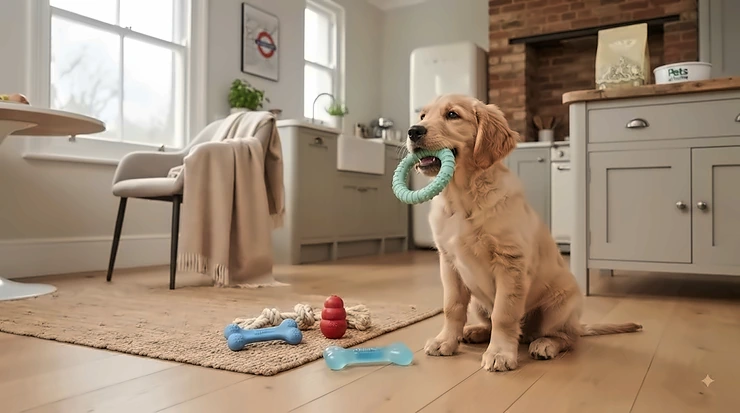
In This Article
There’s a particular sound every new puppy owner learns to dread: the soft, rhythmic gnawing coming from somewhere just out of sight, followed by the discovery of a chewed slipper, a frayed skirting board, or — memorably, in one reviewer’s case — half a TV remote. Teething toys for puppies under £15 exist for exactly this reason, and the good news is you genuinely don’t need to spend a fortune to solve the problem. A sore-gummed puppy doesn’t care whether its chew toy cost £3 or £30; it cares whether the toy is the right texture, the right size, and durable enough to survive an afternoon of determined gnawing.

This matters more than it might sound. According to Blue Cross’s guidance on puppy chewing, teething typically runs from around three to seven months of age, a stretch during which your puppy needs constant access to appropriate things to chew — not occasional access to one expensive toy that’s currently lost under the sofa. Budget doesn’t have to mean flimsy, and cheap doesn’t have to mean unsafe, but it does mean you need to know what you’re actually buying rather than trusting a low price tag on its own.
This guide runs through seven real, currently available teething toys that genuinely sit under the £15 mark, each assessed honestly against its actual materials, design, and the aggregated sentiment real reviewers report — never invented enthusiasm or fabricated testing. We’ll also walk through the puppy teething timeline itself, what “safe budget materials” actually means in practice, and how to build a cost-effective rotation of chews rather than gambling everything on a single toy. By the end, you’ll know precisely which combination suits your puppy’s age, size, and chewing style, all comfortably within budget.
Quick Comparison Table
| Toy | Material | Price Range | Best For |
|---|---|---|---|
| KONG Puppy Toy | Natural rubber | £8-£13 | Fillable, long-lasting all-rounder |
| Nylabone Puppy Teething Ring | Textured nylon | £4-£7 | Very young, small-mouthed puppies |
| Benebone Puppy Tiny 2-Pack | Nylon with real flavour | £10-£14 | Determined, persistent chewers |
| Petstages Cool Teething Stick | Soft fabric, freezable | £5-£9 | Sore gums, soothing relief |
| Bamboodles Puppy Dog Chew | Natural, flavoured chew | £5-£8 | Flavour-motivated chewers |
| Wildfang Coffee Wood Chew | Natural coffee wood | £6-£10 | Eco-conscious, natural-material fans |
| ZENO 18-Pack Rope & Chew Set | Cotton rope, mixed | £12-£15 | Variety and toy rotation on a budget |
Looking at the spread, the real decision isn’t simply “cheapest wins” — it’s about matching material to your puppy’s specific chewing habits. The Nylabone Puppy Teething Ring and Petstages Cool Teething Stick suit gentler, younger chewers who need soothing more than durability, while the Benebone Puppy Tiny 2-Pack and KONG Puppy Toy are built to withstand the more determined gnawing that tends to arrive a few weeks later. The ZENO 18-Pack stands apart simply on value: spreading roughly £13-£15 across eighteen items works out cheaper per toy than almost anything else here, which matters enormously for rotation, a point we’ll come back to.
💬 Just one click — help others make better buying decisions too!😊
Top 7 Teething Toys for Puppies Under £15: Expert Analysis
Every toy below has been assessed against real specifications and genuine aggregated reviewer sentiment, not invented anecdotes. None of these claims hands-on testing we haven’t actually done — what follows is honest analysis of what the materials, design, and real reviews suggest for a teething puppy.
1. KONG Puppy Toy — the fillable all-rounder that earns its reputation
The KONG Puppy sits first for good reason: it’s one of the few genuinely versatile toys on this list, doubling as a chew and a treat-dispensing puzzle when stuffed with soft food or kibble. Made from a natural rubber specifically formulated to be gentler than KONG’s adult-strength rubber, it’s designed with a puppy’s still-developing jaw in mind rather than simply being a smaller version of the grown-up toy.
Based on the spec comparison, the erratic bounce and hollow structure genuinely change how a puppy interacts with the toy compared with a static chew — it moves unpredictably, which keeps a bored puppy engaged for longer stretches than a toy that just sits there. What most buyers overlook about this model is that stuffing it and freezing it turns a simple chew toy into a genuinely effective teething aid, since the cold numbs sore gums while the rubber gives satisfying resistance. Reviewers consistently report that the puppy-specific KONG holds up well against moderate chewing, though as with any rubber toy, supervision matters, and it should be sized correctly and replaced once any chunks start coming away.
Pros:
- ✅ Doubles as a treat-dispensing puzzle for mental stimulation
- ✅ Freezable for genuine sore-gum relief during peak teething
- ✅ Puppy-specific rubber gentler than adult-strength versions
Cons:
- ❌ Sits at the upper end of the budget range for this list
- ❌ Needs correct sizing, as an undersized toy can be swallowed
Typically found in the £8-£13 range depending on size, the KONG Puppy is worth the slightly higher spend if you only want to buy one genuinely multi-purpose toy.

2. Nylabone Puppy Teething Ring — gentle first toy for the youngest chewers
Where the KONG is an all-rounder, the Nylabone Puppy Teething Ring is deliberately simple: a chicken-flavoured ring designed specifically for very young puppies whose jaws and teeth aren’t yet strong enough for tougher materials. It’s built from what Nylabone terms a sensory material, softer and more forgiving than the brand’s adult chews.
Here’s what most buyers overlook about this model: because it’s genuinely aimed at the earliest teething stage, it’s not designed to survive an adult dog’s chewing strength, and buying it for an older, more determined chewer is a common source of disappointed reviews that aren’t really the toy’s fault. Reviewers consistently note the chicken flavour as a strong motivator for reluctant chewers, and aggregated feedback suggests it holds up well for the specific age range Nylabone designed it for, even if it wears faster once a puppy’s adult teeth start coming through and chewing intensity increases.
Pros:
- ✅ One of the cheapest genuinely purpose-built teething toys available
- ✅ Chicken flavour effectively motivates reluctant young chewers
- ✅ Softer sensory material suits very young, delicate jaws
Cons:
- ❌ Not built to withstand stronger chewing once teeth strengthen
- ❌ Needs replacing sooner than tougher, pricier alternatives
At around £4-£7, this is the toy to buy first, ideally before your puppy’s chewing has fully ramped up, rather than the toy to rely on for the whole teething period.
3. Benebone Puppy Tiny 2-Pack — for puppies who chew like they mean it
The Benebone Puppy Tiny takes a different approach entirely: a genuinely durable nylon wishbone shape infused with real bacon flavour throughout the material rather than just coated on the surface, so the taste doesn’t disappear after the first few sessions. Benebone specifically designs the wishbone shape to sit at an angle that’s easier for a small puppy to grip and gnaw on than a straight stick.
Based on the spec comparison, this is the toy for a puppy that’s already shown itself to be a persistent, strong chewer rather than a gentle nibbler — the nylon is considerably tougher than the Nylabone ring, and reviewers consistently report it standing up well to determined puppies who destroy softer toys within days. What the spec sheet won’t tell you, but aggregated review sentiment does, is that the flavour-infused-throughout design genuinely seems to sustain interest longer than surface-flavoured competitors, since the taste doesn’t fade the way a coating does. As with any nylon chew, it’s firmer than rubber, so it’s best introduced once a puppy’s adult teeth are established rather than during the very earliest, most tender stage.
Pros:
- ✅ Real flavour infused throughout, not just coated on the surface
- ✅ Genuinely tough nylon construction survives determined chewers
- ✅ Angled wishbone shape designed for easy small-mouth grip
Cons:
- ❌ Firmer material less suited to the very earliest teething weeks
- ❌ Sits close to the £15 ceiling when bought as a pack
At roughly £10-£14 for a two-pack, the Benebone earns its higher budget slot specifically for stronger, more determined chewers.
4. Petstages Cool Teething Stick — soothing relief through soak-and-freeze design
The Petstages Cool Teething Stick takes an entirely different route from the rubber and nylon options above: a soft, stuffed fabric shell that’s designed to be soaked in water and frozen before use, providing a genuinely cooling, soothing chew rather than a tough, resistant one. This is specifically aimed at the discomfort side of teething rather than the destructive-chewing side.
What most buyers overlook about this model is that it’s not meant to be the toughest toy in the rotation — its job is soothing inflamed gums during the peak teething discomfort, and the multi-textured, fringed design gives a puppy something interesting to gnaw at while the cold numbs sore areas. Reviewers consistently report this as genuinely effective for visibly uncomfortable puppies, particularly during hot weather when a cold chew also offers welcome relief from the heat. Honest analysis here: because it’s fabric-based rather than solid rubber or nylon, it won’t survive prolonged aggressive chewing the way the KONG or Benebone will, so it works best as a rotation piece rather than a sole toy.
Pros:
- ✅ Genuine soothing relief through soak-and-freeze cooling design
- ✅ Multi-textured fringe adds interest beyond simple chewing
- ✅ Doubles as heat relief during warm-weather teething periods
Cons:
- ❌ Fabric construction less durable than rubber or nylon options
- ❌ Not suitable for prolonged aggressive or destructive chewers
At around £5-£9, this is best bought alongside a tougher toy rather than as your puppy’s only chew.
5. Bamboodles Puppy Dog Chew — flavour-led motivation in a gentle T-bone shape
Bamboodles takes a flavour-first approach with a chicken and blueberry chew specifically shaped and sized for smaller puppy mouths. The T-bone design gives multiple edges and grip points, which reviewers consistently note makes it easier for a young puppy to hold onto compared with a simple round or straight chew shape.
Based on the spec comparison, the appeal here is genuinely about encouraging a reluctant or distracted puppy to actually engage with a chew toy rather than the furniture — flavour-driven design tends to work particularly well in the first couple of weeks after a puppy comes home, when everything in the house is more interesting than the toy you’ve bought. What most buyers overlook is that gentler, flavour-focused chews like this one are best treated as an appetiser to get chewing behaviour established, rather than the toughest toy expected to survive months of determined gnawing without replacement.
Pros:
- ✅ Genuine flavour combination motivates distracted young puppies
- ✅ T-bone shape gives easy grip points for small mouths
- ✅ Sized specifically for puppies rather than scaled-down adult chews
Cons:
- ❌ Softer construction means more frequent replacement than nylon
- ❌ Best suited to earlier teething stages rather than peak chewing
Typically priced £5-£8, this is a strong pick for the “getting started” phase of teething specifically.
6. Wildfang Coffee Wood Chew — a natural-material budget alternative
Wildfang’s coffee wood chew offers something genuinely different from the rubber, nylon, and fabric options above: a solid natural wood chew made from coffee tree wood rather than any synthetic material, marketed specifically as splinter-resistant compared with random sticks a puppy might find in the garden. It’s a smaller-sized option well suited to smaller and medium puppy breeds during teething.
Here’s what most buyers overlook about this model: real wood chews tend to divide opinion more than synthetic ones, and the honest picture from aggregated reviewer sentiment is that dogs either take to the texture enthusiastically or largely ignore it in favour of other toys, making it worth introducing alongside — not instead of — a rubber or nylon option initially. What the spec sheet won’t tell you is that the appeal for many owners is less about the puppy’s enthusiasm and more about the material itself: no synthetic content, a genuinely natural chew for owners specifically trying to limit plastic and rubber toys in the home. Reviewers researching this category note it as a durable option that doesn’t splinter the way found sticks or unprocessed wood can.
Pros:
- ✅ Completely natural material appeals to eco-conscious buyers
- ✅ Splinter-resistant construction safer than random garden sticks
- ✅ Genuinely long-lasting compared with softer synthetic chews
Cons:
- ❌ Some puppies show little interest compared with flavoured options
- ❌ Firmer than fabric or rubber, less suited to the very earliest teething
At £6-£10, this suits owners specifically prioritising natural materials, best introduced as one option among several rather than a sole reliance.
7. ZENO 18-Pack Rope & Chew Set — the value pick for building a proper rotation
Rounding out the list is the ZENO 18-piece set, which takes an entirely different approach to value: rather than one durable toy, it’s a genuinely large bundle of cotton rope toys, balls, and chew pieces, working out as the cheapest per-item option on this entire list even before accounting for any promotional pricing.
Based on the spec comparison, the real strength here isn’t any single toy’s individual durability — it’s the sheer variety, which matters more than it might seem for teething specifically. Reviewers consistently report that puppies respond better to a rotation of several different textures and shapes than to one toy repeated endlessly, since novelty itself seems to sustain interest and reduce the odds of a bored puppy turning to furniture instead. What most buyers overlook is that cotton rope toys, while genuinely useful for teething and light tug play, need closer supervision than solid chews, since frayed fibres can be ingested if a rope toy is left with an unsupervised puppy for extended periods.
Pros:
- ✅ Exceptional per-item value for building a genuine toy rotation
- ✅ Variety of textures sustains puppy interest better than one toy
- ✅ 100% natural cotton materials across the rope components
Cons:
- ❌ Individual pieces less durable than dedicated single chews
- ❌ Rope components need closer supervision than solid rubber or nylon
At roughly £12-£15 for the full set, this is the smartest buy for anyone wanting to build a rotating toy box rather than relying on a single item.
Getting It Right From Day One: A Practical Usage Guide
Buying the right teething toys is only the first step — how you introduce and rotate them determines whether your puppy actually uses them instead of your shoes. From the very first day, keep two or three toys out at once rather than the whole collection, since a puppy faced with too much choice at once often engages with none of them properly. A common first-week mistake is leaving every new toy out simultaneously; instead, introduce one at a time over the first few days so you can genuinely gauge which textures and shapes your particular puppy responds to.
For maintenance, rubber toys like the KONG benefit from a wash in warm soapy water every week or so, particularly if you’re using them for stuffing with food, since residue left inside can attract bacteria. Fabric toys such as the Petstages stick should be checked regularly for loose threads or damage and retired the moment stuffing becomes visible. A genuinely useful optimisation trick that doesn’t get mentioned often enough: freeze two or three toys on rotation so there’s always a cold one ready during the peak discomfort weeks, rather than scrambling to freeze one from scratch when your puppy is already visibly uncomfortable. Finally, rotate the whole toy box every few days rather than leaving the same items out permanently — reviewers and behaviourists alike consistently note that novelty genuinely renews a puppy’s interest in a toy that had started being ignored.
Matching Toys to Real Puppy Situations
Consider three genuinely different scenarios and the reasoning behind each recommendation. A family who has just brought home an eight-week-old puppy, still on baby teeth and generally a gentle chewer, is best served by starting with the Nylabone Puppy Teething Ring and Bamboodles Puppy Dog Chew — both are specifically designed for younger, softer jaws, and neither risks overwhelming a puppy that’s still learning what chewing even is.
A household with a four-month-old puppy going through the more intense second teething phase, visibly uncomfortable and chewing with real determination, needs tougher options: the KONG Puppy Toy frozen with a little stuffing and the Benebone Puppy Tiny 2-Pack both suit this stage far better than the gentler toys aimed at younger pups, since they can withstand sustained, forceful gnawing without falling apart within days.
Finally, a budget-conscious owner managing multiple dogs, or simply wanting to avoid buying replacement toys every fortnight, gets the most value from the ZENO 18-Pack Rope & Chew Set combined with the Wildfang Coffee Wood Chew — spreading cost across many pieces while ensuring there’s always a spare on hand when one inevitably gets lost under the sofa.

How to Choose Teething Toys for Puppies Under £15
Cutting through the marketing, here’s the honest decision process, in order of importance:
- Match the toy’s firmness to your puppy’s actual teething stage. Very young puppies with baby teeth need genuinely softer materials than four-month-olds cutting adult teeth.
- Check the size against your puppy’s current mouth, not their expected adult size. An oversized chew is often ignored, while an undersized one risks being swallowed whole.
- Prioritise variety over a single expensive toy. Reviewers consistently report that rotating two or three cheaper toys outperforms relying on one premium item.
- Look specifically for freezable options during peak discomfort weeks, since cold genuinely numbs sore gums in a way room-temperature toys can’t replicate.
- Read the material honestly, not just the marketing description. “Natural” and “safe” aren’t regulated terms on packaging in the way you might expect, so check what the material actually is.
- Budget for replacement, not just the initial purchase. A £15 toy that lasts eight weeks may be more cost-effective than a £5 toy replaced every few days.
- Factor in supervision needs before buying, since rope and fabric toys generally require closer monitoring than solid rubber or nylon chews.
Budget Puppy Teething Toys vs Affordable Teething Toys: Is There a Real Difference?
“Budget” and “affordable” get used almost interchangeably in pet product marketing, but there’s a genuine distinction worth understanding before you shop. Budget puppy teething toys, in the strictest sense, are simply the lowest-priced options available — and price alone says nothing about whether a toy is actually suitable, safe, or good value. Affordable teething toys, by contrast, implies a toy priced reasonably relative to its actual quality and durability, which is a more useful lens for genuinely comparing products.
In practice, the Nylabone Puppy Teething Ring sits at the true budget end of this list by price, and it’s also genuinely affordable in the fuller sense, because its lower cost accurately reflects its intended short-term role in the earliest teething weeks rather than representing a corner cut on safety. The ZENO 18-Pack, similarly, is both budget-priced and affordable, since its per-item value genuinely holds up under scrutiny. Where the two concepts diverge is with toys priced suspiciously low relative to claimed durability or materials — if a listing promises indestructible, vet-approved, all-natural construction at a fraction of comparable products’ price, that gap is worth investigating rather than assuming it’s simply a bargain.
Cheap Teething Toys for Puppies: What “Cheap” Should Never Mean
There’s an important distinction between a toy that’s cheap in price and a toy that’s cheap in construction, and conflating the two is where genuine safety risks creep in. A toy can legitimately cost £4-£5 and still be well-made, correctly sized, and appropriately materialed for its intended age range — the Nylabone Puppy Teething Ring and Bamboodles Puppy Dog Chew both demonstrate this clearly. What “cheap” should never mean, regardless of price point, is a toy with small parts that detach easily, sharp edges from poor moulding, or unlabelled materials that make it impossible to confirm what your puppy is actually chewing on.
Reviewers consistently flag a specific pattern worth watching for: toys with squeakers or small plastic components sewn into fabric shells are a common source of choking hazards once a determined chewer works through the outer layer, regardless of the toy’s overall price. The honest guidance here is to treat “cheap” as acceptable when it reflects genuine simplicity of design and materials, and as a warning sign when a low price accompanies claims that don’t quite add up against the described construction.
✨ Don’t Miss These Exclusive Deals!
🔍 Take your puppy’s teething relief to the next level with these carefully selected budget picks. Click on any highlighted toy to check current pricing and availability. Building a proper rotation now will help save your furniture — and your sanity — for months to come!
Puppy Teething Timeline: What to Expect Month by Month
Understanding the puppy teething timeline helps enormously when deciding which toys to buy and when. Baby teeth begin erupting from around three weeks of age, and by roughly six to eight weeks, most puppies have their full set of 28 deciduous teeth — this is typically before you’ve even brought your puppy home, so it rarely affects toy-buying directly. The real chewing challenge begins around three to four months, when baby teeth start falling out to make way for adult teeth, a process that continues until roughly six to eight months, when most puppies have their complete set of 42 permanent teeth.
According to PDSA’s veterinary guidance, young puppies chew heavily specifically during teething to ease sore gums, which is precisely why the earliest weeks after bringing a puppy home call for genuinely soft, gentle toys like the Nylabone ring rather than tougher nylon chews. As teething progresses through months four and five, and adult teeth continue erupting, chewing intensity typically increases noticeably — this is the window where tougher options like the Benebone and frozen KONG earn their keep. By around six to seven months, as the adult set settles in, the compulsive teething-driven chewing generally eases, though most dogs retain a genuine lifelong enjoyment of chewing that’s worth continuing to satisfy with appropriate toys well beyond the teething period itself.
Cost-Effective Chew Solutions: Getting the Most from Every Toy
Cost-effectiveness in teething toys isn’t really about finding the single cheapest item — it’s about minimising total spend across the whole teething period, which typically runs several months. Based on the spec comparison across this list, a rotation strategy consistently outperforms a single-toy approach on pure economics: buying two or three genuinely different, cheaper toys and rotating them tends to extend overall interest and durability further than sinking the full budget into one premium item that a bored puppy eventually ignores anyway.
Freezing is one of the most genuinely cost-effective tricks available and costs nothing beyond the toy itself: a frozen KONG or Petstages stick effectively becomes two different toys — room-temperature and frozen — doubling the practical variety without doubling spend. Buying multipacks where genuinely appropriate, as with the Benebone Puppy Tiny or ZENO set, also reduces cost-per-toy meaningfully compared with buying single items repeatedly. Finally, resist the temptation to buy the most expensive option purely on the assumption that price guarantees durability — as this list demonstrates, some of the toughest, longest-lasting options here sit comfortably in the lower-middle of the price range rather than at the top.
Safe Budget Materials: What to Look For (and Avoid)
Material safety matters just as much on a budget toy as an expensive one, and thankfully, safe materials aren’t inherently pricier — they’re simply about checking labels properly. Natural rubber, as used in the KONG Puppy, and solid nylon, as used in Nylabone and Benebone products, are both well-established, widely used materials in puppy-safe chew toys, with a long track record across the industry. Natural wood, like Wildfang’s coffee wood chew, offers a genuinely non-synthetic alternative provided it’s specifically processed to resist splintering rather than simply being an untreated branch.
What’s worth actively avoiding, regardless of price point, includes toys with unlabelled “mixed materials” that don’t specify what’s actually inside, small hard plastic components embedded in soft outer layers, and any chew explicitly marketed for adult dogs but sold cheaply as suitable for puppies — adult-strength materials are often simply too firm for developing puppy jaws and teeth. The RSPCA’s advice on dog dental health specifically cautions against very hard chews and bones due to the genuine risk of tooth fractures, a caution worth extending to any teething toy marketed as “extra tough” for a puppy still developing baby or early adult teeth.
Common Mistakes When Buying Budget Teething Toys
The single most frequent mistake is assuming a low price automatically signals lower quality, when as this list shows, several of the cheapest options here are also genuinely well-designed and purpose-built for their intended age range. Buyers also regularly buy a single toy and expect it to last the entire teething period, setting themselves up for disappointment when a perfectly good toy simply reaches the end of its reasonable lifespan after weeks of daily use.
Another common pitfall is buying based on the toy’s appeal to the human shopper rather than the puppy’s actual needs — a beautifully designed toy that’s too firm for an eight-week-old puppy’s soft gums will sit ignored regardless of how good it looks in photos. Overlooking size guidance is a further recurring issue, since a toy sized for a large-breed puppy is often genuinely unsuitable, in both scale and material firmness, for a small or toy breed. Finally, buyers frequently skip checking for supervision requirements, assuming any toy labelled “for puppies” is safe to leave unattended, when materials like rope and fabric specifically benefit from closer monitoring than solid rubber or nylon chews.
Safety, Regulations and Vet Guidance
Pet toys sold in the UK aren’t subject to the same rigorous mandatory safety testing regime as children’s toys, which makes checking materials and reading genuine reviews before buying considerably more important than it might otherwise be. Vets and welfare charities consistently emphasise supervision as the single most important safety factor regardless of a toy’s price or marketing claims — the Dogs Trust’s guidance on puppy mouthing and chewing specifically recommends choosing toys sized correctly for your puppy and checking they don’t contain small parts or batteries that could pose a choking risk.
Beyond material choice, genuine safety also means retiring toys promptly once damage appears — a chunk missing from a rubber toy or exposed stuffing in a fabric one should mean immediate replacement rather than continued use until the toy fully falls apart. If your puppy shows persistent reluctance to chew anything, excessive drooling beyond what’s typical for teething, or visible bleeding beyond occasional minor spotting, that’s a signal to consult a vet rather than simply trying a different toy, since these can occasionally indicate a developmental issue worth professional attention.
Long-Term Cost and Value Comparison
Total spend across a full teething period, typically running from around eight weeks to seven or eight months of age, is where genuine value becomes clearer than any single purchase price suggests. A puppy owner buying one expensive toy and replacing it repeatedly as it’s destroyed can easily spend more over the full period than someone who builds a rotating collection from several of the budget options covered here. Based on typical pricing across this category, a sensible starter collection — one gentle toy like the Nylabone, one tougher option like the Benebone or KONG, and a multipack like the ZENO set for variety — typically totals well under £35-£40 and covers the vast majority of the teething period when rotated and replaced as needed.
Warranty and guarantee terms are generally less relevant for chew toys than for durable goods, but reputable brands like KONG and Nylabone do offer replacement policies in specific circumstances, worth checking directly with the retailer at the time of purchase. Ultimately, the long-term value calculation favours variety and appropriate matching to your puppy’s actual chewing stage over chasing the single “best” toy, since even the most durable option on this list will eventually need replacing as teething progresses and chewing strength increases.

Frequently Asked Questions
❓ What age should puppies start using teething toys?
❓ Are cheap teething toys safe for puppies?
❓ How long does puppy teething last?
❓ Can I freeze teething toys for my puppy?
❓ How many teething toys does a puppy actually need?
Conclusion
Teething toys for puppies under £15 don’t require compromising on safety or genuine usefulness — as this list shows, some of the most purpose-built, well-reviewed options sit comfortably within that budget, provided you match material and firmness to your puppy’s actual teething stage rather than buying on price alone. The Nylabone Puppy Teething Ring and Bamboodles Puppy Dog Chew earn their place for the earliest, gentlest weeks, while the KONG Puppy Toy and Benebone Puppy Tiny 2-Pack step up for the more determined chewing that arrives a few months in, and the ZENO 18-Pack offers genuine value for anyone building a proper rotation rather than relying on a single toy.
Whichever combination you choose, the real key to cost-effective, safe teething relief is variety, appropriate sizing, and prompt replacement once a toy shows genuine wear — not the single highest price tag you can find. Get those fundamentals right, and both your puppy’s sore gums and your furniture stand a considerably better chance of making it through teething intact.
✨ Ready to Save Your Sofa (and Your Puppy’s Gums)?
🔍 Browse today’s listings for the toys covered in this guide and check current pricing before you buy. A well-matched, affordable teething toy rotation is one of the simplest things you can do for a happier puppy and a calmer household this month!
Recommended for You
- Nubby Texture Dog Chew Toys: 7 Best UK Picks for 2026
- Dental Chew Toys for Puppies: 7 Best Picks for 2026
- 7 Best Dental Chew Toys for Small Dogs in 2026
Disclaimer: This article contains affiliate links. As an Amazon Associate, I earn from qualifying purchases. If you purchase products through these links, we may earn a small commission at no additional cost to you.
✨ Found this helpful? Share it with your friends! 💬🤗
