In This Article
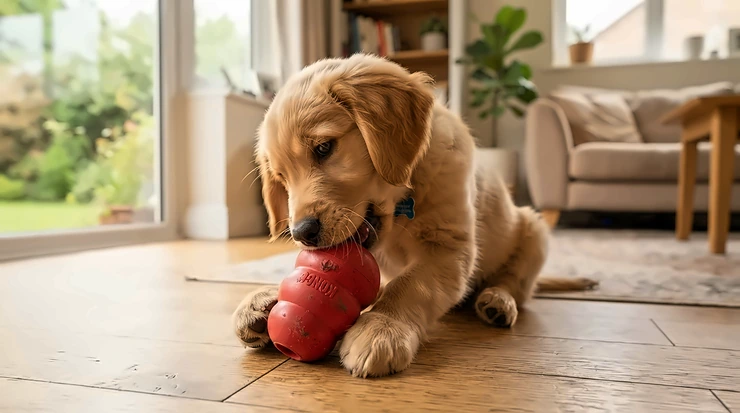
Somewhere between twelve and sixteen weeks, your sweet, snoozy puppy turns into a tiny landshark. Skirting boards, slippers, your wrist, the corner of the sofa: nothing is safe. That’s teething, and it’s about as glamorous as it sounds. A good textured rubber tug toy for teething puppies is one of the few purchases that tackles the problem from both ends. The ridges and nubs give sore gums something worth gnawing, while the handle or rope lets you channel all that frantic energy into a game instead of a fight over your shoelaces.

Here’s the catch. Most “teething toys for puppies” are either too hard for baby teeth, too flimsy to survive a week, or built purely for chewing with nothing you can actually tug. A true textured rubber tug toy for teething puppies has to be soft enough for tender gums, grippy enough for a wobbly-toothed pup, and sturdy enough that it won’t shed fibres or chunks into a small stomach. Few products tick all three boxes, and some of the best options on this list are hybrids that get you most of the way there.
This guide compares seven real products available to UK owners. I’ve leaned on retailer specifications and published vet and kennel-club guidance, not invented testing stories. For each pick you’ll get what the specs mean in practice, honest pros and cons, and who it suits. We’ll also cover when puppies start teething, what makes safe chew toys for young dogs, and how to use soft textured dog toys without turning bedtime into a toy-confiscation drama. 🐶
Quick Comparison Table: Textured Rubber Tug Toy for Teething Puppies at a Glance
| Product | Main materials | Tug-friendly? | Price range (check current price) | Best For |
|---|---|---|---|---|
| World of Pets Puppy Teething Toy with TPR Handle | Soft rope, TPR handle | Yes, handle plus rope | Under £10 | Small puppies, closest rubber-and-rope hybrid |
| Pet London George Teething Puppy Toy | Plush head, rubber rings, rope tassel | Yes, tassel knot | Around £10 | Gentle chewers who love character toys |
| KONG Rope Puppy Tug | Ultra-soft knitted yarn rope | Yes, two handles | Under £12 | Pure tug games with soft texture |
| Nylabone Teething Puppy Chew Freezer Bone | Soft chew with cloth, freezable | Yes, cloth for tug | Under £10 | Cold-therapy fans |
| KONG Puppy Classic | Extra-soft natural rubber | Limited | Under £8 | Stuffing, soothing, solo chewing |
| Nylabone Puppy Teething Keys | Puppy-soft chew material | Light grip-and-pull | Under £10 | Small breeds, travel-size relief |
| N-Bone Puppy Teething Ring | Ring-shaped teething chew | Light two-handed play | Under £10 | Budget-conscious owners wanting a backup |
Prices are indicative ranges from UK retailer listings at the time of research. They change often, so check the current price before you buy. Reading across the table, the World of Pets Puppy Teething Toy with TPR Handle comes closest to the keyword brief of rubber plus tug. The KONG Puppy Classic is the better pure gum-soother but a poor tug partner. Budget buyers should note that most of these sit in the single-digit-pound range, so the real cost difference comes down to how long each one survives, not the sticker.
💬 Just one click — help others make better buying decisions too!😊
Top 7 Textured Rubber Tug Toy for Teething Puppies Options: Expert Analysis
1. World of Pets Puppy Teething Toy with TPR Handle — closest rubber-and-rope hybrid
The standout here is the construction: a soft rope body paired with a TPR (thermoplastic rubber) handle, which is exactly the combination people mean when they search for a textured rubber tug toy for teething puppies.
TPR is softer and more forgiving than hard moulded rubber, so it won’t bruise a pup’s tender gums. The rope section adds the tug element and a bit of floss-like texture. On paper, that means one toy covers both gnawing and gentle two-player games. It’s sold in the UK under the Smart Choice name through retailers such as Jollyes, and it’s aimed at small puppies and small dogs.
My honest take is that it suits owners of toy and small breeds who want a single multi-purpose toy. The retailer’s own guidance calls it durable but not indestructible and recommends supervision, which is the right attitude for any rope-based toy. I couldn’t verify a deep pool of independent reviews, so check the live rating and review count on the listing before buying.
Pros:
- ✅ Soft TPR handle is gentle on gums
- ✅ Rope section allows proper tug games
- ✅ Sized sensibly for small pups
Cons:
- ❌ Rope can fray under determined chewing
- ❌ Too small for medium and large breeds
Price range: typically under £10. Good value for a small-breed hybrid, provided you supervise.
2. Pet London George Teething Puppy Toy — rubber rings with a rope tassel
George earns his place with texture variety: a fuzzy head, canvas ears, bright rubber rings around the neck and a knotted rope tassel at the base.
At roughly nine inches long, he’s a comfortable size for a small-to-medium pup to carry. The rubber rings are the teething bit, giving little gums something firm-but-yielding to grind on. The rope tassel is the tug handle. It’s also what makes him easy to pick up and trot around with, which matters because puppies who carry toys tend to chew toys.
Based on the spec comparison, George suits gentle to moderate chewers who enjoy a “character” toy, and he can double as a comfort toy at bedtime under supervision. The trade-off is that only part of him is rubber. The plush head and canvas ears will tempt determined shredders. I haven’t been able to verify a large body of independent reviews, and he’s mainly stocked by specialist retailers, so check availability and current ratings on amazon.co.uk.
Pros:
- ✅ Rubber rings offer a firm chewing texture
- ✅ Rope tassel makes a natural tug handle
- ✅ Nine-inch size suits small-to-medium puppies
Cons:
- ❌ Plush and canvas parts invite shredding
- ❌ Limited independent review data found
Price range: around £10 at the retailer checked. Fair for a hybrid, but treat him as a supervised toy.
3. KONG Rope Puppy Tug — softest knit for pure tug
This is a rope toy, not a rubber one, but it earns its place for puppy-specific softness. It’s made from an ultra-soft yarn knitted into a dense, solid rope weave.
Two handles mean you and your puppy can both grip, and the seam-free construction reduces the weak points where cheaper rope toys unravel. Because it’s soft polyester yarn rather than stiff cotton rope, it’s kinder on baby teeth. The texture gives that slightly abrasive, floss-like feel puppies seem to love when gums itch. UK pet writers have long advised valuing rope quality over everything else, because loose fibres are the main hazard.
Here’s what to weigh: this is the one to buy if tug games are your priority and you plan to pair it with a separate rubber chew. It’s not a gum-soother on its own for the heaviest chewers. KONG itself says no toy is indestructible, so supervise and bin it at the first sign of loose strands. Check current ratings on the listing, since I couldn’t verify a robust review pool.
Pros:
- ✅ Ultra-soft yarn is gentle on baby teeth
- ✅ Two handles suit shared tug games
- ✅ Seam-free build reduces weak points
Cons:
- ❌ Not rubber, so less gum resistance
- ❌ Fibres can loosen with heavy chewing
Price range: roughly under £12 depending on pack and size. Good value as a tug specialist.
4. Nylabone Teething Puppy Chew Freezer Bone — cold relief with a tug-friendly cloth
The hook is that it can be frozen, which is the classic, low-tech way to numb sore gums.
A veterinary-resource round-up picked the peanut-butter-flavoured version as its best puppy teething toy, noting that the cloth element suits tug-of-war and keep-away. In practice, the sequence works nicely: freeze it, hand it over during the worst of the evening chomp-fest, then use the cloth to play once the gums settle. The cold also makes the toy firmer, so supervise and don’t leave a frozen toy in a determined chewer’s mouth for hours.
This suits owners who want one toy for both comfort and play. The caveat is the flavour: if your puppy has a food sensitivity, check the ingredients, and note that cloth can fray with enthusiastic gnawing. As ever, I couldn’t verify review volumes, so read recent buyer feedback on the listing.
Pros:
- ✅ Freezable for numbing sore gums
- ✅ Cloth section works for tug games
- ✅ Flavour encourages chewing the right thing
Cons:
- ❌ Flavouring may not suit sensitive tummies
- ❌ Cloth can fray with persistent chewing
Price range: typically under £10. A sensible, low-risk starter.
5. KONG Puppy Classic — extra-soft rubber you can stuff and freeze
This is the heavyweight of gum-soothing chew toys. It’s made from extra-soft natural rubber designed specifically for puppy teeth and jaws, and it’s hollow, so you can fill it.
That hollow centre means a smear of puppy-safe filler, frozen, gives you a long-lasting, cold, calming distraction. The odd, bouncy shape also means it skitters around unpredictably, which keeps puppies engaged. It comes in two sizes, so choose the one your pup can’t swallow whole.
It’s not a classic tug toy, and you shouldn’t expect it to behave like one. But if you pair it with a rope tug, it forms half of a very practical two-toy system. Several UK and vet-affiliated round-ups name the puppy KONG as a go-to teething pick, and retailers stress its soft, tooth-friendly rubber. Even so, verify review counts on the listing, since I couldn’t confirm them.
Pros:
- ✅ Extra-soft natural rubber suits baby teeth
- ✅ Hollow design takes frozen fillings
- ✅ Bounces to keep puppies entertained
Cons:
- ❌ Poor for proper tug games
- ❌ Soft rubber won’t suit strong adult chewers
Price range: usually under £8. Excellent value for a staple.

6. Nylabone Puppy Teething Keys — compact, softer-than-adult chew
The standout is the material: softer than Nylabone’s adult range, so it’s gentler on teething pups while still holding up to hours of chewing, according to UK pet-blog coverage.
The key-ring shape gives puppies loops to grip and gnaw, which makes it a decent “light tug” option when you hold one loop and your puppy takes the other. It’s compact, so it fits in a handbag for the vet waiting room or a café stop. Small sizing means small breeds benefit most. A large-breed puppy could chew it too quickly or mouth it too deeply.
This suits owners of small breeds who want a travel-size teething toy. It’s not a heavy-duty tug, and you should keep pulling gentle. Check recent reviews for durability on your size, as I couldn’t verify a deep review pool.
Pros:
- ✅ Softer material designed for baby teeth
- ✅ Loop shape is easy to grip
- ✅ Compact enough for travel
Cons:
- ❌ Small size only suits small breeds
- ❌ Only suited to light tug play
Price range: typically under £10. Solid value for a small-dog household.
7. N-Bone Puppy Teething Ring — the lesser-known budget backup
The hook is simplicity: a ring-shaped teething toy designed to ease teething pain and mouth soreness.
UK pet writers note that rings like this won’t last quite as long as regular chew toys, which is a fair, honest trade-off for a soft, puppy-friendly design. That ring shape lets a puppy grip it with their front teeth or hold it for light two-handed games with you. Look closely at the listing photos for surface texture and finish, since that varies by version.
It makes sense as a second or third toy in the rotation, particularly if you’re worried about boredom. Treat it as a short-lifespan consumable and replace it as soon as it shows chunks missing. I couldn’t verify independent reviews at scale, so read recent ones first.
Pros:
- ✅ Soft, puppy-friendly ring design
- ✅ Easy to grip with front teeth
- ✅ Handy as a rotation backup
Cons:
- ❌ Wears out faster than sturdier chews
- ❌ Limited independent review data found
Price range: typically under £10. Value is fine if you accept it’s disposable.
What Is a Textured Rubber Tug Toy for Teething Puppies?
A textured rubber tug toy for teething puppies is a soft, flexible chew toy made from puppy-grade rubber or TPR, with ridges, nubs or knots that massage sore gums, plus a handle, rope or loop so you can play gentle tug. It combines two jobs in one toy: gum relief and bonding play.
Why does that combination matter? Because puppies don’t separate “chewing for comfort” from “playing.” During teething, the mouth is both sore and the main way a puppy explores the world. A plain hard chew doesn’t invite interaction. A pure rope toy invites tug but gives gums little resistance. Hybrids splice the two together.
Texture isn’t decoration, either. Ridges and bumps create varied pressure on different parts of the gum line, which is why puppies often prefer a nubbly toy over a smooth one. It’s a bit like the difference between a smooth teething ring and a ridged one for a human baby.
When Puppies Start Teething: A Practical Timeline for UK Owners
Understanding when puppies start teething helps you buy the right toy at the right time. According to PetMD’s puppy teething guide, baby teeth start erupting at around three weeks, giving a full set of 28. They begin falling out at around three and a half to five months, with adult teeth arriving through to about six months, finishing with a set of 42.
In practice, most UK owners collect their puppy at around eight weeks, so you’ll often be buying teething toys for puppies just before the real fun begins. Here’s a simple way to read the stages:
- Around 3½–5 months: incisors and canines swap over. This is when the mouthing and nipping usually ramp up.
- Around 4–6 months: premolars arrive. Gums are at their sorest.
- Around 5–7 months: molars finish the job. Chewing remains intense even as the pain eases.
Large and giant breeds tend to erupt adult teeth a little earlier than small breeds, so don’t panic if your Labrador is ahead of your Chihuahua. Notice, too, that adult teeth being in place doesn’t mean chewing stops. It simply shifts from relief-seeking to habit, exploration and boredom. Buy your first teething toys for puppies at around ten to twelve weeks, and expect to re-evaluate size and firmness once adult teeth are in.
How to Choose a Textured Rubber Tug Toy for Teething Puppies
Choosing well takes about five minutes if you know what to look for. Work through these steps:
- Check the softness first. Veterinary guidance suggests teething toys should be soft and flexible, so pick something with a little give. If you can’t dent it with a fingernail, it’s probably too hard for baby teeth.
- Match size to mouth. A toy that fits entirely behind your puppy’s front teeth is a swallowing risk. Choose something clearly larger than their muzzle width.
- Look for real texture. Ridges, nubs and knots offer different pressure points on sore gums. Flat, shiny surfaces tend to be less appealing.
- Inspect the tug element. Rope should be tightly woven and seam-free. Handles should be solid, not glued-on accessories.
- Choose materials you can verify. Look for named materials (natural rubber, TPR, polyester yarn) and a clear manufacturer. Vague “non-toxic” claims with no brand behind them are a flag.
- Consider freezability. If the toy can go in the freezer, you’ve got built-in gum relief on tap. Check the product notes first.
- Plan to rotate. Two or three different toys, swapped regularly, beat one “perfect” toy.
Taken together, these steps mean the best textured rubber tug toy for teething puppies in your house is the one that’s soft enough, sized right and actually supervised. Reading the guidance from VCA Animal Hospitals’ teething advice is a sensible companion read if you want an independent veterinary angle.
Features That Actually Matter (And Those That Don’t)
The pet toy aisle is a masterclass in marketing. Let’s separate signal from noise.
Features that matter:
- Softness and flexibility. This is the single most important trait for sore baby teeth.
- Seam-free or solid construction. Weak joins are where toys fail, and failure means loose bits.
- Appropriate size. More important than brand, colour or shape.
- Texture variety. It’s the reason one toy gets chewed for ten minutes and another for an hour.
- Cleanability. Teething puppies drool profusely, so a toy you can rinse beats one that traps grime.
Features that mostly don’t:
- “Indestructible” claims. The honest manufacturers say no toy is indestructible. Treat that phrase as a warning, not a promise.
- Squeakers, especially in a teething toy. They add a swallowing hazard and a weak point.
- Bright novelty shapes. Cute for photos, no better for gums.
- Elaborate flavour claims. Useful as a nudge to chew the right thing, but not a reason to buy.
What most buyers overlook is how a toy ages. A soft toy that’s fine on day one can get chunks missing by week three. That’s not a defect so much as the nature of soft rubber and yarn, which is why inspection habits matter as much as the original purchase.
Safe Chew Toys for Young Dogs: Your Checklist
Safe chew toys for young dogs aren’t a mystery, but the rules are non-negotiable.
Start with supervision. Even a gentle chewer can pull a strand loose or bite a corner off. Never leave a puppy alone with a new toy until you’ve watched how they treat it. Practical veterinary advice also warns against anything with small, sharp or detachable parts, so avoid squeakers, buttons and glued-on eyes in a teething toy.
Check hardness regularly. Toys that were soft in the shop can harden over time, particularly if repeatedly frozen. Replace anything that has lost its give or developed cracks. Likewise, bin rope toys the moment fibres start to unravel, because swallowed strands are a recognised hazard.
Finally, respect size limits. If a toy can slide to the back of your puppy’s throat, it’s too small. And remember that safe doesn’t mean forever: a toy that suits a ten-week-old may be unsuitable at six months, when jaws are stronger and adult teeth are in. When in doubt, ring your vet. They’d much rather answer a quick “is this okay?” call than deal with an obstruction.
Rubber vs Rope vs Plush: Which Soft Textured Dog Toys Suit Teething Puppies?
Not all soft textured dog toys behave the same. Here’s how the three common types stack up for teething.
| Toy type | Gum relief | Tug potential | Typical weakness | Best For |
|---|---|---|---|---|
| Soft rubber (e.g. KONG Puppy Classic) | High | Low | Hard to tug | Solo chewing, stuffing, freezing |
| Rope (e.g. KONG Rope Puppy Tug) | Moderate | High | Fraying fibres | Tug games with supervision |
| Rubber-rope hybrid (e.g. World of Pets Puppy Teething Toy with TPR Handle) | Moderate-high | Moderate-high | Rope section wears | Owners wanting one multi-purpose toy |
| Plush-rubber mix (e.g. Pet London George Teething Puppy Toy) | Moderate | Moderate | Plush gets shredded | Gentle chewers, comfort play |
Looking at the comparison, rubber wins for pure comfort and longevity, rope wins for play, and hybrids trade a little of each for convenience. If you only buy one, a hybrid is the practical choice, but if you can afford two, pairing a rubber chew with a rope tug covers every base. Plush mixes are the riskiest for heavy chewers, so reserve them for supervised sessions.

Gum-Soothing Chew Toys: How to Use Cold Safely (Practical Guide)
Cold is the oldest trick in the teething book. Wikipedia’s puppy teething entry notes that owners often freeze teething toys to soothe irritated gums, and that vets recommend chew toys to relieve teething pain. Done properly, it’s cheap and effective. Done carelessly, it can backfire.
Set-up:
- Choose a toy that suits freezing, such as the Nylabone Teething Puppy Chew Freezer Bone or a stuffed KONG Puppy Classic.
- Chill it for a few hours, not rock-solid for days. You want cold and firm, not an ice brick.
- Hand it over during known “grumpy gum” times, typically evenings.
Maintenance:
- Wash toys after each session. Drool and stuffing residue grow bacteria quickly.
- Rotate two toys so one is always freezer-ready.
- Check for cracks after each thaw. Repeated freezing can make some materials brittle.
Common first-month mistakes:
- Leaving a frozen toy unattended.
- Freezing a toy that isn’t meant for it.
- Filling a KONG Puppy Classic with rich fillings that upset a small tummy. Keep fillings simple and part of your puppy’s daily food allowance.
Gum-soothing chew toys work best as part of a routine, not a one-off fix. Offer one when you notice nibbling escalating, and the toy becomes the answer to the itch rather than your fingers.
Real-World Scenarios: Matching Toys to Real Puppies
Let’s make this concrete with three typical UK households.
Scenario 1: The flat-dweller with a Cockapoo puppy. A fourteen-week-old, small-breed pup in a one-bedroom flat means noise-conscious, compact toys. Pair a KONG Puppy Classic, stuffed and frozen for evening calm, with a KONG Rope Puppy Tug for short daytime games. Total spend stays modest, and neither toy squeaks, which neighbours will appreciate.
Scenario 2: The family with two children and a Labrador puppy. Energy is high, hands are small and supervision is split. Here, a hybrid like the World of Pets Puppy Teething Toy with TPR Handle is better for smaller breeds, but for a Lab, you’d want to check the size carefully and may prefer larger rubber options. Teach the children a simple rule: tug gently, never lift the puppy off the floor, and stop the moment mouthing gets rough.
Scenario 3: The commuter with a Dachshund puppy. Time is tight, so the priority is calming enrichment while you’re out for short, vet-approved periods. A frozen Nylabone Teething Puppy Chew Freezer Bone plus the compact Nylabone Puppy Teething Keys for the car or office covers both home and travel.
The principle across all three: match toy size and texture to breed and routine, then add supervision. The product is only as safe as the habits around it.
Problem → Solution Guide: Teething Troubles Solved
Problem 1: “My puppy bites my hands constantly.” Mouthing spikes during teething. The American Kennel Club’s teething guidance recommends offering acceptable alternatives and teaching that hard biting ends the fun. Keep a KONG Rope Puppy Tug nearby, swap it in when teeth find skin, and pause play if the bite stays hard.
Problem 2: “My puppy ignores the toy I bought.” Try a different texture, a chilled version or a stuffed KONG Puppy Classic. A smear of puppy-safe filler can turn a boring toy into a favourite.
Problem 3: “They shredded it in two days.” That’s a sign of too much unsupervised access or the wrong type. Rope and plush suit supervised play only. Move to soft rubber for solo chewing.
Problem 4: “Everything gets drooled on.” Choose washable materials, rinse after each use and keep a spare. A rotation of two or three toys, including the Nylabone Puppy Teething Keys for small breeds, keeps things hygienic.
Problem 5: “They chew in the middle of the night.” Offer a chilled, appropriate toy before bed, not a new, noisy one. Ask your vet if night-time chewing seems excessive or your puppy seems in real distress.
Long-Term Cost & Maintenance: What Teething Toys Really Cost
The sticker price is the least interesting number. What matters is cost per month of useful life.
| Option | Typical price range | Likely lifespan (supervised) | Value verdict |
|---|---|---|---|
| KONG Puppy Classic | Under £8 | Longest | Best long-term value |
| KONG Rope Puppy Tug | Under £12 | Medium | Good for tug-focused homes |
| World of Pets Puppy Teething Toy with TPR Handle | Under £10 | Medium | Solid hybrid for small pups |
| N-Bone Puppy Teething Ring | Under £10 | Shortest | Fine as a disposable backup |
Prices are indicative and may vary, so check the current price. The takeaway is simple: spending a few pounds more on a soft rubber staple usually beats re-buying cheaper, shorter-lived toys every fortnight. Teething lasts months, not years, so budget for a small rotation of three to four toys across the whole phase, replacing any that show damage.
Maintenance is straightforward. Wash with warm soapy water, rinse thoroughly, air dry and inspect. Anything cracked, chunky-missing or unravelling goes in the bin. After teething, re-assess: many owners graduate to firmer chews, while softer puppy toys retire to gentle play.
Common Mistakes When Buying Textured Rubber Tug Toy for Teething Puppies
Even careful owners trip up. Watch for these:
- Buying adult-strength toys too early. Hard rubber can be uncomfortable for baby teeth. VCA’s guidance favours soft, flexible options for teething.
- Choosing the wrong size. Too small is a choking risk, and too large may be ignored.
- Treating “tough” as “safe.” Durable doesn’t mean harmless. Even tough toys can break into chunks.
- Trusting vague material claims. If a listing doesn’t say what the toy is made from, think twice.
- Tugging too hard. Puppies have developing jaws and wobbly teeth. Keep pulling gentle and let them “win” often.
- Forgetting rotation. One toy gets boring, dirty and over-chewed. Several keep chewing interesting.
- Skipping supervision. No toy replaces your eyes.
Avoid these and you’ll get far more from any textured rubber tug toy for teething puppies you choose.
FAQ
❓ What age can a puppy start using a tug toy?
❓ How many teething toys for puppies do I actually need?
❓ Are soft textured dog toys safe to leave overnight?
❓ How often should I replace gum-soothing chew toys?
❓ Can a rubber tug toy help stop my puppy biting?
Conclusion
Teething is a phase, not a personality, but it’s a loud, soggy, shoe-threatening phase while it lasts. The right textured rubber tug toy for teething puppies won’t magic it away, but it gives your pup a legitimate target and gives you something better to do with your hands than flap them around yelling “no”.
If you want the closest match to the brief, the World of Pets Puppy Teething Toy with TPR Handle is the nearest rubber-and-rope hybrid, especially for small breeds. For pure tug, the KONG Rope Puppy Tug is the soft, well-constructed option. For comfort, the KONG Puppy Classic and the freezable Nylabone Teething Puppy Chew Freezer Bone are hard to beat. The Pet London George Teething Puppy Toy, Nylabone Puppy Teething Keys and N-Bone Puppy Teething Ring round out the list with character, portability and budget flexibility.
Whatever you choose, remember the three rules: soft, sized right and supervised. Add a rotation, a freezer and a bit of patience, and you’ll both get through. 🐾
Recommended for You
- Multi-Ring Rubber Tug Toy For Large Dogs: 7 Proven Picks (2026)
- Rubber Ring Tug Vs Rope Tug For Dogs: Ultimate 7-Pick Guide (2026)
- Rubber Ring Tug Toy For Dogs: 7 Best Tough Picks (2026)
Disclaimer: This article contains affiliate links. As an Amazon Associate, I earn from qualifying purchases. If you purchase products through these links, we may earn a small commission at no additional cost to you.
✨ Found this helpful? Share it with your friends! 💬🤗
