In This Article
There is perhaps no more contentious debate in British dog ownership circles than this one. It sounds simple enough: give the dog something to gnaw on, keep the sofa safe, everyone’s happy. But scratch below the surface — much like your Labrador scratches at the back door at 6am — and you’ll find a genuine minefield of competing claims, passionate vets, and enough online opinion to fuel a medium-sized argument at your local dog-walking group.
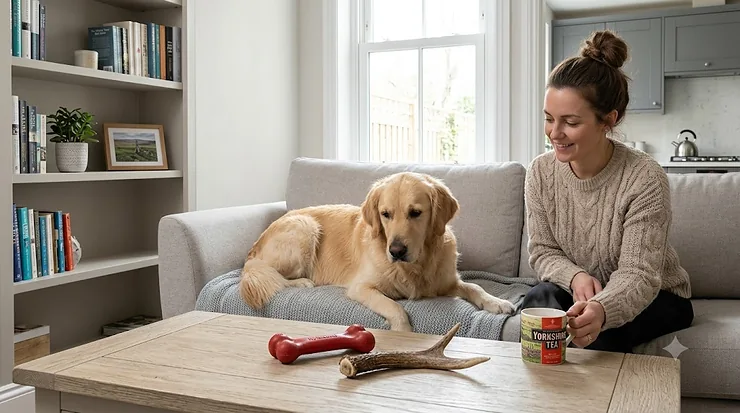
The question of nylabone vs antler chews which is better for dogs has never been more relevant. Antlers have exploded in popularity across UK pet shops and Amazon.co.uk over the past several years, marketed as the “natural” choice — free from additives, ethically sourced, long-lasting. Meanwhile, Nylabone, a brand with over 70 years of history behind it and now distributed exclusively across the UK through Rosewood Pet Products, has built its reputation on durability and dental benefit. Both sides have vocal champions. Both have legitimate concerns.
Here’s what the debate usually glosses over: neither option is universally safe for every dog. The right choice depends enormously on your individual dog — their age, breed, chewing style, and dental history. What works brilliantly for a relaxed Cavalier King Charles Spaniel can be genuinely dangerous for a bored, power-chewing Staffordshire Bull Terrier.
In this guide, we cut through the marketing noise and give you an honest, vet-informed breakdown of nylabone vs antler chews which is better for dogs — covering safety, durability, dental health, and the seven best products currently available on Amazon.co.uk.
Quick Comparison: Nylabone vs Antler Chews at a Glance
| Feature | Nylabone (Synthetic) | Antler Chews (Natural) |
|---|---|---|
| Material | Nylon polymer | Naturally shed deer/elk antler |
| Durability | High — lasts weeks to months | Very high — can last weeks |
| Dental benefit | Moderate — textured surface helps | Moderate — scraping action on plaque |
| Safety risk | Tooth fracture risk; chunk ingestion | High tooth fracture risk; GI blockage if chunks swallowed |
| Flavoured? | Yes (chicken, beef, venison, etc.) | Natural marrow scent only |
| Suitable for puppies? | Softer variants only (FlexiChew) | Not recommended under 12 months |
| Caloric content | Negligible | Minimal (marrow has some fat) |
| Price range (Amazon.co.uk) | £5–£20 | £8–£30+ |
| Best for | Moderate chewers, puppies (soft range) | Adult moderate chewers, supervised use |
| Odour | Low | Virtually none |
| Eco credentials | Plastic — not biodegradable | Naturally shed — no animals harmed |
What this table reveals is not a clear winner, but a clear truth: both categories carry genuine risks that the packaging tends to downplay. Antlers sit at the top of every “hardness” concern list among veterinary dentists, while hard Nylabones raise similar alarms. The question isn’t just which is better — it’s which is better managed. The safest version of either chew is one chosen carefully by size, chew strength, and age, and always used under supervision.
💬 Just one click — help others make better buying decisions too! 😊
✨ Don’t Miss These Exclusive Deals!
🔍 Take your dog’s chewing experience to the next level with these carefully selected products. Click on any highlighted item to check current pricing and availability on Amazon.co.uk — and find exactly what your dog needs!
Top 7 Dog Chews Available on Amazon.co.uk: Expert Analysis
1. Nylabone Power Chew Flavoured Durable Dog Chew Toy
The Power Chew is Nylabone’s flagship product for serious chewers, and it’s been available on Amazon.co.uk for years for good reason. Made from a tough, flexible nylon blend, it comes in multiple flavours (chicken, beef, and the rather indulgent-sounding filet mignon) and size ranges from small breeds under 11 kg up to large dogs over 23 kg. The nub-covered surface isn’t just decorative — it actively scrapes against tooth surfaces as your dog chews, providing a mild mechanical cleaning action.
Here’s the thing the marketing doesn’t tell you though: the Power Chew is for moderate chewers, not extreme ones. If your dog has a jaw like a vice — Staffies, Malinois, Rottweilers, we’re looking at you — the nylon can be broken down into small chunks that are then swallowed. That’s not ideal. For a Spaniel or a Beagle who likes to gnaw calmly rather than demolish things, it’s genuinely excellent.
UK buyers note: sizes align with weight ranges on the UK product listing, and Prime-eligible orders typically arrive next day.
✅ Long-lasting for moderate chewers
✅ Teeth-cleaning texture
✅ Wide range of sizes
❌ Not suitable for extreme/power chewers
❌ Plastic-based — not biodegradable
Price range: Around £7–£15 depending on size. Solid value for a chew that can last weeks.
2. Nylabone FlexiChew Chicken Flavour Dog Chew
If the Power Chew is the workhorse, the FlexiChew is the diplomat — softer, more flexible, and far more accommodating of dogs who are younger, older, or simply less carnivorous in their chewing ambitions. The FlexiChew’s key selling point is flex. You can actually bend it. That one physical property makes an enormous difference to dental safety, because a chew with some give is far less likely to cause a tooth fracture than something with zero yield.
Veterinary professionals who express concerns about hard Nylabones will often make an exception for the softer FlexiChew range. It’s widely recommended for puppies over 3 months and senior dogs whose teeth may already be compromised. For a rescue dog of unknown age, or a dog who’s previously had dental work, this is the Nylabone you want.
UK buyers: available on Amazon.co.uk with Prime next-day delivery, and it represents one of the better value buys in the Nylabone range.
✅ Soft enough for puppies and seniors
✅ Vet-friendly — lower fracture risk
✅ Chicken flavour keeps dogs engaged
❌ Won’t satisfy extreme chewers
❌ Wears down faster than Power Chew
Price range: Around £5–£12. Excellent value, particularly for first-time chew buyers.
3. Nylabone Power Chew Antler Alternative Venison Flavour
Nylabone clearly noticed that antler chews were pinching their market share — so they made their own version. The Antler Alternative is designed to mimic the texture and shape of a real deer antler, but constructed from their tough nylon compound with venison flavour infused throughout. It’s a rather clever piece of product design, frankly.
The practical upshot? You get the idea of an antler — the shape, the texture, the gnawing satisfaction — without the extreme hardness that causes the dental drama. It won’t fracture teeth the way a real antler can, and there’s no risk of sharp bone splinters. The venison flavour means even dogs who’ve previously enjoyed natural antlers tend to engage with it enthusiastically.
This is particularly worth considering for UK owners who’ve heard good things about antler chews but are understandably nervous after reading the vet guidance. It’s a sensible compromise that’s available on Amazon.co.uk in medium/wolf (up to 16 kg) and large/giant (up to 23 kg) sizes.
✅ Antler feel without the fracture risk
✅ Venison flavour — highly appealing
✅ Good for dogs transitioning off real antlers
❌ Still nylon — not suitable for extreme chewers
❌ Not a natural product
Price range: Around £8–£14. A smart middle-ground option.
4. AmeizPet Split Antler Chews for Dogs — Elk/Deer Antler
Now we cross into natural territory. The AmeizPet Split Antler Chews are one of the most consistently reviewed antler products on Amazon.co.uk, and the “split” designation here is genuinely important. A split antler has been cut lengthways to expose the inner marrow — the softer, more flavoursome centre that dogs find irresistible. This design is considerably safer than whole (unsplit) antlers, because your dog doesn’t need to crack through the outer shell to access the good stuff.
Available in sizes ranging from small (around 50–75g) up to XL (around 200g+), the AmeizPet range uses naturally shed deer and elk antler, meaning no animal was harmed in the making — a point that resonates with many UK buyers who are understandably conscious about sourcing. UK reviewers consistently praise the quality of the cut and the absence of preservatives, though some note inconsistency in size between orders.
Supervision is non-negotiable here. Split antlers, while safer than whole ones, are still hard — harder than your fingernail, which is the informal thumb test used by veterinary dentists to assess chew safety.
✅ Split design — safer than whole antlers
✅ Naturally sourced, no preservatives
✅ Long-lasting for most adult dogs
❌ Still hard — risk of tooth fracture remains
❌ Size consistency can vary between orders
Price range: Under £15 for smaller sizes; up to around £25 for larger pieces. Prime eligible.
5. Ace Antlers Deer Antlers for Dogs — Natural Dog Antler Chews
Ace Antlers has carved out a solid reputation among UK buyers as a reliable, British-focused antler chew brand on Amazon.co.uk. Available in an impressive eight sizes — from small pieces suitable for lighter dogs up to XXL for the larger breeds — and in both whole and split variants, the range gives UK owners real flexibility. The split versions are the sensible pick for most households.
What distinguishes Ace Antlers slightly from the competition is the consistent quality control that UK reviewers mention. The antlers are naturally shed (primarily red deer and fallow deer), hand-trimmed, and sourced sustainably — a point worth noting for environmentally conscious buyers. Red deer are, of course, native to Scotland and parts of England, which gives a pleasingly local flavour to what is essentially an ancient chewing tradition.
As with any antler product, this is best suited to adult dogs over 12 months, medium to heavy chewers who gnaw steadily rather than crunch aggressively. A Springer Spaniel who enjoys a long, leisurely chew session would get weeks of enjoyment out of an appropriately sized piece.
✅ Eight size options — excellent range
✅ Sustainably sourced, naturally shed
✅ Well-reviewed by UK buyers
❌ Whole variants carry higher fracture risk
❌ Not suitable for puppies or extreme biters
Price range: Around £8–£25 depending on size and pack. Good value across the range.
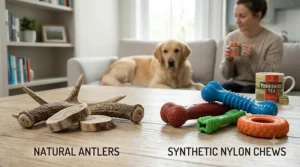
6. Maltbys’ Stores 1904 Ltd Antlers for Dogs — Natural Deer Antler
There’s something rather satisfying about a brand with an establishment date in its name. Maltbys’ Stores 1904 Ltd is a British company with a long heritage in animal products, and their natural deer antler chews on Amazon.co.uk carry that old-fashioned sense of no-nonsense quality. These are whole antlers rather than split, which immediately places them at the “more experienced owner” end of the spectrum — best reserved for adult dogs who chew steadily and methodically, not those who attack their chews with abandon.
Available in a range of weights and frequently Prime eligible, the Maltbys’ antlers are naturally shed and sourced from British and European deer populations. UK customers appreciate the domestic sourcing and straightforward packaging. The product suits dogs in the 15–30 kg range particularly well when the correct size is chosen.
One honest note: because these are whole antlers, the outer cortex is very hard. The fingernail test will fail emphatically. If your dog has any history of dental issues, or if your vet has ever mentioned concern about chewing habits, the Maltbys’ whole antler is not the product to start with — consider the AmeizPet or Ace Antlers split versions instead.
✅ British heritage brand
✅ Naturally shed, no artificial additives
✅ Prime eligible for fast UK delivery
❌ Whole antler — high hardness, dental risk
❌ Not for puppies or dogs with dental history
Price range: Around £10–£20. Decent value from a trusted British supplier.
7. Pets Purest Himalayan Yak Chews with Milk for Dogs
A worthy wildcard entry. The Pets Purest Himalayan Yak Chews aren’t antler and aren’t nylon — they’re a pressed, dried cheese product made from yak and cow milk, originating from the Himalayan tradition of hard cheese production. They’ve become enormously popular in the UK as a middle path between synthetic and bone-hard natural chews, and for many dogs, they genuinely are.
Why include them here? Because if you’re weighing up nylabone vs antler chews which is better for dogs and finding neither option sits comfortably with you, yak chews offer a third way that many vets find easier to recommend. They’re edible (no plastic, no bone fragments), they soften slightly with saliva, and they contain real protein and calcium. The hardness sits somewhere between a Nylabone FlexiChew and a whole antler — firm enough to last, but with some give.
Available in multiple sizes on Amazon.co.uk with Prime delivery, and well-reviewed by UK buyers. When the chew gets small, you can microwave the stub to create a puffed chew snack — a trick that delights dogs and surprised owners alike.
✅ Edible, natural ingredients
✅ No plastic, no hard bone risk
✅ Softer than antlers — gentler on teeth
❌ Can crack if chewed very aggressively
❌ Not suitable for lactose-intolerant dogs
Price range: Around £8–£18 for multi-packs. Excellent overall value.
The Safety Question Nobody Talks About Honestly
Let’s address the elephant — or rather, the fractured premolar — in the room.
Both Nylabones (the hard variants) and antler chews have attracted serious concern from veterinary dental specialists. The Veterinary Oral Health Council (VOHC), which evaluates dental products based on scientific evidence, does not include either hard Nylabones or antler chews on its list of approved products. That’s worth sitting with for a moment.
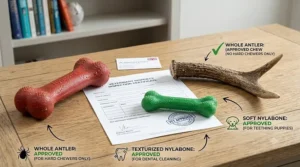
The informal standard used by most vets is what’s often called the “thumbnail test.” Press your thumbnail firmly against the chew. If you can’t make even a slight dent, the chew is probably too hard for your dog’s teeth. A real antler will pass this test spectacularly — in the wrong direction. The outer cortex of a deer antler is approximately as yielding as concrete. Whole, unsplit antlers are particularly concerning.
The risks break down into two main categories:
Tooth fractures. The upper fourth premolar — the largest cheek tooth dogs use for shearing — is the most common casualty. A slab fracture of this tooth can expose the pulp cavity, leading to infection, pain, and a bill from your vet that will make your eyes water. Cornell University College of Veterinary Medicine notes that most veterinary dentists recommend that chew objects should be flexible enough to indent with a fingernail.
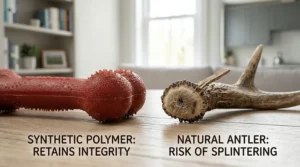
Gastrointestinal complications. When either a Nylabone or an antler breaks into chunks — and eventually, they can — those fragments can become lodged in the throat or digestive tract. The RSPCA advises dog owners to supervise chewing sessions at all times and to discard any chew that shows signs of breaking down into sharp pieces.
None of this means you should never give your dog a chew. Chewing is genuinely beneficial — it reduces boredom, supports dental hygiene, and satisfies a deep-seated natural instinct. The goal is choosing the right chew for the right dog, and managing it sensibly.
Which Chew for Which Dog? A UK Owner’s Practical Guide
This is the section the other buying guides tend to skip. Matching chew to dog matters far more than brand loyalty.
If your dog is a puppy (under 12 months): Skip both whole antlers and hard Nylabones entirely. Baby teeth are fragile, and adult teeth, once they come through, are still developing mineralisation until around 18 months. The Nylabone FlexiChew puppy range is designed for this stage — soft, engaging, safe. Keep antlers well out of reach.
If your dog is a moderate, steady chewer — a Spaniel, a Whippet, a Shih Tzu: Split antler chews (AmeizPet or Ace Antlers) are a reasonable choice under supervision. A Nylabone Power Chew in the correct size also works well. Yak chews are worth considering as an alternative that many vets find easier to endorse.
If your dog is a power chewer — Staffie, Malinois, German Shepherd, Husky: This is where the conversation gets genuinely tricky. Power chewers are the dogs most at risk from both hard Nylabones and antlers, because they apply enormous force. Ironically, the chews marketed as “for aggressive chewers” are often the most hazardous. Rubber chews — specifically dense natural rubber toys — are frequently the safer recommendation for these dogs.
If your dog is a senior (over 8 years): Dental health becomes more precarious with age, and existing wear means less protection for the pulp. The FlexiChew or yak chews are safer territory. Real antlers and hard nylons should be approached with real caution.
If you have a flat in London or Manchester with limited space: All of these chews can be used indoors without issue — they’re low-odour or odourless, which is something British flat-dwellers will appreciate, particularly if you live in a purpose-built block where the lingering smell of a bully stick would raise neighbourly eyebrows.
Nylabone vs Antler: The Real Dental Health Question
Both products claim dental benefits on their packaging. Both are, to some extent, correct — and to some extent, overselling things.
Chewing does mechanically remove plaque, particularly at the point where tooth meets gum. The abrasive action of gnawing against a textured surface — whether nylon or antler — does contribute to this. The PDSA (People’s Dispensary for Sick Animals) notes that dental disease affects the majority of adult dogs in the UK, making any safe contribution to oral hygiene genuinely valuable.
But here’s the asterisk: a chew that fractures teeth is actively harmful to dental health. A product that claims to clean teeth while simultaneously risking a £600 veterinary procedure is offering a rather poor value proposition. This is why the type of chew matters as much as the act of chewing.
The practical hierarchy looks something like this: soft rubber chews and yak chews carry the lowest dental risk. Nylabone FlexiChew sits in a sensible middle ground. Nylabone Power Chew works well for moderate chewers. Split antlers are riskier but manageable with supervision. Whole antlers and hard Nylabones for extreme chewers are where most vets start to wince.
✨ Don’t Miss These Exclusive Deals!
🔍 Ready to find the perfect chew for your dog? Click any highlighted product above to check current pricing and availability on Amazon.co.uk. Prime members enjoy free next-day delivery — your dog’s new favourite chew could be arriving tomorrow.
Common Mistakes UK Dog Owners Make When Buying Chews
Buying by dog breed rather than chewing style. Breed gives you a rough idea, but individual chewing behaviour varies enormously. Two Labradors from the same litter can have completely different chewing intensities. Watch how your dog engages with chews before upgrading to something harder.
Ignoring the size guidance. A chew that’s too small is a choking hazard. The size guidelines on Nylabone packaging are based on body weight and chewing strength — they’re not a marketing suggestion, they’re a safety recommendation. The same applies to antlers: a small antler given to a large dog is dangerous. When in doubt, go bigger.
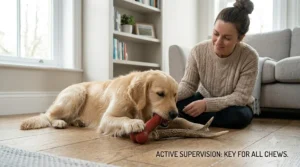
Leaving the dog unsupervised. This is the rule that gets broken most consistently, especially once owners become comfortable with a particular product. Every single chew — without exception — should be used under supervision. The Kennel Club UK recommends checking chews regularly and removing them when they become small enough to swallow whole.
Confusing “natural” with “safe.” Antlers are natural. So is arsenic, technically. The word “natural” on pet product packaging is not a safety certification. It tells you about the source material, not the risk profile.
Not replacing chews promptly. A Nylabone with visible cracks or a worn-down nub end should be binned. An antler reduced to a small nub is a choking hazard. The end of a chew’s useful life is often when it becomes most dangerous.
Long-Term Cost & Value in the UK: What Are You Actually Spending?
Price ranges across the seven products above span roughly £5 to £30 per chew, which sounds reasonable until you factor in frequency of replacement and — the potential cost nobody wants to think about — veterinary bills.
A Nylabone Power Chew priced in the £8–£12 range might last a moderate chewer six to eight weeks. That works out to around £1–£1.50 per week. A mid-range split antler at £12–£18 could last four to six weeks for a similar dog — comparable cost per week.
The calculation shifts dramatically if a tooth fractures. A slab fracture of the carnassial tooth, the most common chew-related dental injury, typically requires surgical extraction or root canal therapy under anaesthetic. In the UK, that typically runs to several hundred pounds — sometimes over £1,000 at specialist practices. Pet insurance may cover it, but not all policies do, and excess payments can still be significant.
The financially sensible approach — which also happens to be the safest — is to spend slightly more on a safer chew type (FlexiChew, yak chew, quality rubber toy) and avoid the risk of a costly dental emergency. The cheapest chew on Amazon.co.uk is rarely the cheapest option when all costs are factored in.
Frequently Asked Questions
❓ Are antler chews safe for dogs in the UK?
❓ Which is better for dog teeth — nylabone or antler chews?
❓ Can I give my puppy a nylabone in the UK?
❓ How long do antler chews last compared to nylabones?
❓ Are antler chews available with free UK delivery on Amazon?
Conclusion: So Which Is Actually Better?
Here’s the honest answer: for most dogs, most of the time, neither a hard Nylabone nor a whole antler chew is the unambiguously correct choice. What the nylabone vs antler chews which is better for dogs debate really reveals is that the chew market has a habit of selling durability and naturalness as synonyms for safety — and they are not.
For puppies and seniors: go soft. The Nylabone FlexiChew range is genuinely excellent and far better supported by veterinary opinion than hard alternatives.
For adult moderate chewers: split antlers (AmeizPet, Ace Antlers) under supervision, or the Nylabone Antler Alternative, offer a solid experience with manageable risk.
For power chewers: consider stepping outside this comparison entirely. Dense rubber chews or yak chews may serve your dog better than either option discussed here.
The right chew is the one your specific dog can enjoy safely. Go by chewing intensity, not breed assumption. Use the thumbnail test. Supervise every session. And replace the chew before it becomes the problem.
✨ Find the Right Chew for Your Dog Today!
🔍 Browse all our highlighted picks above and click through to Amazon.co.uk to check current prices and availability. Your dog’s teeth will thank you — and so will your vet.
Recommended for You
- Nylabone for Large Dogs UK: 7 Best Picks for Power Chewers 2026
- 7 Indestructible Solid Rubber Chew Toys for Power Chewers (UK 2026)
- Best Hollow Rubber Dog Toys to Stuff With Food UK 2026: 7 Expert Picks
Disclaimer: This article contains affiliate links. As an Amazon Associate, I earn from qualifying purchases. If you purchase products through these links, we may earn a small commission at no additional cost to you.
✨ Found this helpful? Share it with your mates! 💬🤗
