

In This Article
There’s a particular kind of guilt that hits when you’re standing over the bin, holding the shredded remains of a squeaky plastic hedgehog your dog demolished in eleven minutes flat. Eco friendly dog toys exist precisely to interrupt that cycle: they’re toys made from natural, recycled, or biodegradable materials — think natural rubber, hemp, jute, and post-consumer plastic — designed to be safer for your dog and gentler on the planet than the synthetic, petroleum-based toys that dominate the average pet aisle. Britain’s dog owners are catching on fast. Search interest in sustainable pet products has climbed steadily since 2023, and it’s not hard to see why once you start reading the small print on a conventional squeaky toy.

Here’s the uncomfortable bit nobody tells you at the till: the pet toy industry in the UK isn’t formally regulated the way children’s toys are, so “non-toxic” or “safe” printed on packaging doesn’t always mean what you’d hope. That gap is exactly why this guide exists. We’ve dug into real UK-available products — natural rubber bones from rubber trees, hemp ropes, jute-stuffed plush toys, and toys built from recycled plastic bottles — and paired the marketing claims with genuine aggregated customer sentiment, so you can separate the toys that hold up from the ones that dissolve into landfill within a week.
Below, you’ll find seven real products spanning budget to premium, a proper side-by-side comparison, and honest commentary on what actually matters when you’re choosing sustainable dog chew toys, non toxic eco dog toys, or simply trying to make your first steps toward zero waste pet ownership. No fluff, no invented five-star raves — just the research, laid out plainly.
Quick Comparison Table: Eco Friendly Dog Toys at a Glance
| # | Product | Core Material | Best For | Price Range |
|---|---|---|---|---|
| 1 | Green & Wild’s You’re Toast | Suede & jute fibre | Gentle chewers wanting a plastic-free cuddle toy | under £15 |
| 2 | Beco Hemp Rope | Hemp & recycled cotton | Tug-of-war and natural teeth-cleaning | under £15 |
| 3 | Beco Bone | 100% natural rubber | Treat-stuffed hollow chewing | £10–£20 range |
| 4 | Beco Dog Ball | Natural rubber & rice husk | Fetch-obsessed dogs | £10–£20 range |
| 5 | Hevea Moon Ball | 100% natural rubber | Small-to-medium dogs, gum relief | £10–£20 range |
| 6 | Beco Rough & Tough | Recycled plastic (RPET) fabric | Soft-toy and squeaker fans | £10–£20 range |
| 7 | KONG Extreme | Natural rubber (extreme formula) | Power chewers wanting maximum durability | £15–£30 range |
At a glance, the spread here tells its own story. If your dog is a “toy survives the unboxing” kind of chewer, Beco Bone and KONG Extreme sit at the tougher end because natural rubber flexes rather than shreds. If your dog is more of a cuddler and carrier than a destroyer, Green & Wild’s You’re Toast and the Beco Hemp Rope give you genuinely plastic-free materials without paying a durability premium you don’t need. Budget-conscious owners should note that “eco” doesn’t automatically mean “expensive” here — several of the plant-fibre options actually undercut mainstream synthetic squeaky toys on price, because jute and hemp are relatively cheap to produce at scale.
💬 Just one click — help others make better buying decisions too!😊
Top 7 Eco Friendly Dog Toys: Expert Analysis
1. Green & Wild’s You’re Toast — plastic-free plush made from suede and jute
This toast-shaped plush toy is about as far from a synthetic squeaky toy as you can get while still looking like something your dog would actually want to carry around the garden. Made from a suede outer with natural jute fibre stuffing, it’s produced without the bonding compounds that get released when your dog gnaws into a typical polyester-stuffed toy.
The specs matter here in a way that’s easy to gloss over: jute is a plant fibre grown with minimal pesticide input, and because it’s 100% biodegradable, a worn-out toy doesn’t sit in landfill for decades the way a foam-filled plastic equivalent would. In practice, that means the environmental cost of replacing this toy every few months is genuinely lower than replacing a synthetic one at the same rate. Based on the spec comparison with rival plush toys, this is one of the few in this category that’s honestly plastic-free rather than “recycled plastic” dressed up as eco-friendly.
Reviewers consistently note that dogs take to the novelty shape quickly, and several mention using it as a comfort toy for snuggling as much as chewing. A recurring theme in aggregated feedback, though, is that it’s not built to survive a committed shredder — owners of strong-jawed breeds report the jute filling coming apart within a single play session, while owners of gentler chewers report it lasting for weeks.
Pros:
- ✅ Genuinely plastic-free — suede and jute only
- ✅ 100% biodegradable filling and construction
- ✅ Small British eco brand with a clear sustainability mission
Cons:
- ❌ Not suited to strong or destructive chewers
- ❌ Stock availability from this small-batch maker can be limited
At a price point that typically sits under £15, this is a low-risk way to trial plastic-free play — just match it to a dog who treats toys as friends rather than targets.
2. Beco Hemp Rope — hemp fibres that double as a natural toothbrush
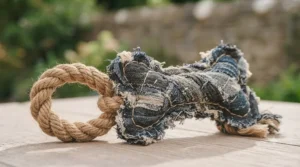
The Beco Hemp Rope leans into a material most people associate with clothing rather than dog toys, and there’s a genuinely sound reason for that crossover. Hemp grows densely, needs comparatively little water, and requires no pesticides — which is precisely the kind of low-input crop that makes an eco-conscious ingredient list credible rather than performative.
Functionally, this is a tug toy first and a dental tool second. The coarse texture of hemp fibre works against a dog’s teeth during tugging and chewing, providing a mild abrasive action that can help reduce plaque build-up over time — not a replacement for proper dental care, but a genuine side benefit synthetic rope toys don’t offer in the same way. What most buyers overlook about hemp specifically is that its fibres are shorter than the nylon strands used in conventional rope toys, which manufacturers argue makes accidental ingestion less likely to cause a blockage, since shorter fibres pass through the digestive tract more readily than long synthetic strands.
Aggregated reviews are genuinely split here, which is worth being upfront about rather than smoothing over. A meaningful share of owners describe the rope as terrier-proof and hard-wearing over several months. An equally vocal group reports it fraying or being reduced to loose strands within days, particularly with larger, more determined chewers. The honest takeaway: this is a toy for interactive tug play under supervision, not an unsupervised chew left with a power-chewing dog.
Pros:
- ✅ Hemp requires minimal water and no pesticides to grow
- ✅ Short natural fibres are considered safer if swallowed
- ✅ Doubles as a mild dental-cleaning tool during tug play
Cons:
- ❌ Durability is inconsistent across different chewing styles
- ❌ Loose hemp fibres can shed during vigorous play
Typically priced under £15, it’s an easy add-on to a toy rotation rather than a single “forever toy” — buy it for interactive play sessions, not solo boredom-busting.
3. Beco Bone — hollow natural rubber chew tapped from real rubber trees
The Beco Bone is arguably the poster child of the UK eco dog toy category, and for good reason: it’s made from natural rubber tapped directly from the trunks of rubber trees, rather than the synthetic, petroleum-derived rubber compounds used in cheaper alternatives. That distinction isn’t just marketing language — natural rubber is a renewable, biodegradable material, whereas synthetic rubber is fundamentally a plastic derivative.
In practical terms, the bouncy, springy texture of natural rubber gives this toy real bite resistance for moderate chewers, and the hollow design means you can stuff it with treats to extend engagement — useful for dogs who need mental stimulation during the day rather than just a quick chew. The vanilla scent is a genuine point of difference too; it’s there to make the toy more appealing to dogs (and, frankly, less unpleasant for owners handling it), and it comes without the synthetic fragrance additives found in some cheaper chew toys.
Here’s where honesty matters more than hype. Aggregated review sentiment is mixed on durability for genuinely heavy chewers: a notable portion of feedback describes strong dogs — Staffies and similar breeds come up repeatedly — tearing strips off within minutes, with owners understandably concerned about ingestion of rubber fragments. Equally, plenty of reviewers report toys lasting weeks under moderate use and specifically praise the manufacturer’s lifetime guarantee as a meaningful safety net if a toy fails prematurely.
Pros:
- ✅ 100% natural rubber, tapped sustainably from rubber trees
- ✅ Hollow design allows treat-stuffing for extended engagement
- ✅ Backed by a manufacturer lifetime guarantee
Cons:
- ❌ Not verified suitable for the strongest power chewers
- ❌ Some reviewers report rubber fragments coming loose under heavy use
Priced in the £10–£20 range depending on size, this sits firmly as a mid-range pick — better matched to moderate chewers than the most destructive dogs in the house.
4. Beco Dog Ball — rice husk rubber that swaps out plastic filler
Where a lot of “rubber” fetch balls quietly bulk out their material with synthetic filler, the Beco Dog Ball takes a different route by blending natural rubber with rice husk — an agricultural by-product that would otherwise typically go to waste. That’s a genuinely clever bit of material engineering: it strengthens the rubber compound while displacing the plastic fillers common in cheaper balls, and it puts a waste stream to use rather than sending it to landfill or incineration.
The wobbly, irregular shape is a deliberate design choice rather than a manufacturing accident — it makes the ball roll unpredictably during fetch, which keeps high-energy dogs more mentally engaged than a perfectly round ball would. Reviewers who bought it specifically for its environmental credentials tend to confirm the material story checks out: it’s non-toxic, free from the plastic fillers found in synthetic equivalents, and noticeably bouncier underfoot than a standard rubber ball, thanks to the rice husk composite.
The honest caveat is durability parity with its sibling product, the Beco Bone — natural rubber, however cleverly reinforced, still isn’t puncture-proof against determined chewing, so this suits dogs who fetch and carry more than dogs who settle down to methodically destroy anything round.
Pros:
- ✅ Rice husk composite reduces plastic filler content
- ✅ Unpredictable bounce keeps fetch sessions engaging
- ✅ Vanilla scent adds genuine appeal without synthetic fragrance
Cons:
- ❌ Same natural rubber wear limitations as other rubber toys
- ❌ Limited size range for extra-large breeds
At around £10–£20, it’s a strong value pick for owners who want an eco-conscious fetch toy without paying a premium purely for the “sustainable” label.
5. Hevea Moon Ball — biodegradable rubber tested to baby-product safety standards
Hevea built its reputation on baby products before moving into pet toys, and that heritage shows in how this ball is positioned: it’s made from 100% natural rubber and, notably, is tested to the same safety standard as the brand’s baby range — a detail worth weighing given that pet toys, unlike children’s toys, face no mandatory UK safety testing requirement at all.
What most buyers overlook about this model is the treat hole built into its uneven, whistling design. It’s not purely decorative — you can pack it with a moist treat and freeze it for a longer-lasting enrichment activity, which is particularly useful for teething puppies or anxious dogs who benefit from a slow, soothing chew. Because the rubber compound is genuinely biodegradable rather than merely “natural-sounding,” both the toy and its packaging break down at end of life in a way that a silicone or synthetic rubber ball simply won’t.
Aggregated feedback highlights the whistling sound during flight as a genuine fetch-game bonus, and the softer-on-teeth feel compared with tennis balls (whose felt coating is abrasive and whose fuzz can trap grit) comes up repeatedly as a reason owners switch. The trade-off is size and price: this is designed with small-to-medium dogs in mind rather than heavy-jawed large breeds, and natural rubber toys of this quality typically command a slightly higher price per gram than mass-produced synthetic balls.
Pros:
- ✅ Fully biodegradable natural rubber, including packaging
- ✅ Tested to baby-product safety standards, not just pet-toy norms
- ✅ Doubles as a treat dispenser and gum-soothing chew
Cons:
- ❌ Best suited to small-to-medium dogs, not heavy chewers
- ❌ Higher price per gram than mainstream rubber balls
Sitting in the £10–£20 range, this is worth the premium specifically if you have a puppy, a senior dog, or a small breed where gentleness on teeth and gums matters as much as durability.

6. Beco Rough & Tough — soft toy stuffing made from recycled plastic bottles
This is the toy that best illustrates a genuinely useful, if less glamorous, branch of the eco toy category: giving existing plastic waste a second life rather than pretending plastic doesn’t belong in sustainable products at all. The stuffing and cloth panels are made from recycled polyester (RPET) sourced from used plastic bottles, with the manufacturer stating a material mix of roughly 60–80% recycled content across the range.
Here’s what the spec sheet won’t tell you outright, but the construction makes clear: durability for a soft toy comes down to stitching, not material purity, and this one is double-stitched with a reinforced second layer along the seams specifically to withstand rougher play than a standard plush toy. Reviewers note the squeaker holds up reasonably well under moderate wrestling, and the brand’s climate-neutral certification — covering carbon offsetting across its supply chain — adds a layer of accountability that plenty of “eco” soft toys simply don’t offer.
Where this product is honest about its own limits: it’s not marketed as an unsupervised chew toy or a rival to natural rubber for power chewers. It’s a play toy, and owners of committed shredders should expect the fabric outer to eventually give way, at which point the recycled stuffing is exposed rather than contained.
Pros:
- ✅ Made from 60–80% recycled plastic bottle content
- ✅ Reinforced double-stitched seams for rougher play
- ✅ Brand is Climate Neutral and B Corp certified
Cons:
- ❌ Fabric construction won’t survive committed shredders
- ❌ Squeaker mechanism may need replacing over time
Priced around £10–£20, this is the pick for dogs who love a good wrestle-and-squeak session without the guilt of buying virgin plastic to get there.
7. KONG Extreme — the toughest rubber formula for genuine power chewers
KONG needs little introduction in the UK pet market, and the Extreme range specifically exists to answer one question: what do you give a dog that destroys everything else on this list? It’s built from KONG’s most durable natural rubber compound, engineered for dogs that other toys simply can’t survive.
On paper this means a hollow, treat-stuffable design with an erratic, unpredictable bounce that keeps dogs engaged well beyond a standard fetch ball, and a rubber formula recommended by vets and trainers specifically because it holds up where lighter natural rubber toys fail. It’s worth being straightforward about where this sits in the eco conversation, though: KONG doesn’t currently market the Extreme range around recycled or plant-based content the way Beco or Hevea do. Its environmental case rests more on longevity — a toy that survives months of heavy chewing replaces far fewer single-use squeaky toys over a dog’s lifetime, which has its own waste-reduction logic even without recycled materials in the mix.
Reviewers consistently praise its resilience against genuinely strong chewers, with repeated mentions of toys surviving where “indestructible” competitors failed within minutes. A smaller but consistent thread of feedback flags inconsistent batches — occasional reports of toys not holding up as expected — which is worth factoring in in case of a rare quality-control miss.
Pros:
- ✅ KONG’s most durable rubber formula, built for power chewers
- ✅ Hollow, treat-stuffable design extends engagement and reduces boredom
- ✅ Longevity reduces overall toy turnover and replacement waste
Cons:
- ❌ Not marketed with recycled or plant-based material content
- ❌ Limited to black colourway across the range
At roughly £15–£30 depending on size, it’s the premium pick here — justified specifically for dogs whose chewing habits have already destroyed the natural rubber and rope options above.
Full Spec Comparison: How the Seven Stack Up
| Product | Construction | Durability Level | Best For | Price Range |
|---|---|---|---|---|
| Green & Wild’s You’re Toast | Suede + jute filling | Light | Gentle chewers, comfort play | under £15 |
| Beco Hemp Rope | Hemp + recycled cotton | Light–Moderate | Supervised tug play | under £15 |
| Beco Bone | Natural rubber | Moderate | Treat-stuffed chewing | £10–£20 |
| Beco Dog Ball | Natural rubber + rice husk | Moderate | Fetch enthusiasts | £10–£20 |
| Hevea Moon Ball | 100% natural rubber | Moderate | Small-medium dogs, puppies | £10–£20 |
| Beco Rough & Tough | RPET fabric, stuffed | Moderate | Soft-toy wrestling and squeak play | £10–£20 |
| KONG Extreme | Extreme-grade natural rubber | High | Power chewers | £15–£30 |
Read across this table and a pattern emerges quickly: durability tends to track with material rigidity rather than eco-credentials specifically, which is why KONG Extreme and Beco Bone sit toward the tougher end while the jute and hemp options serve a different, gentler purpose entirely. If cost-per-month-of-use is your real metric, a £25 toy that survives six months often beats a £10 toy replaced every fortnight — a calculation worth doing before assuming “cheaper” automatically means “better value.”
How to Choose Eco Friendly Dog Toys
Choosing well starts with matching material to your dog’s actual behaviour, not the toy that looks nicest online. Here’s a practical, step-by-step framework built from the spec and review patterns above:
- Identify your dog’s chewing style first. A dog who carries and cuddles toys needs a completely different material to one who treats every toy as a demolition project — jute and plush suit the former, natural rubber or reinforced RPET fabric suits the latter.
- Check the material claim, not just the word “eco.” Look specifically for named materials — natural rubber, hemp, jute, recycled polyester — rather than vague sustainability language with no substance behind it.
- Match size to your dog, not the packaging photo. A ball or bone that’s too small for your dog’s mouth is a choking risk regardless of how sustainably it was made.
- Weigh durability against your dog’s strength honestly. Reviewers consistently flag mismatched expectations — a “tough” toy sold to a determined power chewer usually fails faster than the marketing suggests.
- Factor in end-of-life disposal. Genuinely biodegradable materials like jute and natural rubber compost or break down; recycled plastic toys should still go in general waste once worn out, not recycling, since they’re usually mixed-material.
- Look for supervised vs unsupervised suitability. Rope and hemp toys are largely designed for interactive play, not solo boredom-busting — check whether the manufacturer recommends supervision.
- Read aggregated review themes, not star ratings alone. A 4.5-star average can still hide a consistent minority complaint about durability that matters enormously for your specific dog.
Practical Usage Guide: Getting the Most from Sustainable Dog Chew Toys
Bringing a new eco toy home isn’t a “throw it in and hope” situation, particularly with natural materials that behave differently to the plastic your dog might be used to. In the first few uses, supervise closely — natural rubber and hemp both have a different give and texture to synthetic materials, and it helps to see how your dog actually engages before leaving them unattended with it.
For natural rubber toys like the Beco Bone, Beco Dog Ball, Hevea Moon Ball, and KONG Extreme, a light wash in warm soapy water every couple of weeks keeps them hygienic, particularly if they’ve been stuffed with treats — food residue left inside a hollow toy attracts bacteria faster than you’d expect. Freezing a treat-stuffed rubber toy overnight turns a five-minute distraction into a genuinely long-lasting enrichment session, especially useful for teething puppies or dogs who need calming down after an energetic walk.
Jute and hemp toys, like Green & Wild’s You’re Toast and the Beco Hemp Rope, need a slightly different approach: they’re not designed for prolonged submersion in water, and letting fibres air dry fully after any outdoor use prevents mildew building up in the material. Rotate your toy selection every week or two rather than leaving everything out permanently — dogs re-engage with “new” toys they haven’t seen in a while far more enthusiastically than with a permanent pile of options, and rotation also spreads wear more evenly across your collection.
A common first-30-days mistake worth flagging: assuming a “durable” label means unsupervised safety from day one. Inspect every new toy — eco or otherwise — after each of the first several play sessions, checking specifically for small torn pieces of rubber, loosening hemp strands, or a squeaker becoming exposed through worn fabric on the Beco Rough & Tough. Once you’ve established your dog’s actual chewing intensity against a given toy, you can safely relax that inspection frequency.
Real-World Scenarios: Matching Eco Toys to Your Dog and Lifestyle
Consider three genuinely different UK households and how the products above map onto their needs. First, a first-time owner with a food-motivated Labrador puppy in a small flat, on a modest budget, who mainly needs mental stimulation during the working day rather than physical destruction-resistance. The Hevea Moon Ball, frozen with a treat inside, or the Beco Bone stuffed and rotated daily, both suit this brief — gentle on developing puppy teeth, genuinely biodegradable, and priced accessibly.
Second, picture a rescue Staffordshire Bull Terrier cross with a well-documented history of destroying every toy within minutes, owned by someone determined to reduce plastic waste without sacrificing durability. This is where KONG Extreme earns its premium price tag — its rubber formula is specifically engineered for dogs that outlast lighter options, and while it’s the least “recycled-materials” pick on this list, its longevity genuinely reduces how often a replacement toy needs manufacturing and shipping at all.
Third, a semi-rural household with two dogs — an older Spaniel with sensitive gums and a younger, tug-obsessed Collie — trying to build a fully zero-waste toy box on a mid-range budget. Here, a mixed approach works best: the Green & Wild’s You’re Toast for gentle solo comfort chewing suited to the older dog, paired with the Beco Hemp Rope for supervised tug sessions with the Collie, rotating in the Beco Rough & Tough as a squeaky wrestling toy for shared play. Matching material to temperament, rather than buying one “best” toy for the whole household, consistently produces better outcomes than a one-size-fits-all purchase.
Zero Waste Pet Ownership: Building the Habit Beyond Toys
Toys are usually the easiest entry point into zero waste pet ownership, but they’re rarely the biggest lever for genuine impact. Food packaging, poo bags, and flea and worming treatment packaging typically generate more household plastic waste over a year than toys do — so treating toy choice as one part of a wider habit shift, rather than the whole solution, keeps expectations realistic.
That said, toys do offer one genuine advantage: unlike consumables, a well-chosen eco toy is a one-off purchase that keeps paying back the longer it lasts. Extending a toy’s working life through proper care, as covered in the usage guide above, does more for total plastic reduction than swapping brands every few months chasing the “most sustainable” label. Where a toy is genuinely worn beyond safe use, check whether the material is compostable — jute and untreated hemp generally are, in a home compost bin away from food waste, while natural rubber and recycled plastic fabrics should go into general waste rather than kerbside recycling, since most UK councils’ recycling streams aren’t set up to process mixed pet-toy materials.
Beyond toys, building a fuller zero waste pet routine typically involves compostable poo bags, refillable treat and food packaging where your local pet shop offers it, and buying secondhand or durable equipment — leads, harnesses, bowls — designed to be repaired rather than replaced. None of this needs to happen overnight; even one or two swaps a year compounds meaningfully over a dog’s lifetime, and toys are simply the most visible, easiest place most owners start.
✨ Don’t Miss These Exclusive Deals!
🔍 Take your dog’s playtime to the next level with these carefully selected eco toys. Click on any highlighted item to check current pricing and availability. These toys help you build a genuinely sustainable routine your dog — and the planet — will thank you for!
Non-Toxic Eco Dog Toys: What the Labels Actually Mean
“Non-toxic” is one of the most overused phrases on pet toy packaging, and because the UK dog toy industry has no mandatory chemical safety testing regime comparable to children’s products, that word is doing a lot of unverified work. Genuinely meaningful signals to look for include named certifications — OEKO-TEX Standard 100, for instance, requires every component of a textile product, including thread and trims, to be tested against over a thousand regulated and unregulated substances — rather than a bare “non-toxic” claim with nothing behind it.
For rubber toys specifically, “natural rubber” is a materially different claim to “rubber” alone. Natural rubber, tapped from rubber trees, is free from the phthalates, PVC, and BPA that can appear in synthetic rubber and plastic compounds — additives sometimes used to keep cheaper synthetic materials pliable, which have been linked in broader research to hormonal and developmental concerns in mammals, dogs included. Reviewers consistently note that vanilla-scented natural rubber toys, like several on this list, smell noticeably different — and less chemically sharp — than synthetic equivalents, which many owners take as an informal but reasonably reliable proxy for genuine material difference.
The practical takeaway for buyers: treat “non-toxic” as a starting point for further checking, not a guarantee in itself. Look for named materials, third-party certifications where available, and a manufacturer willing to specify exactly what a toy is made from rather than relying on vague reassurance.
Sustainable Dog Chew Toys vs Traditional Plastic Chew Toys
The comparison between sustainable dog chew toys and their conventional plastic counterparts isn’t simply an environmental one — it plays out in day-to-day durability, safety, and cost too, and it’s worth walking through properly rather than assuming “eco” automatically wins on every front.
| Factor | Eco-Friendly Toys | Conventional Plastic Toys |
|---|---|---|
| Raw material source | Renewable (rubber trees, hemp, jute) or recycled | Virgin petroleum-based plastic |
| End-of-life impact | Biodegradable or recyclable in specific streams | Typically landfill for centuries |
| Chemical additive risk | Lower, especially with natural rubber | Higher risk of PVC, phthalates, BPA |
| Typical durability (heavy chewers) | Moderate to high, material-dependent | Highly variable, often lower |
| Typical price | Comparable to slightly higher | Generally lower for equivalent size |
Interpreting the table, the biggest genuine trade-off isn’t price — several eco options here undercut branded plastic equivalents — it’s durability variance. Conventional plastic toys can be engineered for extreme hardness in a way that sometimes outperforms natural rubber for the very strongest chewers, but that hardness comes with its own risk: a cracked hard-plastic toy produces sharp-edged fragments, whereas a torn natural rubber toy tends to shed softer strips, generally considered less likely to cause internal injury if swallowed. Neither material is risk-free, which is precisely why supervision matters regardless of what a toy is made from.
The RSPCA’s own guidance on canine enrichment makes the wider point clearly: the RSPCA’s advice on dog toys and enrichment notes that safe, non-toxic toys support physical exercise, mental stimulation, and social bonding — welfare benefits that matter regardless of which material category you choose, provided the toy itself is genuinely safe for your individual dog.
Best Environmentally Friendly Dog Toys by Budget
Not every household can or should spend at the premium end, and matching budget to genuine need avoids both overspending and false economy. Use this simple decision framework: if your dog is a light-to-moderate chewer and budget is the primary constraint, start with the Green & Wild’s You’re Toast or Beco Hemp Rope, both typically under £15 and genuinely plastic-free. If you want a reliable mid-range all-rounder that balances durability with sustainability credentials, the Beco Bone, Beco Dog Ball, or Hevea Moon Ball — all sitting in the £10–£20 range — cover fetch, treat-stuffing, and gentle chewing needs without stretching to premium pricing.
If your dog has already destroyed several “durable” toys and cost-per-replacement is becoming the real issue, it’s worth reframing the calculation entirely: spending more upfront on the KONG Extreme, at roughly £15–£30, often works out cheaper over a year than repeatedly replacing budget toys that fail within days. In situations where a soft, squeaky play toy matters more than raw chew-resistance — a companionable wrestling toy rather than a solo chew — the Beco Rough & Tough delivers recycled-material credentials in the same £10–£20 bracket as the mid-range rubber options.
Sustainable Pet Products Beyond the Toy Box
Once eco friendly dog toys become a habit rather than a one-off purchase, it’s worth casting a slightly wider net toward sustainable pet products generally, since toys are only a fraction of a dog’s total environmental footprint. Compostable poo bags — made from cornstarch or similar plant-based materials rather than conventional plastic — address one of the highest-volume single-use plastic categories in dog ownership, given how frequently they’re used compared with a toy bought every few months.
Bedding is another meaningful swap: beds filled with recycled polyester fibre, similar in principle to the RPET stuffing in the Beco Rough & Tough, give plastic waste a genuinely useful second life rather than sending it to landfill. Food and treat packaging is trickier — most mainstream kibble still comes in multi-layer plastic sacks that aren’t kerbside recyclable — but a growing number of UK brands now offer refill schemes or recyclable mono-material packaging, worth actively seeking out if packaging waste concerns you as much as the toys themselves. Grooming tools made from bamboo or FSC-certified wood, rather than moulded plastic, round out a genuinely lower-impact pet cupboard without requiring any single dramatic overhaul.
Green Dog Toy Brand Guide: Who’s Actually Doing This Well
Not every brand marketed as a green dog toy brand backs that claim with the same level of substance, so it’s worth knowing who’s behind the products on this list and why. Beco Pets, founded in 2009, has built its entire product range around sustainably tapped natural rubber, rice husk composites, hemp, and recycled plastic fabric, and states publicly that it offsets its carbon emissions and holds B Corp certification — a reasonably rigorous third-party accreditation that requires ongoing verification of social and environmental performance, not a one-time badge.
Hevea’s credibility comes from a slightly different angle: it built its reputation in baby products before expanding into pet toys, which means its natural rubber items are tested to the same safety standard as products designed for human infants — a meaningful bar given the complete absence of mandatory testing for pet toys in the UK. Green & Wild’s, a British company, focuses specifically on jute, felt, and split-leather offcuts that would otherwise go to waste, positioning itself firmly at the plastic-free end of the market rather than the recycled-plastic end.
KONG sits slightly apart from the other three here — it’s not marketed primarily as an eco brand, and its Extreme range doesn’t lean on recycled or plant-based material claims the way its competitors do. Its inclusion on this list rests on a different, equally legitimate sustainability argument: exceptional durability that reduces how often a toy needs replacing at all, which has real waste-reduction value even without a “made from recycled bottles” label attached.
Common Mistakes When Buying Eco Friendly Dog Toys
The most frequent mistake is buying purely on the word “eco” without checking what material is actually being used — vague sustainability language, unaccompanied by a named material or certification, is a reliable signal that the claim is marketing rather than substance. A close second is mismatching toy strength to chewing style: buying a delicate jute plush for a determined power chewer wastes money and creates a genuine choking risk once the toy starts coming apart.
Owners also commonly assume “natural” automatically means “unsupervised safe,” which doesn’t hold up — natural rubber and hemp toys still need the same inspection routine as any other toy, arguably more so in the early days while you learn how your specific dog interacts with an unfamiliar material. Another recurring error is disposing of worn eco toys incorrectly: putting a mixed-material recycled-plastic toy in the recycling bin, when most UK kerbside schemes can’t process it, or composting a rubber toy that won’t actually break down in a standard home compost setup. Finally, plenty of buyers skip reading aggregated review themes entirely and rely on the headline star rating alone, missing a consistent minority complaint — say, durability issues with strong chewers — that would have been the single most relevant data point for their own dog.
Long-Term Cost & Maintenance: Is Eco Really Cheaper?
The upfront price comparison between eco and conventional toys is close enough to be roughly a wash, but total cost of ownership tells a more interesting story once replacement frequency enters the equation. A £10 toy that needs replacing every three weeks costs considerably more across a year than a £20 toy that survives six months — and durability, not eco-credentials specifically, is the real driver of that outcome.
| Chewing Intensity | Typical Toy Lifespan | Approx. Ongoing Cost Pattern |
|---|---|---|
| Light (cuddler/carrier) | Several months+ | Low — infrequent replacement |
| Moderate (regular chewer) | Weeks to a couple of months | Mid — periodic replacement |
| Heavy (power chewer) | Days to weeks, material-dependent | Higher — frequent replacement unless matched correctly |
Maintenance costs beyond the initial purchase are minimal across this category — a wash in warm soapy water for rubber toys, air-drying for fibre toys — but the bigger long-term cost lever is simply matching toy strength correctly the first time. Reviewers who report the shortest toy lifespans overwhelmingly describe a mismatch between their dog’s chewing intensity and the toy’s intended durability tier, not a fundamental flaw in the eco materials themselves. Getting that match right from the start, using the decision framework earlier in this guide, is the single biggest lever for genuine long-term value.
Safety, Regulations & Compliance for Dog Toys in the UK
It’s worth restating clearly: unlike children’s toys, which fall under strict UK and EU safety regulations, dog toys sold in the UK have no equivalent mandatory testing regime for chemical safety or choking hazards. That’s precisely why third-party textile certifications like OEKO-TEX Standard 100, brand-level testing commitments like Hevea’s baby-product safety standard, and transparent material sourcing matter more in this category than in almost any other pet product area — they’re voluntary signals filling a genuine regulatory gap rather than a legal requirement.
On the environmental side, UK policy is moving steadily toward reducing avoidable plastic waste generally: the government has set a public target of zero avoidable plastic waste by the end of 2042, alongside existing restrictions on microbeads, plastic straws, and stirrers. That broader policy direction is part of why recycled-content and biodegradable pet products have moved from a niche interest to a genuinely mainstream retail category over the past few years.
On the day-to-day safety side, the fundamentals apply regardless of material: choose a size your dog can’t fully close their mouth around, inspect toys regularly for wear, supervise new toys until you understand how your dog interacts with them, and remove anything showing signs of coming apart. PDSA’s guidance on choosing safe toys for dogs reinforces this point specifically: the safest toy is one your dog can carry without needing to hold the entire thing in their mouth, with rubber rings and puncture-resistant balls generally recommended over small, easily-swallowed items.
Frequently Asked Questions
❓ Are eco friendly dog toys safe for puppies?
❓ How long do natural rubber dog toys last?
❓ What is the best eco friendly dog toy for aggressive chewers?
❓ Can eco dog toys be composted or recycled?
❓ Are eco friendly dog toys more expensive than regular ones?
Conclusion
Choosing eco friendly dog toys isn’t really about finding one perfect product — it’s about matching genuine, verifiable materials to your own dog’s chewing habits, then building good maintenance and rotation habits around whatever you buy. Across the seven products covered here, the pattern holds firm: natural rubber and reinforced recycled fabric suit determined chewers, while jute, hemp, and lighter rubber options suit dogs who play rather than destroy. None of the seven are flawless, and treating any of them as “indestructible” undersells the genuine care each one still needs during play.
What ties the whole guide together is a simple, honest principle: sustainability and safety aren’t marketing add-ons, they’re specific, checkable claims — a named material, a certification, a transparent brand — worth verifying before you buy rather than assuming from a green packaging design alone. Whether you start with a single jute toy or commit to rebuilding your dog’s entire toy box around natural rubber and recycled fabric, every genuine swap away from short-lived synthetic plastic adds up, for your dog’s safety and for the household waste bin alike.
Recommended for You
- Multi Knot Rope Dog Toys for Large Dogs: 7 Tough Picks 2026
- Knotted Rope Dog Toys for Aggressive Chewers: 7 Tough Picks 2026
- Rope Ball Dog Toys: 7 Best Picks for Fetch & Chew 2026
Disclaimer: This article contains affiliate links. As an Amazon Associate, I earn from qualifying purchases. If you purchase products through these links, we may earn a small commission at no additional cost to you.
✨ Found this helpful? Share it with your friends! 💬🤗
