
In This Article
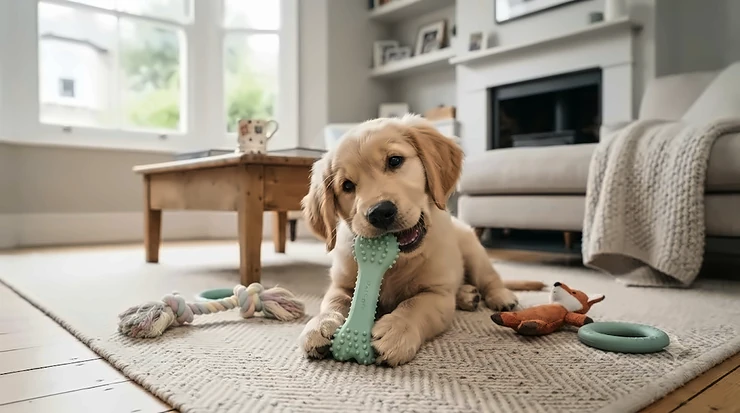
Somewhere between the eighth cushion corner and the third remote control casualty, most new puppy owners have the same realisation at 2am: this is not naughtiness, this is teething. What is soft chew toys for teething puppies, in plain terms? They’re chews built from forgiving rubber, fabric or plush — softer and more forgiving than standard adult dog toys — designed to cushion a puppy’s developing jaw and inflamed gums while they lose 28 baby teeth and grow 42 adult ones. Get the material wrong and you risk cracked baby teeth or a toy that’s shredded in minutes; get it right and you’ve bought yourself (and your sofa) some peace.
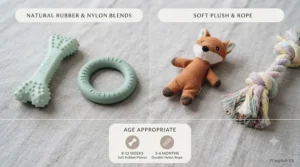
This guide skips the marketing fluff and goes straight to genuine product research: real specs, real aggregated review sentiment, and honest analysis of which soft chew toys for teething puppies are actually worth your money on amazon.co.uk in 2026. According to PDSA veterinary guidance, puppies lose their deciduous teeth from around four months old, with the full adult set settling in by roughly six months — which is exactly the window where the right chew makes the biggest difference. We’ve dug into seven real products, broken down what their specs actually mean for a sore-gummed pup, and built in practical guides you won’t find on a standard Amazon listing. Whether you’ve got a Cockapoo determined to destroy everything within reach or a nervous Whippet pup who just wants something soft to nuzzle, there’s something here that fits.
Let’s get into it — starting with a quick snapshot before the full breakdown.
Quick Comparison Table
| Toy | Material | Best For | Price Range |
|---|---|---|---|
| KONG Puppy Binkie | Soft natural puppy rubber | Nervous first-time chewers | Under £10 |
| Nylabone Puppy Chew Teething Pacifier | Soft flexible nylon-blend | Flavour-motivated chewers | Under £10 |
| Petstages Cool Teething Stick | Fabric shell, freezable filling | Cooling gum relief | £6-£10 range |
| KONG Puppy Goodie Bone | Soft natural puppy rubber | Treat-driven training | £6-£11 range |
| KONG Puppy Tires | Soft natural puppy rubber | Active fetch-and-chew pups | £8-£12 range |
| KONG Cozie Marvin the Moose | Plush fabric, minimal stuffing | Comfort and crate-time cuddling | £8-£14 range |
| Rosewood BioSafe Puppy Bone | Antimicrobial hygienic nylon-composite | Budget-conscious multi-dog households | Under £8 |
Looking at the spread above, there’s a clear split between rubber teethers built to survive a determined chewer and fabric or plush options built for softer, comfort-driven chewing styles. If your puppy is a demolition specialist in training, lean rubber; if they’re the type who just wants something to snuggle and gnaw gently, plush and fabric options like the Petstages Cool Teething Stick or KONG Cozie Marvin the Moose will likely get more genuine use. Price-wise, none of these seven cracks the £15 mark, so this isn’t a category where spending more automatically buys you more relief for those sore gums.
💬 Just one click — help others make better buying decisions too!😊
Top 7 Soft Chew Toys for Teething Puppies: Expert Analysis
1. KONG Puppy Binkie — pacifier shape soothes teething gums
The KONG Puppy Binkie takes its unusual dummy-like shape seriously — it’s designed to sit comfortably across a small jaw rather than requiring a puppy to gnaw side-on. It’s made from KONG’s dedicated puppy rubber formula, which is noticeably softer and more forgiving than the red rubber used in the adult KONG Classic. That distinction actually matters: vets and trainers routinely warn against giving young puppies the standard adult KONG, since its firmer compound can be harsh on baby teeth that are still loose in the gum. Here, the give in the rubber means a puppy can bite down hard without transmitting that pressure straight into a sensitive tooth root.
Under the hood, the hollow centre is stuffable — pack it with a little kibble, natural yoghurt or a smear of peanut butter, then freeze it, and you’ve turned a simple chew into 20 minutes of focused, cold relief. Reviewers consistently report that the frozen version is the toy that finally gets a fussy pup to settle during the worst teething flare-ups, though a handful note that determined chewers eventually work through the rubber at the base after several months of daily use.
Pros:
- ✅ Puppy-specific rubber is genuinely gentler on sore gums
- ✅ Stuffable and freezable for extended, soothing chew sessions
- ✅ Dishwasher-safe, which matters given how often it gets slobbered on
Cons:
- ❌ Base can weaken after months of heavy daily chewing
- ❌ Colour is randomly assigned (pink or blue), so no choosing
At around £6-£9, the KONG Puppy Binkie sits comfortably in impulse-buy territory, and given how often teething puppies gravitate toward it, that’s a fair trade for the relief it offers.
2. Nylabone Puppy Chew Teething Pacifier — dual-texture ring for flavour-driven chewers
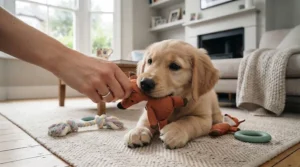
The Nylabone Puppy Chew Teething Pacifier takes a different approach: instead of one shape, you get two textured pacifier heads joined on a ring, both infused with a bacon flavour that runs through the material rather than sitting on the surface. That’s a meaningful detail — flavour-coated toys lose their appeal once the coating wears off, whereas flavour-through toys like this one keep motivating a chewer for the toy’s full lifespan.
The material is Nylabone’s softer teething-specific blend, explicitly not the harder nylon used in their adult Dura Chew range, and each pacifier head carries raised nubs designed to massage gums as a puppy works the toy between their jaws. Based on the spec comparison with harder Nylabone products, this one is squarely aimed at puppies with milk teeth still intact — Nylabone itself flags it as unsuitable once a dog has a full set of adult teeth and a stronger bite, at which point you’d want to size up to their moderate or extreme chew ranges.
Pros:
- ✅ Flavour runs through the material, not just the coating
- ✅ Two textures on one toy adds variety without buying two products
- ✅ Ring shape is easy for small paws to hold steady while chewing
Cons:
- ❌ Not designed to survive once adult teeth fully erupt
- ❌ Some reviewers note the ring connector is the first part to fray
Priced under £10, the Nylabone Puppy Chew Teething Pacifier earns its keep as a low-cost way to add variety to a teething toy rotation, especially for puppies who respond better to flavour than to texture alone.
3. Petstages Cool Teething Stick — freezable fabric for hot gums and hot days
Where the previous two toys lean on rubber, the Petstages Cool Teething Stick takes the cooling-relief route entirely. It’s a stuffed fabric stick with a cotton-poly shell that you soak in water and freeze; once frozen, the fabric turns pleasingly crunchy, giving a puppy a genuinely different sensory experience compared with rubber or nylon. What most buyers overlook about fabric teethers like this one is that the cold does more of the actual pain relief than the chewing itself — icy temperatures numb inflamed gum tissue in a way that a room-temperature toy simply can’t replicate.
The ribbon and streamer ends add texture variety and make the toy easy to bat around during play, not just chew sessions, which extends its usefulness beyond the strict teething window. Reviewers are honest about durability here: this isn’t marketed as an indestructible chew, and aggressive chewers can work a ribbon end loose within a single session, which is worth knowing before you leave a puppy unsupervised with it.
Pros:
- ✅ Crunchy-when-frozen texture gives genuinely different sensory relief
- ✅ Cold therapy directly reduces gum inflammation, not just distraction
- ✅ Doubles as a warm-weather cooling toy outside the teething window
Cons:
- ❌ Ribbon and streamer ends aren’t built for aggressive chewers
- ❌ Needs freezer planning ahead — no instant relief straight from the packet
At roughly £6-£10, the Petstages Cool Teething Stick is best treated as a supervised, rotate-in toy rather than an everyday unsupervised chew, but for cooling relief specifically, it does a job rubber can’t match.
4. KONG Puppy Goodie Bone — treat-driven rubber for training and teething together
The KONG Puppy Goodie Bone uses the same forgiving puppy rubber formula as the Binkie, but shapes it into a classic bone with two “Goodie Gripper” ends designed to physically trap small treats rather than let them fall straight out. That’s a genuinely useful engineering detail if you’re using chew time as part of crate training or independence training — a puppy who has to work at extracting the last bits of treat stays occupied noticeably longer than one whose toy empties in seconds.
Based on the spec comparison with the plain-ended Binkie, the Goodie Bone’s grippers make it the better choice specifically for extended, self-directed chew sessions rather than quick teething relief. Aggregated review sentiment on Amazon points to this being a favourite for owners managing separation anxiety alongside teething, since the combination of soothing rubber and slow-release treats tends to keep puppies settled during short absences.
Pros:
- ✅ Goodie Grippers extend chew time meaningfully versus plain rubber bones
- ✅ Same gentle puppy-specific rubber formula as the Binkie
- ✅ Useful dual-purpose tool for teething relief and training together
Cons:
- ❌ Less effective as a “just chew” toy without treats inside
- ❌ Available sizes run small to medium only, not suited to large-breed puppies
Sitting at roughly £6-£11 depending on size, the KONG Puppy Goodie Bone offers strong value if you want a toy that pulls double duty rather than one dedicated purely to gum relief.
5. KONG Puppy Tires — bouncy rubber teether built for fetch and freeze
The KONG Puppy Tires takes KONG’s puppy rubber formula and moulds it into a tyre shape with a stuffable inner track, which is the standout feature here: it’s one of the few soft chew toys for teething puppies genuinely built for active play rather than passive gnawing. The tyre shape gives it an erratic, unpredictable bounce when thrown, which channels a puppy’s energy into fetch as well as chewing — useful if your pup’s teething discomfort is tangled up with general puppy zoomies rather than purely calm chewing.
Here’s what the spec sheet won’t tell you, but reviewers note repeatedly: the inner track holds treats well enough to freeze into a genuinely long-lasting enrichment activity, not just a quick snack. That combination of physical exercise and mental stimulation through treat extraction is exactly the kind of enrichment the Animal Welfare Act 2006’s welfare needs framework points to when it talks about an animal’s ability to exhibit normal behaviour — chewing and retrieving both count.
Pros:
- ✅ Erratic bounce makes fetch sessions more engaging for young dogs
- ✅ Stuffable inner track supports both quick treats and frozen enrichment
- ✅ Combines physical exercise with the soothing benefit of chewing
Cons:
- ❌ Bulkier shape isn’t ideal for very small toy-breed puppies
- ❌ Higher bounce can send it under furniture during indoor play
At around £8-£12, the KONG Puppy Tires costs slightly more than the simpler shapes on this list, but the added fetch functionality justifies it for owners of higher-energy breeds.

6. KONG Cozie Marvin the Moose — plush comfort toy for gentle chewers and crate time
Not every teething puppy wants something to gnaw hard on constantly, and the KONG Cozie Marvin the Moose exists for exactly that gap in the market. It’s a soft plush teething toy in the truest sense: a squeaker-equipped, minimally stuffed comfort animal built from an extra layer of fabric for durability, positioned by KONG as suited to both a gentle round of fetch and quiet, cuddly downtime. For puppies whose teething discomfort shows up as clinginess or anxiety rather than aggressive chewing, a plush companion like this often does more good than another rubber toy ever could.
The minimal stuffing design is a deliberate mess-reduction choice — if a puppy does eventually work a seam open, there’s far less fluff to deal with than in a traditionally overstuffed plush toy. Reviewers describe it as a toy that survives moderate chewing far better than typical children’s-style soft toys, though it’s honestly framed by KONG itself as intended for gentle to moderate chewers, not power chewers who’ll go through a rubber KONG in months.
Pros:
- ✅ Doubles as a comfort object for crate time and separation anxiety
- ✅ Minimal stuffing means less mess if the seams eventually give
- ✅ Squeaker adds an extra sensory element beyond pure chewing
Cons:
- ❌ Not rated for aggressive or power chewers
- ❌ Needs closer supervision than solid rubber teethers as it wears down
Priced around £8-£14 depending on size, the KONG Cozie Marvin the Moose is less a teething-pain solution and more a whole-puppy comfort tool — arguably the most emotionally useful entry on this list, even if it’s not the most durable.
7. Rosewood BioSafe Puppy Bone — hygienic budget pick from a British brand
Closing out the list is the Rosewood BioSafe Puppy Bone, a hygienic, antimicrobial chew from Rosewood, a long-established British pet brand widely stocked across UK retailers. The headline feature is the antimicrobial treatment built into the material itself, which is designed to inhibit the growth of odour-causing bacteria on a toy that’s going to spend a lot of time coated in puppy saliva — a genuinely practical consideration that pure rubber or fabric toys don’t address at all.
It’s also mint-scented, which Rosewood positions as a secondary aid to fresher breath during the exact developmental window when puppy breath tends to get noticeably worse as new teeth push through. Based on the spec comparison with the rest of this list, this is the toy to reach for if hygiene and value matter more to you than novelty features like stuffable tracks or bounce — it’s a straightforward bone shape doing one job well, at the lowest price point here.
Pros:
- ✅ Antimicrobial treatment specifically targets bacterial odour build-up
- ✅ Mint scent offers a mild secondary freshening benefit
- ✅ Lowest price point on this list, ideal for multi-toy rotation
Cons:
- ❌ Fewer novelty features (no stuffing, freezing or squeaker)
- ❌ Sized primarily for small breeds rather than larger puppies
At under £8, the Rosewood BioSafe Puppy Bone is the easiest toy on this list to buy two or three of, which matters given how often vets recommend rotating chews to keep a teething puppy interested.
Puppy Comfort Chewing: A Practical Usage Guide
Buying the right toy is only half the job — how you introduce and manage it shapes whether it actually delivers puppy comfort chewing or just becomes another ignored item in the toy basket. Start by offering two or three different textures in the first week rather than one toy on repeat; puppies, like small children, often surprise you with which texture they gravitate to, and you won’t know until you’ve offered rubber, fabric and plush side by side.
For the first thirty days, build a simple freeze rotation: keep one rubber teether like the KONG Puppy Binkie stocked and stuffed in the freezer at all times, so you always have a cold option ready the moment you spot gum-sensitivity signs such as pawing at the mouth or reluctance to eat hard kibble. Swap toys every two to three days rather than leaving the same one down permanently — this single habit change is one of the most common fixes trainers recommend for puppies who “go off” a toy quickly, since novelty genuinely resets a puppy’s interest.
A common first-30-days mistake is leaving unsupervised access to a fabric or plush toy like the Petstages Cool Teething Stick or KONG Cozie Marvin the Moose — both are best used during active supervision until you understand your individual puppy’s chewing intensity. Inspect every toy weekly: check rubber for splitting at stress points, fabric for loosened seams, and replace anything showing wear before it becomes a choking risk rather than after.
Real-World Scenarios: Matching Toys to Your Puppy
Every puppy’s teething experience looks a little different, so it helps to think in terms of specific situations rather than a single “best” toy. If you’re a first-time owner with a nervous eight-week-old Cavapoo who startles at loud toys, the KONG Cozie Marvin the Moose paired with a frozen KONG Puppy Binkie covers both emotional comfort and physical gum relief without overwhelming a small, anxious pup during those first disorientating days home.
If instead you’re managing a boisterous four-month-old Labrador cross who chews through everything within an hour, lean into the KONG Puppy Tires and KONG Puppy Goodie Bone together — the fetch element burns physical energy while the treat-dispensing rubber gives a slower, more mentally engaging chew that tires the brain as well as the jaw. Budget matters here too: a family managing two puppies from the same litter on a tight budget benefits most from stocking multiple Rosewood BioSafe Puppy Bone units alongside a single shared frozen fabric toy, since duplicating the cheaper option avoids resource-guarding squabbles without blowing the budget on seven individual toys per pup.
Finally, for a small-breed puppy like a Chihuahua or Yorkshire Terrier with a genuinely tiny mouth and correspondingly fragile baby teeth, the Nylabone Puppy Chew Teething Pacifier and Petstages Cool Teething Stick are the gentler picks — both avoid the firmer bite resistance that some rubber shapes can present to the smallest breeds.
Problem → Solution: Common Teething Troubles Solved
Problem: My puppy chews everything except the toys I bought. This usually means texture mismatch, not a badly behaved dog. Rotate in a fabric option like the Petstages Cool Teething Stick if you’ve only been offering rubber, or vice versa — chewing preference is genuinely individual.
Problem: The toy gets ignored once it warms up from frozen. Solve this with a two-toy system: keep a spare in the freezer at all times so a fresh cold one is ready the moment the first warms through, rather than waiting for a single toy to refreeze.
Problem: My puppy swallowed a small piece of fluff or rubber. Stop use of that toy immediately and monitor closely; contact your vet if you see vomiting, lethargy or reduced appetite, since ingested material can occasionally cause a blockage requiring veterinary attention.
Problem: Gums still look inflamed despite regular chew sessions. Cold therapy is genuinely more effective than room-temperature chewing here — prioritise freezable options like the KONG Puppy Binkie or Petstages Cool Teething Stick over dry rubber shapes for a few days and reassess.
Problem: My puppy is nipping hands, not just chewing toys. This is a redirection training issue as much as a teething one. The moment teeth touch skin, calmly substitute a toy already in hand — reviewers and trainers alike note that consistency here matters more than which specific toy you use.
How to Choose Gentle Chew Toys for Young Puppies
Choosing gentle chew toys for young puppies well means looking past marketing claims and checking a handful of concrete details before you buy:
- Check the age or weight rating first. Every reputable brand marks a puppy-specific weight range; a toy sized for an adult Labrador is simply the wrong density for an eight-week-old Spaniel’s milk teeth.
- Prioritise puppy-specific rubber over adult formulas. As Blue Cross explains, puppies need to chew far more than adult dogs during teething and adolescence, so a softer, more forgiving compound reduces the risk of tooth fractures.
- Look for stuffable or freezable designs where possible. Cold, food-motivated chewing keeps a puppy engaged for longer sessions than a plain, unstuffed shape.
- Match texture to your individual puppy’s preference. There’s no universally “best” material — some pups favour rubber, others fabric or plush, and the only way to know is to offer a small rotation early on.
- Factor in supervision requirements honestly. Fabric and plush toys generally need closer supervision than solid rubber, so match your choice to how much hands-on time you realistically have.
- Buy more than one toy from the start. A rotation of two or three toys keeps novelty high and gives you a spare while one is in the freezer or the wash.
- Replace at the first sign of damage, not after. A split rubber seam or a loosened plush seam is a choking hazard waiting to happen, not a toy still worth one more session.
Plush vs Rubber Teethers: Which Is Better for Sore Gums?
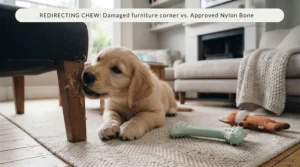
The plush vs rubber teethers debate isn’t really about which material is objectively superior — it’s about matching material to your individual puppy’s chewing style and emotional needs, and honestly, most households end up needing both. Soft plush teething toys like the KONG Cozie Marvin the Moose excel at providing comfort alongside physical relief; the give in the fabric and the presence of a squeaker or minimal internal stuffing make them genuinely soothing for anxious pups, and they double as a security object during crate training or car journeys.
Rubber teethers, by contrast, tend to win on raw durability and on delivering the cold-therapy benefit more reliably, since dense rubber holds a chill for noticeably longer once frozen than a thin fabric shell. The KONG Puppy Binkie, KONG Puppy Goodie Bone and KONG Puppy Tires all fall into this camp, and reviewers consistently rate them higher for lasting through a full teething cycle without needing replacement.
Where soft-bite teething toys genuinely shine is in that first fortnight home, before you’ve learned your puppy’s individual chewing intensity — a soft-bite toy is inherently lower-risk for baby teeth than jumping straight to a firmer chew. The practical answer for most households: start soft-bite and fabric-led in week one, then introduce a rubber option like the Binkie or Goodie Bone as you observe how hard your puppy actually bites down. Neither category “wins” outright; they solve different parts of the teething problem.
Gentle-on-Gums Materials: A Safety and Regulations Guide
Understanding gentle-on-gums materials matters more than most buyers realise, because “soft” as a marketing word covers a genuinely wide range of actual firmness. Puppy-specific rubber formulas, like the ones KONG uses across its puppy range, are chemically softer compounds than adult rubber — they’re engineered to flex under bite pressure rather than push back hard against a loose baby tooth. Nylon-blend teethers, such as the Nylabone puppy range, achieve softness differently, through a more flexible base material rather than a rubber compound, which is why Nylabone explicitly grades its own products by hardness level and recommends starting with their softest puppy tier.
Antimicrobial treatments, as used on the Rosewood BioSafe Puppy Bone, address a different safety dimension entirely: bacterial build-up on a constantly-drooled-on toy, rather than bite firmness. It’s worth noting this doesn’t replace regular washing — antimicrobial coatings reduce bacterial growth between cleans, they don’t eliminate the need for them.
From a broader welfare standpoint, providing appropriate chew items isn’t just a nice-to-have — it’s part of a dog’s legal welfare needs under UK law, as covered earlier. Alongside chew toys, ongoing dental care matters just as much once the adult teeth settle in; PDSA’s dental care guidance recommends starting to introduce gentle toothbrushing routines around this stage, so a chewing puppy grows into a dog with genuinely good oral hygiene rather than one who simply stops mouthing things. Practically, this means checking any chew toy regularly for degradation, removing anything with loose small parts a puppy could swallow, and never leaving a puppy unsupervised with a toy you haven’t already tested during an active chewing session.
Common Mistakes When Buying Soft Chew Toys for Teething Puppies
The single most common mistake is buying one toy and expecting it to solve teething on its own — as this guide’s product breakdown shows, different toys solve different parts of the problem (cold relief, texture variety, comfort, mental stimulation), and a single-toy household almost always ends up with a puppy chewing something it shouldn’t within days.
A second frequent error is buying adult-sized or adult-hardness toys “to save money later,” on the assumption a puppy will grow into them. In practice, an oversized or overly firm toy is more likely to be ignored entirely or, worse, to put unnecessary pressure on developing teeth. Sizing down and buying again as your puppy grows is the safer and, over a teething cycle, often the cheaper route once you factor in a toy that never actually got used.
Third, many new owners skip the freezing step entirely, not realising that a room-temperature rubber toy delivers meaningfully less gum relief than the same toy frozen. And finally, plenty of buyers assume “squeaky” or “plush” automatically means “durable enough to leave unsupervised” — as covered above, most soft-bite and plush options need more active supervision than solid rubber, not less.
Long-Term Cost and Maintenance: What Teething Toys Really Cost
Total cost of ownership for soft chew toys for teething puppies is genuinely low compared with most puppy essentials, but it’s not zero, and thinking it through upfront avoids surprise reordering. A realistic starter rotation — one rubber teether, one fabric or plush toy, and a budget bone like the Rosewood BioSafe Puppy Bone for backup — typically lands in the low-to-mid £20s in total, and most of these toys need replacing every one to three months during the peak teething window, depending on chewing intensity.
Maintenance is straightforward but easy to skip: rubber toys like the KONG Puppy Binkie and KONG Puppy Goodie Bone are dishwasher-safe or hand-washable, which matters given how much saliva and stuffed treat residue they accumulate. Fabric and plush toys generally need machine washing on a gentle cycle, and should be air-dried rather than tumble-dried if they contain a squeaker, since heat can degrade the internal mechanism. Budgeting for replacement rather than expecting any single toy to survive the full six-month teething period is the realistic long-term view — treating these as consumables, not one-off purchases, avoids both wasted money on toys that get abandoned and unnecessary risk from toys used well past their safe lifespan.
✨ Ready to build your puppy’s teething toy kit?
🔍 Compare the full line-up above and pick two or three that match your pup’s chewing style — a rotation beats a single “best” toy every time. Click through to check current pricing and availability before you buy.
What to Expect: Real-World Performance of Soft-Bite Teething Toys
Specs only tell part of the story, so here’s what actually tends to happen once these soft-bite teething toys meet a real puppy. In the first week, expect curiosity over intensity — most puppies investigate a new toy cautiously before settling into a genuine chewing pattern, so don’t judge a toy as “unpopular” after a single ignored session. By weeks two to four, texture preference usually becomes obvious: you’ll notice your puppy consistently reaching for either the rubber or the fabric option, which is useful information for future purchases.
During the peak discomfort phase, typically around four to five months as the largest adult teeth (the canines and molars) push through, expect noticeably more intense and prolonged chewing sessions across all toy types, alongside visible gum redness that a vet can confirm is normal rather than concerning. Frozen toys tend to see the sharpest jump in demand during this window — reviewers across multiple products in this guide report their puppy specifically seeking out the freezer-stored toy during flare-ups, almost as if they know which one brings the most relief. By six months, as the adult set settles in, expect general chewing intensity to plateau or shift toward harder adult-appropriate toys, which is the natural cue to start transitioning away from the soft, puppy-specific formulas covered in this guide.
Frequently Asked Questions
❓ How long does puppy teething actually last?
❓ Are soft plush teething toys safe to leave unsupervised?
❓ What's the difference between gentle chew toys for young puppies and adult dog toys?
❓ Should I freeze chew toys for a teething puppy?
❓ How many teething toys does one puppy actually need?
Conclusion
Teething is a genuinely uncomfortable few months for a puppy, and the right soft chew toys for teething puppies won’t eliminate that discomfort, but they will redirect it somewhere safer than your furniture, your shoes and your fingers. Across the seven products covered here, the pattern is consistent: rubber options like the KONG Puppy Binkie, KONG Puppy Goodie Bone and KONG Puppy Tires deliver durability and effective cold-therapy relief, fabric and plush picks like the Petstages Cool Teething Stick and KONG Cozie Marvin the Moose add comfort and sensory variety, and budget-friendly options like the Nylabone Puppy Chew Teething Pacifier and Rosewood BioSafe Puppy Bone make it affordable to build out a proper rotation rather than relying on a single toy.
There’s no single “best” pick that suits every puppy — the honest, research-backed advice is to start with a small mix of textures, watch what your individual puppy gravitates toward, and adjust from there as their chewing style and adult teeth develop. Whichever combination you land on, remember that supervision, regular inspection and timely replacement matter just as much as the toy itself.
Recommended for You
- Rubber Teething Rings for Puppies: 7 Best Picks (2026 UK Guide)
- Puppy Kong Toy Review 2026: 7 Tough Picks That Actually Last
- 7 Best Freezable Teething Toys for Puppies UK (2026 Guide)
Disclaimer: This article contains affiliate links. As an Amazon Associate, I earn from qualifying purchases. If you purchase products through these links, we may earn a small commission at no additional cost to you.
✨ Found this helpful? Share it with your friends! 💬🤗
