In This Article
There’s a particular kind of dread that comes with your dog climbing onto the sofa for a cuddle and breathing directly into your face. If you’ve been Googling mint flavoured dog chew toys at 11pm because your Labrador’s breath could strip paint, you’re in good company — it’s one of the most common (and most avoided) complaints among dog owners. The good news is that this is a genuinely solvable problem, and not just with a trip to the vet.
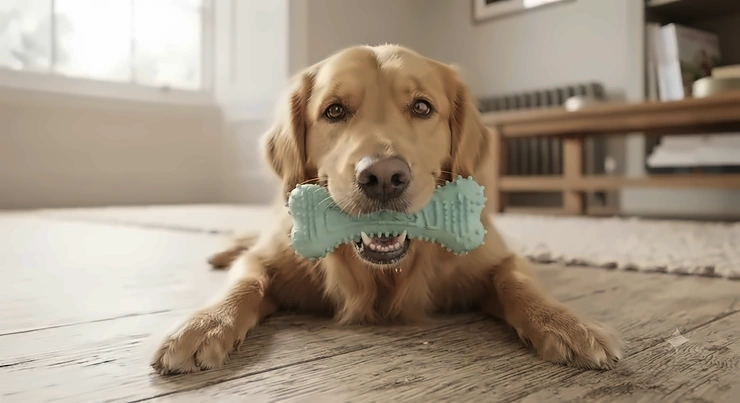
Mint flavoured dog chew toys work on two fronts at once: the physical act of gnawing helps loosen plaque before it hardens into tartar, and the mint itself gives a short-term breath boost your dog will actually enjoy, rather than tolerate. That combination — mechanical cleaning plus a flavour dogs seem drawn to — is why this category has grown from a niche pet-shop shelf to a proper subsection of the dental aisle.
This guide has done the legwork so you don’t have to scroll through hundreds of near-identical nylon bones. We’ve researched seven real, currently available products spanning puppies to powerful adult chewers, budget nylon rings to premium rubber balls, and we’ll walk through what the specs actually mean, what reviewers consistently say, and where mint flavoured chew toys fit into a wider dental routine. We’ll also tackle the question every careful owner should ask before buying anything mint-scented for their dog: is it actually safe? Let’s get into it.
What Is a Mint Flavoured Dog Chew Toy?
A mint flavoured dog chew toy is a durable toy — typically nylon or natural rubber — infused or coated with a dog-safe mint flavouring, designed to encourage chewing while helping freshen breath and support gum health. Unlike edible dental chews, it isn’t meant to be consumed, only gnawed.
Quick Comparison: Our Top Picks at a Glance
Before we dig into the full breakdown, here’s a snapshot of how the seven products stack up against each other on the criteria that actually matter when you’re stood in front of a screen trying to decide.
| Product | Material | Best For | Price Range |
|---|---|---|---|
| Rosewood Large Mint Bone | Nylon | Big dogs, budget buyers | Under £10 |
| Rosewood BioSafe Blue Puppy Bone | Nylon/antimicrobial | Teething puppies | Under £10 |
| Trixie Denta Fun Ball Mint | Natural rubber | Gentle chewers | Under £15 |
| Nylabone Power Chew Double Action | Nylon | Fussy dogs wanting variety | £10-£15 range |
| Apasiri Tough Chew Toy | Reinforced nylon | Aggressive chewers | £10-£20 range |
Looking at this table, the pattern that jumps out is that price doesn’t map neatly onto quality here — some of the cheapest options, like the Rosewood Large Mint Bone, are genuinely well suited to their job because nylon bones don’t need premium engineering to work. What you’re really paying for as the price rises is durability against powerful jaws and, in the case of rubber toys like the Trixie Denta Fun Ball Mint, a gentler chewing experience for dogs with sensitive teeth or gums.
💬 Just one click — help others make better buying decisions too! 😊
Top 7 Mint Flavoured Dog Chew Toys: Expert Analysis
We’ve picked these seven products to cover the full spread of what a UK household actually needs: a teething puppy, a small flat-dwelling terrier, a large garden-roaming Labrador, and everything in between. Every product here is real, currently sold, and genuinely mint-flavoured — not just mint-adjacent marketing copy.
1. Rosewood Large Mint Bone — best budget nylon bone for big chewers
The standout here is straightforward: at under a tenner, this is one of the most affordable ways to get a genuinely durable, mint-infused chew into a large dog’s routine. It’s a 17cm nylon bone built specifically for dogs weighing 20kg and over.
The nylon construction means the mint flavour runs through the material rather than sitting as a surface coating, so it doesn’t wear off after the first few sessions the way a sprayed-on flavour would. In practical terms, that means a dog who chews for twenty minutes at the end of a session still gets roughly the same taste experience as when they started, which matters if fresh breath is genuinely the goal rather than a marketing footnote.
Based on the spec comparison with similar nylon bones in this size bracket, this is squarely aimed at dogs who chew hard but don’t need the reinforced density of a specialist “power chewer” product — think Labradors, Spaniels and similar breeds rather than a Malinois with a grudge against furniture. What most buyers overlook about nylon bones generally is that the ridged surface texture does more of the plaque-scraping work than the flavour does; the mint is the reward, the ridges are the mechanism.
Reviewers consistently report that the mint scent is noticeable when the toy is first opened and fades gradually with use, which is standard for this product type rather than a flaw specific to this bone.
Pros:
- ✅ Genuinely affordable for a large-breed nylon chew
- ✅ Flavour runs through the material, not just the surface
- ✅ Ridged texture actively helps reduce plaque build-up
Cons:
- ❌ Nylon is rigid — not ideal for dogs with sensitive teeth
- ❌ Mint intensity fades with heavy, prolonged use
Priced under £10, this sits firmly in impulse-buy territory, and for a large dog owner wanting to trial mint chews without much financial risk, it’s a sensible starting point.
2. Rosewood Small Mint Ring — neatest mint pick for small-jawed dogs
The advantage of the ring shape over a bone is simple: it’s easier for a small dog’s jaw to get proper purchase on, especially for breeds with narrower muzzles like Dachshunds or Jack Russells. This is the small-dog counterpart to the bone above, built for dogs under 10kg.
At 9cm across, the ring is sized so it can’t easily be swallowed whole by a determined terrier, while still being light enough that a puppy-adjacent breed can carry it around the house without strain. The nylon build means it holds its shape and flavour over a long chewing lifespan rather than degrading into soft, swallowable fragments.
On paper, this means it’s best suited to small-to-medium adult dogs who chew moderately rather than obsessively — the nylon is firm enough that owners of extreme power chewers in this size bracket (some terriers genuinely fit that description) may want to size up or look at a reinforced alternative instead. What the spec sheet won’t tell you, but owner reports suggest, is that ring shapes tend to get “lost” under sofas and beds more than bone shapes, simply because they roll.
Aggregated review sentiment for this line of Rosewood nylon toys tends to highlight good value and long-lasting shape retention, alongside occasional comments that determined chewers wear the surface pattern down faster than expected.
Pros:
- ✅ Ring shape suits narrow or small jaws well
- ✅ Compact and genuinely portable for travel or the car
- ✅ Holds mint flavour for an extended chewing lifespan
Cons:
- ❌ Can roll away and get lost under furniture
- ❌ Not reinforced enough for the most determined small-breed chewers
At a similarly low price point to its large-dog sibling, this is an easy, low-commitment way to introduce a mint scented dog chew into a small dog’s toy box.
3. Rosewood BioSafe Blue Puppy Bone — best antimicrobial teether for puppies
What separates this from a standard mint chew is the BioCote antimicrobial coating, which the manufacturer states kills 99.99% of germs on the toy’s surface — a genuinely useful feature given how much puppies drool, drop and re-mouth their toys.
This is a puppy-specific bone, softer than the adult nylon ranges above, designed to soothe teething discomfort while the mint scent gives a gentle introduction to fresh-breath habits from a young age. The softer material matters here: puppy jaws and emerging teeth are far more delicate than an adult dog’s, and a toy that’s too hard risks damaging baby teeth rather than helping them.
Here’s what to weigh if you’re choosing between puppy chews: hygiene features like BioCote matter disproportionately for young dogs because their immune systems are still developing, and puppies mouth everything within reach almost constantly. This bone’s real strength is combining that hygiene angle with the mint flavour rather than treating them as separate selling points.
This product has a verified track record on Amazon, sitting at roughly 4.2 out of 5 stars across several hundred ratings, with recurring themes around good value and suitability for the teething stage specifically, alongside a smaller number of comments about the toy needing replacement once permanent teeth come through and chewing strength increases.
Pros:
- ✅ BioCote coating targets surface bacteria specifically
- ✅ Softer material appropriate for developing puppy teeth
- ✅ Genuinely budget-friendly for a puppy-specific product
Cons:
- ❌ Not durable enough once adult teeth and stronger jaws arrive
- ❌ Softer build means it needs replacing more frequently than adult chews
At around £3-£5, this is one of the cheapest entries on this list and arguably the easiest recommendation for anyone with a puppy under six months old.
4. Trixie Denta Fun Ball Mint — best rubber option for gentle gum massage
Where the nylon products above rely on rigidity, this natural rubber ball takes a completely different approach: small raised nodules across the surface are designed to massage gums as the dog chews, rather than simply scraping against enamel.
Made from 100% natural rubber and available at roughly 7cm diameter, it’s built with bounce and give, which makes it noticeably softer on the mouth than a hard nylon bone. The mint flavour is infused into the rubber itself rather than applied as a coating, following the same “flavour throughout” logic as the nylon products, but the material difference changes the whole chewing experience — softer, bouncier, and arguably more playful as a toy rather than purely a chew.
Based on the spec comparison with nylon alternatives, this is the better pick for older dogs, dogs recovering from dental work, or simply dogs whose owners prefer a softer material on welfare grounds. What most buyers overlook is that the bounce factor makes this genuinely dual-purpose — it doubles as a fetch or indoor play toy, which nylon bones generally don’t.
Reviewers of the wider Trixie Denta Fun range consistently mention the ball’s durability holding up well to moderate chewing and its usefulness as both a chew and a play toy, though rubber does compress under very strong jaws in a way nylon doesn’t.
Pros:
- ✅ Softer material genuinely better for gum health and welfare
- ✅ Doubles as a bouncy play toy, not just a static chew
- ✅ Mint flavour infused through the rubber, not sprayed on
Cons:
- ❌ Less durable than nylon under heavy power-chewing
- ❌ Can become slippery and harder to grip once wet
Typically priced in the £5-£15 range depending on size, this represents solid mid-tier value for owners prioritising comfort over raw toughness.
5. Trixie Denta Fun Rugby Ball Mint — best treat-stuffable mint chew for enrichment
The grooved surface is the headline feature here — those channels aren’t just texture, they’re designed to hold small treats or a smear of something tasty, turning a simple chew into a proper enrichment activity.
Made from the same natural rubber as the standard Denta Fun ball but in an oval rugby-ball shape roughly 11cm long, the grooves increase the surface area that contacts the teeth and gums during chewing, which in theory improves the plaque-scraping action compared with a smooth ball. The mint flavour sits within the rubber, giving the same “fresh from first chew to last” consistency as the other Trixie products on this list.
What the spec sheet won’t tell you, but the shape makes obvious, is that this toy is genuinely better for dogs who get bored quickly — stuffing the grooves with a little cheese or a dab of peanut butter (checking it’s xylitol-free first) extends engagement time considerably compared with the plain ball. On paper this means it suits dogs left alone for short stretches, or households wanting a toy that doubles as a low-effort training reward.
Aggregated feedback on this product line highlights the treat-holding grooves as a genuine point of difference from competitors, with a smaller number of reviewers noting the oval shape can roll unpredictably on hard floors compared with a round ball.
Pros:
- ✅ Grooved surface holds treats for enrichment-style chewing
- ✅ Natural rubber is gentler on teeth than hard nylon
- ✅ Oval shape genuinely harder for most dogs to gulp down whole
Cons:
- ❌ Rolls unpredictably on hard flooring
- ❌ Grooves require regular washing to avoid residue build-up
Sitting in a similar £5-£15 bracket to its round sibling, this is worth the small premium if enrichment value matters as much as dental benefit in your household.
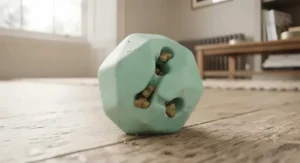
6. Nylabone Power Chew Double Action — best dual-flavour pick for fussy dogs
This one takes a different tack entirely: rather than mint throughout, it pairs a bacon-flavoured exterior with a mint-flavoured centre, so a dog gets an immediately appealing outer flavour and a fresher-breath payoff as they chew deeper into the toy.
Built from Nylabone’s durable nylon blend, the dual-flavour design is a genuine point of engineering rather than a gimmick — the two flavour zones are moulded into different sections of the toy rather than simply mixed together. Reviewers consistently note that this two-stage flavour structure keeps notoriously fussy dogs interested for longer than single-flavour alternatives, because the bacon exterior does the initial “hook” and the mint centre sustains interest once the novelty wears off.
Here’s what to weigh: if you’ve previously bought a mint flavoured toy and had your dog sniff it once and walk away, dual-flavour designs like this one are specifically aimed at solving that exact problem. Based on the spec comparison with single-note mint chews, this is the sensible pick for dogs who are food-motivated but mint-indifferent on their own.
Aggregated review sentiment for Nylabone’s Power Chew range broadly praises durability and flavour retention over time, with occasional comments noting that, like all nylon chews, it’s genuinely hard and unsuitable for dogs with existing dental damage.
Pros:
- ✅ Dual-flavour structure appeals to fussier dogs
- ✅ Durable nylon holds up well to sustained daily chewing
- ✅ Mint centre still delivers genuine breath-freshening benefit
Cons:
- ❌ Rigid nylon unsuitable for dogs with weak or damaged teeth
- ❌ Bacon exterior may not suit dogs on a restricted diet
Generally priced in the £10-£15 range, this sits at the mid-point of our list and earns its place through genuine problem-solving rather than novelty alone.
7. Apasiri Tough Chew Toy — toughest mint chew for power chewers
If your dog can demolish a standard nylon bone in a single sitting, this is the entry built specifically for that problem: a reinforced nylon construction aimed squarely at aggressive chewers, available in a mint flavour option alongside bacon, peanut butter and beef.
Sized for small or medium/large dogs, the reinforced formula uses a denser nylon blend than standard bones, which is the entire point — it’s designed to resist the kind of sustained, powerful chewing that would reduce a budget toy to shards within days. The mint flavour variant follows the same infused-not-coated approach as the other nylon products here, meaning the fresh-breath element survives the toy’s extended lifespan rather than disappearing after week one.
What most buyers overlook about “indestructible” claims generally is that no nylon toy is genuinely indestructible — the honest framing is “significantly more resistant” rather than immune to damage, and this product should still be inspected regularly for cracks or sharp edges, particularly around the joints where reinforcement material meets the main body. Reviewers of tough-chew nylon products in this category consistently flag genuine durability gains over standard bones as the main selling point, alongside the expected higher price tag.
Pros:
- ✅ Reinforced nylon genuinely outlasts standard bones for hard chewers
- ✅ Mint flavour holds up over the toy’s extended lifespan
- ✅ Available across multiple sizes for small to large power chewers
Cons:
- ❌ Noticeably firmer, which some dogs’ teeth may struggle with
- ❌ Sits at the higher end of the price bracket for this category
Typically priced from around £10 up to £20 depending on size, this is the toy to reach for once you’ve established that your dog genuinely destroys standard chews rather than merely enjoying them.
How to Choose Mint Flavoured Dog Chew Toys
Picking the right one isn’t really about finding the “best” product in the abstract — it’s about matching a toy’s material, size and flavour intensity to your specific dog. Here’s the framework we’d actually use:
- Match material to chewing style first, flavour second. A gentle chewer does better with natural rubber; a power chewer needs reinforced nylon regardless of how appealing the mint flavour is, because a destroyed toy is a choking risk, not a dental aid.
- Size up rather than down. A toy that fits entirely inside your dog’s mouth is a swallowing hazard — always choose the size bracket above your dog’s current weight if they’re between categories.
- Check the ingredient framing, not just the word “mint.” Genuine dog-safe mint flavouring is different from human mint products, which can contain xylitol — more on this below.
- Consider your dog’s dental history. Dogs with existing gum disease or loose teeth generally do better with softer rubber options than rigid nylon.
- Think about supervision realistically. If a toy is only ever used unsupervised, prioritise durability over novelty features like treat-holding grooves.
- Rotate rather than replace. Introducing two or three different mint scented dog chews and swapping them weekly keeps interest higher than relying on a single toy indefinitely.
- Set a replacement trigger, not a replacement date. Swap the toy out the moment you see splintering, deep gouges or exposed rough edges — not on a fixed monthly schedule.
Mint Scented Dog Chews vs Traditional Flavoured Chews
It’s a fair question: why choose mint scented dog chews over the beef, chicken or bacon-flavoured toys that dominate most pet shop shelves? The honest answer is that they’re solving slightly different problems, and the best household toy box usually has both.
Traditional meat-flavoured chews are optimised for one thing: getting a dog interested in chewing at all. That’s genuinely valuable, particularly for anxious or under-stimulated dogs, but it does nothing specific for breath. Minty dental chew toys are optimised for a secondary benefit on top of the same chewing mechanism — the flavour itself contributes a short-term freshening effect, and several ranges (like the Trixie and Rosewood products above) pair that with textured surfaces specifically designed to disrupt plaque.
| Factor | Mint Flavoured Chews | Traditional Flavoured Chews |
|---|---|---|
| Primary appeal | Novelty flavour + freshness | Strong meaty scent |
| Breath benefit | Direct and immediate | Minimal to none |
| Best For | Dogs with noticeable bad breath | Dogs needing a chewing “hook” |
| Fussy-dog appeal | Moderate | Generally higher |
What this comparison actually tells you is that mint flavoured dog chew toys aren’t a replacement for meat-flavoured options in a fussy or anxious dog’s routine — they’re an addition, best introduced once a dog already has an established chewing habit. Owners who try to switch a food-motivated dog straight to mint with no meaty transition period sometimes find the toy gets ignored, which is exactly the gap dual-flavour products like the Nylabone Power Chew Double Action are built to close.
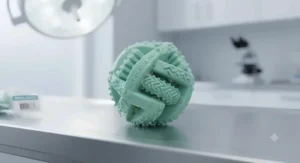
The Mint and Dental Health Link: What the Science Actually Says
It’s worth separating marketing language from the genuine evidence here, because “mint” and “dental health” get bundled together a lot more casually in pet product copy than the underlying science actually supports.
The mechanical chewing action is the part with the strongest evidence behind it. According to the PDSA’s guidance on dental disease in dogs, plaque is a soft, sticky bacterial film that hardens into tartar over time if it isn’t disrupted regularly, and dental disease affects a striking proportion of dogs, often without obvious symptoms in the early stages. Chewing on an appropriately textured toy helps physically dislodge some of that soft plaque before it mineralises, which is the genuine dental mechanism at play — the mint flavour itself doesn’t dissolve plaque.
What mint contributes is different: a short-term masking and freshening effect on breath odour, plus (in some dogs) an incentive to chew for longer, which indirectly increases the mechanical benefit. The PDSA also notes that dogs tend to chew mainly with their back teeth, meaning chew toys — mint-flavoured or otherwise — do little for the front incisors and canines, which is exactly where daily brushing still earns its place as the genuine gold standard.
Reviewers and owners consistently report a noticeable, if temporary, breath improvement after chewing sessions with minty dental chew toys, which lines up with how flavour and odour perception actually work rather than suggesting any deeper clinical effect. Treat mint chews as one part of a wider routine — alongside brushing and regular vet checks — rather than a standalone dental solution.
Breath Freshening Benefits: How Fresh Breath Flavour Toys Actually Work
The breath freshening benefits of a mint chew toy come from two overlapping mechanisms, and understanding both helps set realistic expectations rather than disappointment.
First, there’s the direct sensory effect: mint compounds have a distinctive, strong scent that temporarily overlays the odour compounds produced by oral bacteria, in much the same way a human mint sweet masks coffee breath rather than curing its cause. This effect is real but genuinely short-lived — expect noticeably fresher breath for a stretch after a chewing session, fading back toward baseline over the following hours.
Second, and more durable, is the indirect benefit from increased chewing time. Because dogs tend to find mint scented dog chews more engaging than an unflavoured equivalent, they chew for longer, which mechanically removes more soft plaque — and plaque bacteria are one of the primary sources of persistent bad breath in the first place. In that sense, the flavour’s real value is less about masking and more about motivation.
What most owners overlook is that fresh breath flavour toys work best as part of a routine rather than a one-off fix. A single chewing session won’t undo weeks of plaque build-up, but a daily habit — even just ten to fifteen minutes — compounds meaningfully over a few weeks. If breath odour persists or worsens despite a consistent chewing routine, that’s a signal worth raising with a vet, since the PDSA notes that dental disease can develop without obvious pain signs that owners would otherwise catch early.
Cooling Mint Sensation: Why Dogs Actually Respond to It
There’s a genuinely interesting bit of biology behind why dogs seem drawn to the cooling mint sensation in these toys, and it’s not simply “dogs like mint” as a flat fact.
Menthol, the compound largely responsible for mint’s cooling effect in humans and dogs alike, works by activating a specific cold-sensing receptor in the mouth (TRPM8, for the curious), which triggers a cooling sensation independent of actual temperature. Dogs have the same receptor family, which is part of why a mint-flavoured toy can produce a genuinely novel sensory experience compared with a plain rubber or nylon chew — it’s not just taste, it’s a distinct physical feeling in the mouth.
That novelty appears to be a meaningful driver of engagement. What the spec sheet won’t tell you, but behavioural patterns suggest, is that dogs who’ve become bored of a standard chew toy sometimes show renewed interest when a mint variant is introduced, purely because the sensory profile is unfamiliar rather than because of any nutritional or flavour preference in the traditional sense. This is one reason rotating between a mint toy and a meat-flavoured toy tends to sustain interest better than sticking with either exclusively.
It’s worth noting, though, that individual dogs vary considerably here — some show strong enthusiasm for the cooling mint sensation, while others are indifferent or even mildly put off by strong menthol scents, particularly dogs with a more sensitive sense of smell. If your dog falls into the latter camp, a milder mint-infused rubber toy (rather than a strongly scented nylon one) is generally the gentler starting point.
Practical Usage Guide: Getting the Most from Fresh Breath Flavour Toys
Buying the right toy is only half the job — how you introduce and manage it makes a genuine difference to both dental outcomes and how long the toy survives.
First introduction: Let your dog investigate the toy on their own terms rather than pushing it into their mouth. Place it near their existing toys and let curiosity do the work; most dogs will sniff, mouth and eventually chew within the first day or two.
Building a routine: Aim for short, consistent sessions — ten to fifteen minutes once or twice daily — rather than leaving the toy out permanently. Consistent, moderate use both maximises the plaque-disrupting benefit and reduces the risk of a single marathon chewing session damaging the toy or a tooth.
Common first-30-days mistakes: The most frequent misstep is buying a size based on breed stereotype rather than actual jaw size — a lean, narrow-jawed large dog may need a smaller product than a stockier medium breed. The second is leaving new toys unsupervised before you’ve established how your specific dog chews; the first week is when you learn whether you’ve got a gentle chewer or a determined one.
Maintenance: Nylon toys benefit from an occasional wash in warm soapy water to remove saliva build-up and food residue, particularly for grooved designs like the Trixie Denta Fun Rugby Ball Mint, where debris can collect in the channels. Rubber toys should be checked regularly for surface tears, since small pieces can be more easily bitten off than from solid nylon.
Optimisation trick: Lightly dampening a nylon chew and freezing it for an hour intensifies both the texture (useful for teething puppies) and the perceived cooling mint sensation, giving a slightly stronger sensory experience during hot weather or after exercise.
Real-World Scenarios: Matching the Right Chew to Your Dog
Sometimes the clearest way to choose is to see yourself in a specific situation, so here are three common households and the products that genuinely fit.
The busy commuter with a Cocker Spaniel. If you’re out of the house nine to five with a moderate chewer who’s occasionally destructive when bored, the Trixie Denta Fun Rugby Ball Mint is a strong fit — the treat-holding grooves extend engagement time meaningfully, and natural rubber is gentle enough for unsupervised use with a dog who chews but isn’t a demolition specialist.
The first-time puppy owner with a Cockapoo pup. Teething is the priority here over dental “optimisation” — the Rosewood BioSafe Blue Puppy Bone is built for exactly this stage, with a softer material that won’t damage emerging teeth and an antimicrobial coating that matters given how much puppies mouth everything in the house.
The rural household with a working-line Labrador. A dog getting several hours of exercise and mental stimulation a day, with a genuinely strong jaw, needs durability above all else. The Apasiri Tough Chew Toy in mint flavour, paired with the Rosewood Large Mint Bone as a rotation option, gives both the reinforced toughness for daily heavy use and a budget-friendly backup for lighter sessions.
Notice that none of these scenarios rely on a single “best” product — the right answer changes with jaw strength, supervision availability and life stage, which is exactly why building a small rotating toy box beats committing to one item.
Common Mistakes When Buying Mint Flavoured Dog Chew Toys
A handful of buying mistakes come up repeatedly, and most are avoidable with a little forethought.
Buying on flavour alone, ignoring chewing style. A strongly mint-scented toy that’s too soft for a power chewer will be destroyed within days regardless of how appealing the flavour is — durability should be the first filter, flavour the second.
Assuming “mint flavoured for dogs” and “human mint products” are interchangeable. They are not, and mixing the two up is a genuine safety issue rather than a minor preference — see the safety section below.
Skipping the size guide. Manufacturers size these toys against dog weight for a reason; a toy sized for a 10kg dog given to a 30kg dog either poses a choking risk (too small) or fails to engage the dog properly (too large for effective chewing leverage).
Expecting a toy to replace brushing entirely. As the PDSA’s dental care advice for dogs makes clear, brushing remains the most effective single intervention for canine dental health — chew toys are a genuinely useful supplement, not a substitute.
Not rotating stock. Leaving the same toy out indefinitely accelerates wear on one item while the rest of the toy box goes untouched, and it also means flavour fatigue sets in faster for dogs who respond well to novelty.
Safety, Regulations and Mint Toxicity: What UK Owners Need to Know
This is the section most guides skip, and it’s arguably the most important one if you’re specifically drawn to mint flavoured products.
The key distinction to understand is between dog-formulated mint flavouring and human mint products. Genuine pet-industry mint flavouring, used in tiny, carefully controlled concentrations in products like the ones reviewed above, is manufactured specifically to be safe for dogs to mouth and occasionally lick. Human mint products — chewing gum, breath mints, toothpaste, peppermint sweets — are an entirely different matter, and should never be substituted or offered as a “cheaper” alternative.
The specific danger is xylitol, a sugar substitute used widely in sugar-free human mint products, which is highly toxic to dogs even in small amounts and can cause a rapid, dangerous drop in blood sugar. This isn’t a reason to avoid mint flavoured dog chew toys — reputable pet brands don’t use xylitol in their formulations — but it is a strong reason to keep human mint products, gum and toothpaste entirely separate from anything your dog might access.
Beyond flavour-specific concerns, general toy safety principles still apply. As Pets at Home’s toy safety guidance notes, toys should be sized so a dog can hold them comfortably without being able to close their mouth fully around them, and any toy showing signs of significant wear, cracking or missing pieces should be replaced immediately rather than left in circulation “until it’s really bad.” UK dog toys aren’t regulated to the same rigorous standard as children’s toys, which puts more responsibility on owners to supervise new toys during the first few uses and inspect regularly thereafter.
If your dog does ever get hold of a genuinely human mint product — a dropped mint sweet, a stick of gum, or spat-out toothpaste — treat it as a potential emergency rather than a wait-and-see situation, and contact your vet promptly, particularly if the ingredient list is unknown.
Long-Term Cost and Maintenance
It’s tempting to compare these products purely on sticker price, but the more useful figure is cost-per-month of realistic use, which varies more than the upfront price suggests.
A budget nylon bone like the Rosewood Large Mint Bone, priced under £10, that survives six to nine months of daily use for a moderate chewer works out to roughly £1-£1.50 a month — genuinely excellent value. The same toy given to a determined power chewer might last a matter of weeks, at which point the effective monthly cost climbs sharply and a reinforced product like the Apasiri Tough Chew Toy becomes the more economical choice despite its higher upfront price, simply because it survives proportionally longer against that same chewing style.
Rubber toys like the Trixie Denta Fun Ball Mint sit in an interesting middle ground: the material itself is generally more expensive to manufacture than basic nylon, but the gentler chewing experience it encourages can extend the toy’s working life for dogs who don’t need maximum toughness, partially offsetting the higher initial outlay.
The genuinely hidden cost in this category isn’t the toy price at all — it’s the downstream dental cost of skipping preventive chewing altogether. Professional dental treatment for dogs with advanced dental disease typically runs into hundreds of pounds under general anaesthetic, which puts even the pricier end of this product category into perspective as a comparatively small ongoing investment.
FAQ
❓ Are mint flavoured dog chew toys safe for all dogs?
❓ How long does the mint flavour actually last?
❓ Can mint chew toys replace brushing my dog's teeth?
❓ Is peppermint the same as the mint flavouring used in dog toys?
❓ What size mint chew toy should I buy for my dog?
Conclusion
Mint flavoured dog chew toys occupy a genuinely useful middle ground: not a replacement for brushing, not a miracle cure for chronic bad breath, but a real, evidence-backed way to encourage more chewing time and a noticeable — if temporary — freshness boost, wrapped around a natural behaviour most dogs already want to engage in anyway.
Across the seven products covered here, the pattern worth remembering is that material should drive your decision before flavour does. A puppy needs the Rosewood BioSafe Blue Puppy Bone‘s softer build far more than it needs a specific flavour; a committed power chewer needs the Apasiri Tough Chew Toy‘s reinforcement regardless of how appealing mint sounds on the packaging. Once you’ve matched material and size to your dog’s actual chewing style, the mint flavour becomes a genuine bonus rather than the deciding factor — better breath, more engaged chewing, and one more small, manageable piece of a wider dental care routine.
Whichever product you land on, pair it with regular brushing where you can manage it, keep an eye on wear and tear, and remember that the biggest safety rule here isn’t about the toys themselves — it’s about keeping human mint products firmly out of paw’s reach.
Recommended for You
- Peanut Butter Flavoured Dog Toys: 7 Brilliant Picks for 2026
- Beef Flavoured Dog Chew Toys: 7 Best UK Picks for 2026
- Chicken Flavoured Chew Toys for Dogs: 7 Best UK Picks (2026)
Disclaimer: This article contains affiliate links. As an Amazon Associate, I earn from qualifying purchases. If you purchase products through these links, we may earn a small commission at no additional cost to you.
✨ Found this helpful? Share it with your friends! 💬🤗
