In This Article
If you’ve ever watched a nine-week-old Chihuahua try to demolish a table leg with all the confidence of a Rottweiler, you’ll know exactly why teething toys for small breed puppies deserve more thought than “grab whatever’s cheapest at the pet shop.” Toy and small breeds don’t just need a scaled-down version of a big dog’s chew — they need something built around a jaw the size of a fifty pence piece, gums that are genuinely sore, and teeth so tiny they can vanish into a carpet without a trace.
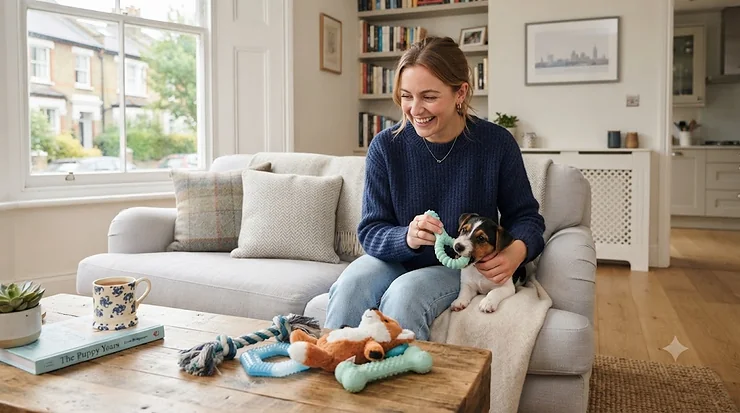
So, what is a teething toy for small breed puppies? In short, it’s a chew designed specifically for dogs under roughly 10kg, with a smaller circumference, softer give, and a shape their jaw can actually manage — built to soothe sore gums during the roughly six-month teething process rather than test them against something meant for a Labrador.
This matters more than most new owners expect. As the Royal Kennel Club notes, mouthing and chewing are entirely natural puppy behaviours that need a proper outlet rather than a telling-off. Give a toy breed puppy the wrong outlet — something oversized, rock hard, or shredable — and you’ll end up with either a bored pup ignoring it completely or, worse, a vet bill. Get it right, and you’ll save your skirting boards, your slippers, and quite possibly your sanity.
We’ve spent time researching real, currently available products across amazon.co.uk, cross-checking genuine specifications against aggregated customer review sentiment, so you’re not just buying whatever has the shiniest packaging. Below you’ll find seven real teething toys for small breed puppies, honestly compared, plus everything from a proper small breed teething timeline to the mistakes that trip up even well-meaning owners.
Quick Comparison Table
Short on time? Here’s the lightning-round version before we get into the detail.
| Product | Best For | Price Range | Material |
|---|---|---|---|
| KONG Puppy Toy X-Small | Gentle all-rounder, treat-stuffing | £6-£9 | Natural rubber |
| Nylabone Puppy Sensory Chew Teething Ring | Freezer relief, gum massage | £8-£11 | Textured nylon/thermoplastic |
| Nylabone Puppy Wishbone X-Small | Easy-grip first chew | £5-£8 | Flexible nylon blend |
| Benebone Puppy 2-Pack Dental Chew/Wishbone | Determined chewers, longevity | £14-£18 | Nylon with real bacon flavour |
| Pupstages Cool Teething Stick | Very young pups (0-6 months) | £7-£10 | Soft textile-wrapped freezer toy |
| Rosewood Nylon Dog Chew | Budget first toy | £3-£5 | Chicken-flavoured nylon |
| Rosewood Chubleez Plush Teether | Comfort chewing, squeak-lovers | £7-£10 | Plush with squeaker |
Looking at the spread above, there’s a genuine budget-to-premium range here, and no single toy wins every category — the Rosewood Nylon Dog Chew is the cheapest way to test whether your puppy is even a “chewer,” while the Benebone Puppy 2-Pack costs three times as much but is built to survive weeks rather than days. For very young or very gentle chewers, the Pupstages Cool Teething Stick and Rosewood Chubleez Plush Teether offer softer alternatives that won’t feel like hard work on sensitive new gums.
💬 Just one click — help others make better buying decisions too!😊
Top 7 Teething Toys for Small Breed Puppies: Expert Analysis
We’ve picked a genuine mix of budget, mid-range, and premium options, plus different textures — rubber, nylon, plush, and freezer-style — because no single material suits every toy breed puppy. A gentle-mouthed Cavalier and a determined Jack Russell terrier mix have completely different chewing styles, even at the same bodyweight.
1. KONG Puppy Toy X-Small — gentle rubber that bounces, squeaks and hides treats
The standout here is versatility: this isn’t just a chew, it’s a treat-stuffable toy that doubles as a fetch item once the teething phase eases off. Made from KONG’s softest rubber formulation, specifically softer than their adult-dog range, it’s designed to flex under gentle bite pressure rather than fight back against sore gums. The X-Small size (roughly 7.5cm) suits breeds under about 4.5kg, such as Chihuahuas, Yorkshire Terriers and Pomeranians, while the Small size stretches to around 9kg.
Based on the spec comparison with other rubber chews on the market, what stands out is the erratic bounce — a small but genuinely useful feature, since it keeps a puppy engaged with the toy rather than abandoning it after two minutes. This is best suited to puppies who are moderate chewers rather than determined destroyers; it’s a comfort chew and enrichment toy first, a heavy-duty chew second.
Reviewers consistently report that the toy holds up well for small breeds specifically, describing it as long-lasting for tiny dogs even where the same range disappoints owners of bigger, more aggressive chewers. A recurring theme in aggregated feedback is that some buyers find the X-Small genuinely tiny — appropriate for its stated weight range, but worth double-checking against your own puppy’s current size rather than their expected adult size.
Pros:
- ✅ Soft rubber gentle enough for very sore gums
- ✅ Stuffable design extends engagement time
- ✅ Doubles as a bounce/fetch toy later on
Cons:
- ❌ Some owners find the X-Small runs small
- ❌ Not intended for determined, aggressive chewers
Sitting in the £6-£9 range, this is solid mid-range value — you’re paying a little extra over basic nylon chews for genuine treat-stuffing versatility that continues to earn its keep well past the teething phase.
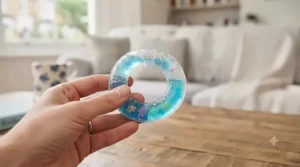
2. Nylabone Puppy Sensory Chew Teething Ring — freezes for extra cooling gum relief
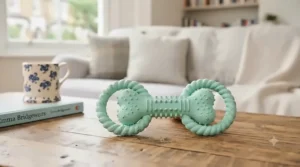
What makes this one worth a second look is the freezer trick: soak it in water, pop it in the freezer, and the textured ring turns an even more vivid colour once it’s ready, giving you a visual cue rather than guesswork. That’s a genuinely practical touch for anyone who’s ever forgotten a chew toy at the back of the freezer for three weeks.
The ring shape is designed with small raised bristles running through the material, working a little like a soft toothbrush against the gumline as your puppy chews. It’s rated for puppies up to roughly 11kg with no adult teeth yet, and the chicken flavour runs through the whole toy rather than sitting on the surface, so it doesn’t wear off after a few sessions the way surface-coated flavourings tend to.
What most buyers overlook about ring-shaped chews specifically is that the circular design gives a puppy multiple grip angles at once — useful for smaller jaws that struggle to get proper purchase on a straight stick shape. Aggregated review sentiment for this line is broadly positive on durability for the intended teething-only life stage, with the most common caveat being that, like all nylon-based chews, it should be swapped out once adult teeth are fully in and chewing strength increases.
Pros:
- ✅ Freezer-ready for genuine cooling gum relief
- ✅ Flavour runs throughout, not just on the surface
- ✅ Textured ring shape suits multiple small grip angles
Cons:
- ❌ Designed specifically for the teething stage only
- ❌ Not rated for adult dogs or power chewers
Priced around £8-£11, this sits comfortably in the mid-range bracket, and the freezer function alone makes it worth considering for anyone dealing with a puppy in the more painful 16-24 week teething window.
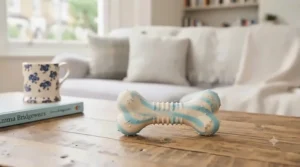
3. Nylabone Puppy Wishbone X-Small/Petite — curved shape built for tiny paws to hold
The wishbone shape is the whole story here: it’s curved specifically so a puppy without much paw dexterity can pin it down and get proper chewing leverage, rather than watching it skid away across the kitchen floor. That sounds like a small detail until you’ve watched a puppy get genuinely frustrated chasing a straight chew stick around a hard floor for the tenth time.
Made from a flexible nylon blend rather than the harder nylon used in adult Nylabone ranges, it’s pitched at the X-Small/Petite size for puppies without adult teeth, generally under about 4.5-5kg. The chicken flavour is baked through the material, and the surface has a slightly matte, easy-grip texture rather than being smooth and slippery.
Here’s what the spec sheet won’t tell you, but reviewers note: the softer flex of the puppy-specific range genuinely does feel different in hand compared with adult Nylabone chews, and several buyers comparing the two directly mention their puppy engaged with the Puppy Wishbone far more readily. On the flip side, a fair number of aggregated reviews mention colour fading or the toy picking up stains from carpets and grass relatively quickly — cosmetic rather than functional, but worth knowing if that bothers you.
Pros:
- ✅ Curved shape easy for small paws to pin down
- ✅ Softer flex designed for pre-adult-teeth puppies
- ✅ Flavour baked through rather than surface-coated
Cons:
- ❌ Colour can fade or stain with regular use
- ❌ Needs replacing once adult teeth fully erupt
At roughly £5-£8, this is one of the more affordable purpose-built options here, making it a sensible first purchase before you know your puppy’s chewing style.
4. Benebone Puppy 2-Pack Dental Chew/Wishbone — real bacon flavour built to last weeks, not days
The standout feature is durability paired with genuine flavour infusion — this isn’t a toy dusted with scent, it’s made with real bacon incorporated into the nylon itself, which explains why it consistently tops “won’t get ignored” lists among puppy chews. The two-pack includes both the wishbone and dental chew shapes, giving your puppy two different grip and texture experiences from a single purchase.
Sized specifically as “Tiny,” this is Benebone’s smallest option, built for genuinely small and toy breed puppies rather than being a scaled-down large-breed chew. The ridged dental design is intended to help scrape away soft plaque as your puppy gnaws, while the softer puppy-specific nylon blend (compared with Benebone’s adult range) is meant to be forgiving on developing teeth.
Based on the spec comparison with the other nylon chews in this list, what justifies the higher price here is longevity — reviewers consistently report these lasting considerably longer than cheaper nylon alternatives, with “weeks rather than days” being a common phrase in aggregated feedback. The trade-off, and it’s a real one, is that nylon this tough can occasionally be too hard for the very youngest or most sensitive-gummed puppies; several reviews specifically flag it as better suited once a puppy is a confident, established chewer rather than a brand-new one.
Pros:
- ✅ Real bacon flavour infused throughout the nylon
- ✅ Two shapes in one pack for grip variety
- ✅ Reviewers report significantly longer lifespan
Cons:
- ❌ Firmer nylon may be too hard for very young pups
- ❌ Higher price point than basic nylon chews
At around £14-£18 for the pack, this is the premium pick on this list — but divided across two toys and weeks of use, the cost-per-week works out competitively against toys that need replacing every fortnight.
5. Pupstages Cool Teething Stick — soft freezer relief for puppies under six months
This one earns its place through gentleness: a soft, textile-wrapped stick rather than a hard chew, designed specifically for the 0-6 month bracket when gums are at their most tender. Soak it, freeze it, and the crunchy-when-frozen texture provides genuine cooling relief without demanding the bite force a rubber or nylon toy needs.
The playful fringe detailing isn’t just decorative — it gives curious puppies something textural to explore with their mouths beyond straightforward chewing, which appeals particularly to breeds that are more “mouthy investigators” than determined gnawers in the early weeks. It’s a moderate-chewer product rather than a heavy-duty one, and Petstages is explicit that this is intended for supervised chew time rather than unsupervised access.
What most buyers overlook about freezer-style textile toys is that they need replacing more often than solid rubber or nylon options — the fabric shell simply isn’t built for the same lifespan, and reviewers commonly note it’s a “first weeks” toy rather than a toy that lasts the full teething period. Where it excels, according to aggregated feedback, is specifically with very young, very gentle puppies who find harder chews genuinely uncomfortable to gnaw on.
Pros:
- ✅ Soft textile shell gentle on newly erupted teeth
- ✅ Genuine cooling relief once frozen
- ✅ Well suited to puppies under six months old
Cons:
- ❌ Less durable than rubber or nylon alternatives
- ❌ Not appropriate for determined or aggressive chewers
Sitting around £7-£10, it’s reasonably priced for what is essentially a specialist, short-window comfort toy — budget for a replacement once your puppy graduates to firmer chewing.
6. Rosewood Nylon Dog Chew — the no-frills budget starter chew
There’s honestly not much to this one, and that’s rather the point: a simple, chicken-flavoured nylon bone with no bells, whistles, or clever gimmicks, at a price that makes it an easy first purchase before you know whether your puppy is even interested in chewing toys over, say, your remote control.
Made by Rosewood, a long-established British pet brand, the chew is a single-piece nylon bone shape without the textured ridges or ring designs seen on some competitors. That simplicity is arguably the appeal for cautious first-time buyers: there’s little to break, no stuffing to remove, and no small parts to worry about beyond the chew itself.
Here’s what the spec sheet won’t tell you: for genuinely determined toy breed chewers, a smooth nylon bone with no texture can be less engaging than a ridged or ring-shaped alternative, since there’s less for the tongue and teeth to “grip” onto. Aggregated review sentiment reflects this split — some puppies happily settle in for long sessions, while others lose interest within days. Given the low price point, though, that’s a low-stakes experiment either way.
Pros:
- ✅ Genuinely low-cost entry point for testing interest
- ✅ Simple single-piece design with nothing to break
- ✅ Chicken flavour baked through the nylon
Cons:
- ❌ Smooth shape may bore determined chewers quickly
- ❌ Fewer textures for gum-massaging benefit
At roughly £3-£5, this is genuinely the cheapest toy on this list, and a sensible way to gauge chewing interest before spending more on a premium option.
7. Rosewood Chubleez Plush Teether — squeaky plush comfort chewing for gentle mouths
The appeal here is entirely different from the six chews above it: this is a soft plush toy with a built-in squeaker, aimed at puppies who want comfort and play as much as they want relief from sore gums. For toy breeds that treat a chew more like a security blanket than a workout, that distinction matters.
Constructed from plush fabric around a squeaker mechanism, it’s explicitly marketed as a teething aid rather than a heavy chew, and is sized across a genuinely small range suited to XS-S dog sizes. Unlike the rubber and nylon options on this list, there’s no freezer function and no ridged dental texture — the value proposition is comfort, sound stimulation, and gentle mouthing rather than active plaque control.
Reviewers consistently note that dogs respond enthusiastically to the squeak factor, and it’s frequently mentioned as a settling or bonding toy as much as a functional teether. The honest caveat, and one worth taking seriously with any plush toy: it is not designed for unsupervised or determined chewing, since fabric and stuffing can be pulled apart and swallowed if left with an aggressive chewer. This is very much a supervised-play toy rather than a leave-them-with-it-for-an-hour chew.
Pros:
- ✅ Squeaker adds genuine engagement and comfort value
- ✅ Soft on very sore or sensitive gums
- ✅ Doubles as a bonding and settling toy
Cons:
- ❌ Not suitable for unsupervised chewing
- ❌ Stuffing/squeaker pose a risk if torn open
At around £7-£10, it’s mid-range for a plush toy, and works best as a companion piece alongside a proper chew rather than as your puppy’s only teething toy.
How to Introduce a New Teething Toy: A 30-Day Guide
Bringing home a new chew on day one and expecting instant obsession rarely works — puppies, like toddlers, need a bit of encouragement and repetition. Start by offering the toy for short, supervised five-minute sessions rather than leaving it in a toy box to be ignored; novelty fades fast for young dogs, so rotating two or three toys weekly keeps interest genuinely high.
In the first week, pair the new chew with something already familiar — a light rub of wet food or a lick of peanut butter on rubber toys like the KONG can transform indifference into genuine enthusiasm within days. By weeks two and three, watch for wear: nylon and rubber toys should be inspected for cracks or chunks missing, and anything showing sharp edges or loose pieces needs retiring immediately rather than “one more day.”
A common mistake in the first thirty days is leaving a freezer-style toy, like the Pupstages Cool Teething Stick, out at room temperature and wondering why it’s suddenly less appealing — the cooling effect is genuinely part of the draw during the peak 16-24 week discomfort window, so keeping a spare in the freezer on rotation makes a real difference. By day thirty, most puppies have developed a clear preference between texture types (rubber versus nylon versus plush), which is genuinely useful information for choosing what to buy next.

Which Teething Toy Suits Your Puppy? Real Owner Scenarios
The nervous first-timer with a 9-week-old Chihuahua puppy. Tiny jaws, minimal chewing experience, and understandably cautious about anything that seems too hard. The soft Pupstages Cool Teething Stick and Rosewood Chubleez Plush Teether are sensible starting points — low-pressure, gentle, and unlikely to put a first-timer off chewing altogether.
The budget-conscious student with a rescue terrier-cross puppy. Money’s tight, and there’s no way of knowing yet whether this puppy will be a gentle nibbler or a demolition expert. Starting with the Rosewood Nylon Dog Chew at a few pounds makes sense as a low-risk test, with the Nylabone Puppy Wishbone as a slightly sturdier step-up once interest is confirmed.
The working professional with a confident, food-motivated Jack Russell puppy. Long days mean the toy needs to hold attention solo for genuine stretches. The KONG Puppy Toy X-Small, stuffed and frozen before leaving the house, buys real independent engagement time, while the Benebone Puppy 2-Pack handles the more determined chewing sessions once teeth strengthen.
How to Choose Teething Toys for Small Breed Puppies
- Match the toy to current size, not adult size. A toy rated for your puppy’s eventual 6kg adult weight may already be too large for their 1.5kg teething-age jaw.
- Check the hardness against the “fingernail test.” If you can’t dent the surface with a fingernail, it may be too hard for sore, developing gums.
- Prioritise texture variety over a single toy. Rubber, nylon, and plush each engage differently, and most puppies show a clear preference within a couple of weeks.
- Look for genuine flavour-through-material, not surface coating. It lasts longer and keeps interest through repeated washing or freezing.
- Factor in supervision level. Plush and freezer-textile toys need active supervision; nylon and rubber tolerate more independent chewing.
- Plan for replacement, not permanence. Teething toys are a six-month-ish investment, not a lifetime purchase — budget for two or three swaps.
- Read aggregated review themes, not star ratings alone. A 4.2-star toy with consistent “too big” comments tells you more than the number itself.
Small Breed Teething Timeline: What to Expect Week by Week
Small breed teething timeline questions come up constantly from new owners, and the honest answer is that it follows a fairly predictable pattern, even if individual puppies vary by a week or two either side. Baby teeth typically erupt between three and six weeks of age, while the puppy is still with its litter, giving a full set of around 28 needle-sharp teeth by around six to eight weeks — which, unhelpfully for new owners, is usually right around when the puppy comes home.
The real chewing storm tends to arrive between twelve and sixteen weeks, when incisors start loosening and falling out to make way for adult teeth, and intensifies further between sixteen and twenty-four weeks as canines and premolars come through. According to Hill’s Pet UK’s puppy development timeline, the early tooth eruption itself begins as early as the third week of life, well before most puppies have even left their mother. By around six to seven months, all 42 permanent adult teeth should be in place, and persistent chewing intensity generally starts to settle from that point onward.
Small and toy breeds don’t always follow this on the exact same schedule as larger dogs — some vets and breeders report slightly earlier onset in smaller breeds, though the overall window is broadly similar. What’s genuinely useful for owners is tracking your own puppy’s pattern: if a baby tooth is still present at seven months alongside an adult tooth beside it, that’s worth flagging to your vet rather than assuming it will sort itself out.
Toy Breed Chew Strength: Why Jaw Size Changes What’s Safe
Toy breed chew strength is a genuinely different consideration from simply “how hard can this dog bite,” because jaw leverage, tooth spacing, and bite force all scale non-linearly with size. A Chihuahua’s bite force is nowhere near proportional to a Labrador’s in the way body weight might suggest — but that doesn’t mean toy breed chewing is automatically gentle. Some small terriers and terrier-crosses chew with startling determination relative to their size.
| Chew Intensity | Typical Breeds | Suitable Toy Type | Best For |
|---|---|---|---|
| Gentle mouther | Cavalier, Maltese, some toy poodles | Plush, soft freezer textiles | Rosewood Chubleez Plush Teether, Pupstages Cool Teething Stick |
| Moderate chewer | Pomeranian, Yorkshire Terrier, Dachshund | Soft rubber, flexible nylon | KONG Puppy Toy X-Small, Nylabone Puppy Wishbone |
| Determined chewer | Jack Russell, terrier-crosses, some Chihuahuas | Firmer nylon, dual-texture | Benebone Puppy 2-Pack, Nylabone Puppy Sensory Chew Teething Ring |
The table makes the point clearly: chew strength, not just body size, should drive your purchase. A gentle-mouthed toy breed given a firm nylon chew may simply ignore it, while a determined small terrier given a delicate plush toy could destroy — and potentially swallow parts of — it within a single session. Watching your own puppy’s early chewing style for the first week or two is more useful than relying on breed stereotypes alone.
✨ Ready to Find Your Puppy’s Perfect Match?
🔍 Compare the options above against your puppy’s current size and chewing style, then click through to check today’s availability and current pricing on amazon.co.uk.
Bite-Size Teether Safety: Choking Hazards and Red Flags
Bite-size teether safety deserves its own section because small breed puppies are genuinely more vulnerable to choking incidents than larger dogs, simply due to airway size relative to typical toy dimensions. A chew or piece small enough to disappear whole into a Chihuahua’s mouth might be entirely harmless for a Beagle.
The PDSA recommends choosing chews that are soft enough to indent with a fingernail, warning that anything harder risks fractured teeth or bleeding gums — a genuinely useful rule of thumb regardless of which toy you’re considering. Beyond hardness, watch for: toys small enough to be swallowed whole once worn down, squeakers or stuffing that become accessible if plush fabric tears, and any chew that’s begun splitting into sharp-edged fragments rather than wearing smoothly.
Supervision remains the single biggest safety factor across every toy on this list. Even well-designed, purpose-built teething toys for small breed puppies are not a substitute for keeping an eye on a chewing session, particularly in the first few weeks with any new toy while you learn how your individual puppy interacts with it. Retire and replace any toy showing significant wear rather than waiting for it to fail completely.
Mini Puppy Teether Toys vs Standard Puppy Chews
It’s tempting to assume “puppy chew” already means small enough, but plenty of puppy-labelled chews on general marketplaces are sized for medium and large breed puppies rather than genuinely mini puppy teether toys built around a toy breed jaw. The difference shows up in circumference, overall length, and how much bite force is needed to get any purchase on the toy at all.
Standard puppy chews, even when marketed broadly as “puppy,” often assume a puppy that will grow into a 15-25kg adult, meaning the toy itself is thicker and firmer than a genuinely small breed puppy can comfortably manage in the early weeks. Mini or X-Small specific ranges — like the sizing seen across the KONG Puppy Toy X-Small, Nylabone Puppy Wishbone X-Small, and Benebone Puppy 2-Pack Tiny size — are engineered around a smaller bite radius and softer give from the outset, rather than simply being a smaller version of the same firmness.
The practical takeaway: always check the stated weight range on the packaging rather than trusting the word “small” or “puppy” alone, since labelling conventions vary considerably between brands.
Common Mistakes When Buying Small Jaw Teething Toys
Even well-meaning owners trip up when shopping for small jaw teething toys, and the mistakes tend to repeat across forums and review sections. Buying based on adult breed weight rather than current puppy size is probably the most common — a toy sized for a 5kg adult Yorkshire Terrier can be genuinely unmanageable for the same dog at eight weeks old and 800 grams.
A second frequent error is assuming price reflects safety or quality equally across all toy types; a premium plush toy is not inherently safer than a budget nylon chew if it’s the wrong category of toy for your puppy’s chewing style. Buyers also commonly overlook washing instructions, letting rubber and plush toys accumulate bacteria from saliva and food residue over weeks of use — a quick wash on a regular schedule genuinely matters for a chew that spends hours in your puppy’s mouth.
Finally, many owners buy a single toy and expect it to satisfy every stage of teething from eight weeks to seven months, when in reality most puppies benefit from at least two or three different toys across that period as chewing intensity and jaw strength change.
Toy Breed Teething Toys for Different Lifestyles
Not every household has the same routine, and toy breed teething toys genuinely perform differently depending on how much supervised time you can offer. Owners working from home with flexible schedules can lean toward supervision-dependent options like the Rosewood Chubleez Plush Teether, getting the comfort and engagement benefits without worrying about unsupervised access.
Households with longer working hours or school-run schedules tend to do better with more independently durable options like the Nylabone Puppy Sensory Chew Teething Ring or KONG Puppy Toy X-Small, both of which tolerate longer unsupervised (though still monitored) chewing sessions than plush or textile alternatives. Multi-dog households, meanwhile, should factor in resource guarding potential — offering enough toys that a small breed puppy isn’t competing directly with a larger housemate over a single chew.
Long-Term Cost & Maintenance
Thinking purely in cost-per-toy misses the bigger picture, because teething toys wear out at different rates depending on material and chewing intensity. A £4 nylon chew that needs replacing every ten days works out more expensive over a six-month teething period than a £16 Benebone pack that reasonably lasts several weeks per toy.
| Toy Type | Typical Price Range | Approx. Lifespan | Cost-Per-Month Estimate |
|---|---|---|---|
| Budget nylon (e.g. Rosewood Nylon Dog Chew) | £3-£5 | 1-2 weeks | £6-£20 |
| Mid-range rubber/nylon (e.g. KONG Puppy Toy X-Small) | £6-£11 | 4-8 weeks | £3-£8 |
| Premium nylon (e.g. Benebone Puppy 2-Pack) | £14-£18 | 6-10+ weeks per toy | £4-£9 |
| Plush/freezer textile (e.g. Rosewood Chubleez, Pupstages Cool Teething Stick) | £7-£10 | 3-6 weeks | £5-£10 |
Interpreting the numbers above, the cheapest sticker price doesn’t automatically mean the cheapest ongoing cost — the Benebone Puppy 2-Pack‘s higher durability narrows the real-world monthly cost gap considerably compared with repeatedly replacing budget nylon chews. That said, budget options remain genuinely useful for testing chewing preferences before committing to a pricier toy your puppy might simply ignore.
Features That Actually Matter (And Those That Don’t)
Marketing copy loves to lean on buzzwords, so it’s worth separating genuine value from noise. Flavour infused through the material (rather than sprayed on the surface) actually matters, since it extends engagement across washing and repeated chewing sessions — you’ll see this called out specifically for products like the Nylabone Puppy Sensory Chew Teething Ring and Benebone Puppy 2-Pack. Freezer functionality also genuinely matters during the peak 16-24 week discomfort window, offering real, physical cooling relief rather than a marketing gimmick.
What matters considerably less: elaborate colour schemes or novelty shapes with no functional purpose, and vague “vet recommended” claims without any specifics behind them. Squeakers, meanwhile, sit somewhere in between — genuinely useful for engagement and bonding, as seen with the Rosewood Chubleez Plush Teether, but not a safety or dental feature in themselves, so don’t let a squeak substitute for checking the actual chew material.
Frequently Asked Questions
❓ How do I know if a teething toy is too hard for my puppy?
❓ What size teething toy should I buy for a small breed puppy?
❓ Can I freeze any puppy teething toy?
❓ How often should I replace my puppy's teething toys?
❓ Are cheap teething toys from Amazon safe for small breed puppies?
Conclusion
Choosing teething toys for small breed puppies isn’t really about finding one perfect product — it’s about building a small rotation that matches your individual puppy’s size, chewing style, and the stage of teething they’re currently working through. A gentle-mouthed Cavalier puppy and a determined terrier-cross will happily ignore each other’s favourite chew, and that’s completely normal.
Start cautious and budget-friendly if you’re unsure what you’re dealing with — something like the Rosewood Nylon Dog Chew or Pupstages Cool Teething Stick costs little to test. Once you’ve learned your puppy’s preferences, invest in something built to last through the more intense weeks, whether that’s the treat-stuffable KONG Puppy Toy X-Small or the longer-lasting Benebone Puppy 2-Pack. Whatever you choose, keep supervision, correct sizing, and regular replacement front of mind, and the whole six-month process becomes considerably less stressful for both of you — and considerably safer for your furniture.
For further reading on managing the mouthy behaviour that comes alongside teething, Blue Cross’s guide to puppy biting and mouthing is a genuinely useful, UK-specific companion piece to everything covered here.
Recommended for You
- Soothing Teethers for Puppies: 7 Best Picks to Try in 2026
- 7 Best Soft Chew Toys for Teething Puppies in 2026 (UK Guide)
- Rubber Teething Rings for Puppies: 7 Best Picks (2026 UK Guide)
Disclaimer: This article contains affiliate links. As an Amazon Associate, I earn from qualifying purchases. If you purchase products through these links, we may earn a small commission at no additional cost to you.
✨ Found this helpful? Share it with your friends! 💬🤗
