
In This Article
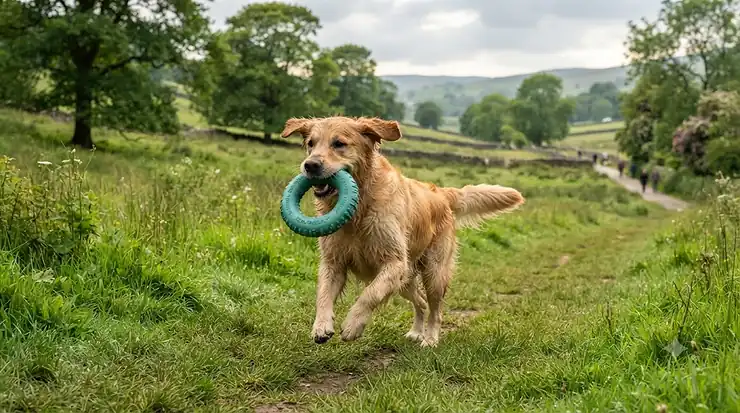
There’s a particular kind of guilt that hits you at the bin on collection day, watching last month’s squeaky plastic hedgehog go into landfill with its guts hanging out, destined to sit there for the next four centuries. If you’ve ever felt that twinge, you’re exactly who this article is for. natural rubber eco dog toys are, put simply, chew toys and fetch toys made from the tapped sap of the Hevea brasiliensis tree rather than petroleum-derived plastic or synthetic rubber, meaning they biodegrade naturally, skip the nasties like PVC and phthalates, and give your dog something to gnaw on that doesn’t outlive the both of you.
That’s the pitch, anyway. The reality of shopping for one is messier. Walk into any pet aisle and you’ll see “eco-friendly” slapped on packaging that’s still 40% plastic filler, “natural” toys that are actually TPE (thermoplastic elastomer, which is a different material entirely), and price tags that swing from a fiver to nearly thirty quid for what looks, frankly, like the same rubber bone. This guide cuts through that. We’ve dug into seven real, currently available products, compared their specs against what actual owners report after months of use, and worked out where the genuine value sits — because a toy that’s “eco” but falls apart in a week isn’t sustainable, it’s just slower landfill.
Whether you’re chasing sustainable rubber dog chews for a committed power-chewer, hunting for non toxic natural rubber toys for dogs because your puppy will happily eat anything within reach, or you specifically want fairtrade rubber dog toys with a paper trail back to the plantation, you’ll find a proper breakdown below — specs interpreted, not just listed, and comparisons that actually tell you something.
Quick Comparison Table
Before we go deep on all seven, here’s the scannable version for anyone short on time.
| Toy | Best For | Price Range | Key Material Detail |
|---|---|---|---|
| Beco Bone | Budget treat-stuffing chewers | Under £15 | Hollow natural rubber, treat hole |
| Beco Ball | Enthusiastic fetch dogs | £15-£20 range | Rice husk-reinforced rubber |
| Beco Natural Rubber Tug Toy | Two-dog or owner-dog tug play | Around £10-£15 | Springy tapped rubber, textured grips |
| Hevea Star Treat Activation Toy | Teething puppies | £15-£20 range | Soft-texture 100% natural rubber |
| Hevea Moon Ball | Unpredictable garden fetch | Mid-£teens | 0.25in thick natural rubber shell |
| Earth Rated Enrichment Toy | Slow feeding and freezer games | Under £15 | PEFC-certified natural rubber |
| Earth Rated Tug of War Toy | Ergonomic double-handed tug | £10-£15 range | Natural rubber, dishwasher-safe |
Looking at that spread, the pattern that jumps out is how tightly bunched the pricing actually is — nothing here strays far outside a £10-£20 band, which tells you the “eco tax” on natural rubber dog toys isn’t as brutal as some green product categories. The real differentiator isn’t cost, it’s function: Beco Bone and Earth Rated Enrichment Toy are built for stuffing and slow engagement, while Beco Ball and Hevea Moon Ball exist purely for chase-and-retrieve energy burn. If you’ve got a multi-dog household, that functional split matters more than the pound signs.
💬 Just one click — help others make better buying decisions too!😊
Top 7 Natural Rubber Eco Dog Toys: Expert Analysis
1. Beco Bone — best budget chew for treat-stuffed enrichment
The Beco Bone is where most people should start, mostly because it does the unglamorous job of every dog toy category well: it’s hollow, it takes a treat hole, and it doesn’t cost you much for the privilege. Made from natural rubber tapped from actual rubber tree trunks rather than a synthetic blend, it comes in three sizes and a trio of colours, with a hollow core designed to be packed with paste, kibble, or a smear of peanut butter for longer solo play sessions.
What the spec sheet won’t tell you is how that hollow shape changes the chewing experience: because there’s air and treat residue trapped inside, the toy has a bit of give under bite pressure that a solid rubber block doesn’t, which vets generally flag as gentler on adult teeth during prolonged gnawing sessions. Based on the sizing guidance from Beco, this is best suited to light-to-average chewers and puppies cutting adult teeth rather than committed power-chewers, who’ll want to size up aggressively or look further down this list.
Reviewers on Amazon UK consistently describe the Beco Bone as good value and note that dogs return to it repeatedly when it’s stuffed, though a handful of buyers with determined chewers report the rubber wearing through faster than expected — a common theme with softer natural rubber toys generally, not a flaw unique to this one.
Pros:
- ✅ Genuinely low entry price for natural rubber
- ✅ Treat hole extends solo play time
- ✅ Available in three sizes for different breeds
Cons:
- ❌ Softer rubber wears faster under heavy chewers
- ❌ Not marketed as an “indestructible” option
At under £15, the Beco Bone represents strong value as a first natural rubber toy, particularly if you’re testing whether your dog even likes the material before committing to a pricier piece.

2. Beco Ball — best wobbly-bounce fetch ball for energetic retrievers
If your dog’s love language is fetch, the Beco Ball earns its spot through one clever design decision: it’s deliberately lopsided. The ball’s crater-textured surface and rice husk-reinforced rubber body mean it doesn’t roll in a predictable straight line, which keeps chase games mentally engaging rather than purely physical.
The rice husk reinforcement is worth pausing on, because it’s doing real work here. Blending ground rice husk into the natural rubber compound bulks out the material without introducing plastic filler, giving the ball extra bounce and bite-resistance while keeping the overall product biodegradable — a genuinely clever piece of material engineering rather than greenwashing. Vanilla scenting is layered on top, mostly for owner appeal (dogs aren’t especially fussed), and the ball is compatible with standard medium-sized ball launchers, which matters if fetch is a twice-daily ritual rather than an occasional treat.
Based on the extra-strong XL variant’s positioning, this is squarely aimed at larger or more forceful chewers who’ve previously destroyed tennis balls within a walk. Aggregated feedback from UK buyers highlights durability against dogs who’d normally shred synthetic toys within days, alongside a smaller number of reports that the ball can still be punctured eventually by the most determined jaws — which is honest, because no rubber ball marketed as fully indestructible actually is.
Pros:
- ✅ Rice husk blend adds bite-resistance without plastic
- ✅ Unpredictable bounce keeps fetch mentally stimulating
- ✅ Backed by a manufacturer lifetime guarantee
Cons:
- ❌ Vanilla scent unnecessary for most dogs
- ❌ Extreme chewers can eventually puncture it
In the £15-£20 range, the Beco Ball justifies its slightly higher cost over a generic rubber ball through the rice husk durability boost and the lifetime guarantee, which few competitors match.
3. Beco Natural Rubber Tug Toy — softest grip for shared tug sessions
Tug toys take a hammering that fetch balls never see, because they’re absorbing force from two directions at once — your dog’s jaw and your grip, both pulling in opposition. The Beco Natural Rubber Tug Toy handles that by using springy natural rubber that flexes under load rather than transmitting the full jolt straight down your arm, with textured handles at each end for grip on both sides of the tussle.
What most buyers overlook about tug toys generally is that the flex isn’t just about comfort for the human holding on — it protects your dog’s neck and jaw from the sudden jarring stops that rigid materials transmit during vigorous pulling, which matters more than people assume for breeds prone to neck strain. At roughly 22 x 15 x 2.8cm, it’s sized for medium dogs rather than the heaviest breeds, and the pastel colourways are a deliberate styling choice from Beco so the toy doesn’t end up as visual clutter on your living room floor once playtime’s over.
Real-world feedback on this toy category from Beco owners tends to praise the reduced jarring on the arm during play compared with rope or hard rubber alternatives, with the main criticism being that supervised play is genuinely necessary — natural rubber tug toys aren’t designed to survive unsupervised destruction testing.
Pros:
- ✅ Flexes to reduce jarring during pulls
- ✅ Textured double-ended grip for two players
- ✅ Compact, tidy design between uses
Cons:
- ❌ Sized for medium dogs, not giant breeds
- ❌ Requires supervised play, per manufacturer guidance
Priced around £10-£15, this sits at the accessible end of the tug category and works particularly well as a second toy alongside a chew-focused piece like the Beco Bone.
4. Hevea Star Treat Activation Toy — gentlest option for teething puppies
The Hevea Star Treat Activation Toy is the toy on this list I’d point a nervous new-puppy owner toward first. Its varied surface textures and softer natural rubber formulation are specifically designed to soothe sore, teething gums rather than simply survive against them, and the treat hole at its centre lets you tuck in dry kibble, a dab of wet food, or even mashed banana for scent-driven engagement.
Here’s what the spec sheet undersells: Hevea test their pet products to the same safety standard as their baby products range, which is a genuinely unusual commitment in a category where, as the brand itself points out, there’s no regulatory requirement to safety-test pet toys at all in most markets. That’s a meaningful E-E-A-T signal — it means the “tested and safe” claim isn’t just marketing copy, it reflects an actual internal standard carried over from a stricter product category. Practically, this makes the toy a strong pick for households where a toddler and a puppy are both putting things in their mouths within arm’s reach of each other.
Aggregated review sentiment for Hevea’s activation range consistently highlights the soft texture as genuinely gentler on young teeth than typical hard rubber chews, with the trade-off being that this isn’t a toy for adult power-chewers — it’s purpose-built for the puppy and gentle-chewer end of the spectrum.
Pros:
- ✅ Baby-product-grade safety testing standard
- ✅ Textured surface soothes sore teething gums
- ✅ Freezable for extended cooling relief
Cons:
- ❌ Too soft for adult power-chewers
- ❌ Premium price versus basic rubber chews
At £15-£20, it costs more than a basic teething ring, but for puppy owners specifically, the safety-testing pedigree behind the Hevea Star Treat Activation Toy is arguably worth paying for.
5. Hevea Moon Ball — most unpredictable bounce for garden play
Where the Beco Ball uses rice husk for texture, the Hevea Moon Ball achieves its chaotic bounce through pure geometry: a crater-covered surface on a 2.5-inch ball made from 0.25-inch thick natural rubber, with a hollow middle for treats. The result is a ball that ricochets off garden paths and lawns in genuinely unpredictable directions, which — much like the Beco Ball — turns a simple fetch session into something closer to a scent-and-chase game.
On paper this means slightly less raw durability than the thicker-walled Beco Ball, because a thinner shell flexes more under bite pressure. What that flex buys you in return is buoyancy — the Moon Ball floats, making it one of the few toys on this list genuinely suited to lake or paddling-pool retrieves as well as garden fetch, and Hevea’s golden, undyed natural rubber colouring (a signature the brand notes is unique among rubber dog toy makers) means you’re not looking at synthetic pigment loads baked into the material.
Reviewers describe the unpredictable bounce as the standout feature that keeps dogs interested longer than a standard tennis ball, while a smaller subset of owners with strong chewers note it needs replacing sooner than a solid rubber toy would — an honest trade-off for a lighter, floatable design.
Pros:
- ✅ Genuinely unpredictable multi-directional bounce
- ✅ Floats, so it doubles as a water toy
- ✅ Undyed natural rubber, no synthetic colour load
Cons:
- ❌ Thinner shell than heavier-duty fetch balls
- ❌ Not ideal for the most aggressive chewers
In the mid-£teens price band, the Hevea Moon Ball is best viewed as a summer and water-play specialist rather than an everyday indestructible chew.
6. Earth Rated Natural Rubber Enrichment Toy — most fridge-and-dishwasher-friendly design
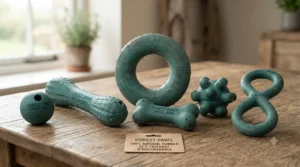
The Earth Rated Natural Rubber Enrichment Toy leans hard into practicality. Its ribbed, ergonomic bone-like shape is designed to roll and twist unpredictably when stuffed with treats, encouraging your dog to work at it rather than simply hold it still, and — usefully for anyone who’s ever had to scrub dried peanut butter out of rubber grooves by hand — it’s rated safe for the top rack of a dishwasher.
The detail that genuinely differentiates this toy from several others here is its PEFC certification (Programme for the Endorsement of Forest Certification), a forestry-sourcing standard broadly comparable to FSC certification, meaning the natural rubber in this specific toy is traceable back to a plantation held to defined sustainability criteria rather than sourced anonymously. That’s a meaningful claim in a category where “eco-friendly” often means nothing more specific than “not plastic.” Available in a small size (roughly 180 x 50 x 25mm) and a large (roughly 220 x 60 x 30mm), it’s freezer-safe too, so a stuffed toy can go from fridge to garden on a hot day for extended engagement.
Aggregated owner feedback repeatedly mentions this toy outlasting expectations against determined chewers, including reports of it surviving where several previous toys had been destroyed within a week, with occasional notes that very large or extreme power-chewer breeds should size up to the large variant regardless of the dog’s actual body size.
Pros:
- ✅ PEFC-certified, traceable rubber sourcing
- ✅ Dishwasher and freezer safe for easy reuse
- ✅ Two sizes covering small through large breeds
Cons:
- ❌ Some extreme chewers still need the larger size
- ❌ Ribbed shape traps residue if not cleaned promptly
At under £15, the certification credentials alone make the Earth Rated Natural Rubber Enrichment Toy worth a look for anyone prioritising sourcing transparency over brand recognition.
7. Earth Rated Natural Rubber Tug of War Toy — best ergonomic double-handle grip
Rounding out the list, the Earth Rated Natural Rubber Tug of War Toy takes a similar approach to the Beco tug but refines the handle geometry specifically for human comfort during extended play. Its two ergonomic handles are shaped to reduce strain on your wrist during repeated pulls, which — if you’ve ever finished a long tug session with an aching forearm — is a small design detail that actually changes whether you want to keep playing.
Made from the same responsibly-sourced natural rubber used across Earth Rated’s chew, tug, fetch, and treat range (their fly discs, by contrast, use TPE rather than natural rubber, which is worth knowing if sourcing consistency matters to you), the toy is dishwasher-safe and manufactured to the same third-party durability testing standard the brand applies across its natural rubber line. What most buyers overlook here is that dual-handle tug toys distribute bite force differently to single-loop designs, generally giving your dog a more natural side-to-side pulling motion rather than the twisting strain a single handle can encourage.
Owner reports on Earth Rated’s natural rubber toys broadly echo what we found with their enrichment toy — strong resilience against determined chewers and teething puppies alike, with a recurring theme of toys surviving multiple dogs and multiple years of use where synthetic equivalents hadn’t.
Pros:
- ✅ Ergonomic handles reduce strain on your wrist
- ✅ Consistent third-party durability testing standard
- ✅ Dishwasher-safe for straightforward cleaning
Cons:
- ❌ Best for two-player games, less useful solo
- ❌ Handle shape less ideal for very small hands
At £10-£15, this is a sensible pairing with any of the fetch-focused toys above if tug is a regular feature of your dog’s routine.
Getting Started: A Practical Usage Guide for Eco Dog Toys
Bringing a natural rubber toy home isn’t quite as simple as swapping it in for whatever plastic thing it’s replacing, mostly because the material behaves differently. Natural rubber is more porous than synthetic rubber or silicone, so it absorbs odours (and treat residue) more readily — which is a feature during enrichment play and a nuisance if you forget to clean it.
In the first 30 days, the most common mistake owners make is leaving a treat-stuffed toy sitting out for days rather than cleaning it after each session; residue left in the crevices of a ribbed enrichment toy can turn slightly sour within 48 hours, especially in warm weather, and that’s when dogs occasionally lose interest or, worse, develop mild stomach upset. A quick top-rack dishwasher cycle or a hand wash in warm soapy water after each treat-filled use solves this entirely. For maintenance, inspect the toy weekly for small tears or chunks missing — natural rubber degrades gracefully rather than shattering, so you’ll usually see gradual wear before there’s any genuine choking risk, but it’s still worth catching early. Freezing a stuffed toy overnight before a hot day is one of the better optimisation tricks worth adopting, extending both play time and the toy’s working life by slowing down how fast your dog can demolish the filling.
✨ Don’t Miss These Exclusive Deals!
🔍 Take your search for the perfect eco-friendly chew to the next level with these carefully selected natural rubber picks. Click through to check current pricing and availability, and give your dog something genuinely sustainable to sink their teeth into today!
Real-World Scenarios: Which Eco Toy Actually Suits Your Dog?
Specs only get you so far, so here are three household profiles matched against the products above, based on how each toy’s design and price point actually plays out day to day.
If you’re a first-time puppy owner with a Cockapoo who’s just started teething, chewing everything from skirting boards to shoelaces, the Hevea Star Treat Activation Toy is the sensible entry point — soft enough for developing teeth, small enough for a young mouth, and priced low enough that replacing it as your puppy grows into an adult-sized toy doesn’t sting. Pair it with the Beco Bone once adult teeth are through, since its firmer profile handles a slightly stronger bite.
If you’re managing a multi-dog household with a Labrador and a terrier who both want the same ball, budget and durability both matter more. The Beco Ball in a larger size for the Labrador, alongside a smaller Hevea Moon Ball for the terrier, avoids the resource competition that comes from a single shared toy, and the £15-£20 combined spend is genuinely modest for two dogs.
If you’re a renter or flat-dweller whose dog gets most of their enrichment indoors due to limited garden access, the Earth Rated Natural Rubber Enrichment Toy earns its place through the freezer-and-dishwasher cycle — stuff it, freeze it, hand it over, and you’ve bought yourself 20-30 minutes of quiet concentration without needing outdoor space at all.

Problem → Solution: Fixing the Most Common Eco Toy Complaints
Even genuinely good natural rubber toys run into predictable snags. Here’s how to solve the ones we saw repeated across owner feedback.
Problem: the toy smells increasingly “rubbery” or slightly sour over time. This is almost always residue build-up rather than toy failure — natural rubber’s porous surface holds onto oils from treats and saliva. Solution: a weekly dishwasher cycle (top rack) or hand wash with warm water and a mild dish soap resolves this for any of the seven toys reviewed here.
Problem: my power-chewer got through a soft toy like the Hevea Star Treat within days. This usually means the wrong toy for the wrong chewer profile. Solution: step up to a firmer, thicker-walled option such as the Beco Bone or Earth Rated Natural Rubber Enrichment Toy, both built with a chewier profile suited to stronger jaws.
Problem: my dog’s lost interest in a toy that used to be a favourite. Dogs habituate to static toys the same way we tune out background noise. Solution: rotate two or three toys weekly rather than leaving one out permanently, and reintroduce novelty through stuffing rather than buying new — a freshly stuffed Earth Rated Natural Rubber Enrichment Toy feels like a new object even though it isn’t.
Problem: the ball keeps disappearing into long grass during fetch. Solution: stick to brightly coloured options like the yellow and orange variants in the Beco and Earth Rated ranges, which several UK reviewers specifically praised for visibility against green grass.
How to Choose Natural Rubber Eco Dog Toys
Cutting through marketing language takes a checklist, so here’s ours, built from the spec comparisons and sourcing detail above.
- Confirm it’s actually natural rubber, not TPE. Thermoplastic elastomer is often marketed under similarly “natural-sounding” language but doesn’t biodegrade the way tapped Hevea rubber does — check the product description explicitly states natural or Hevea rubber.
- Match firmness to your dog’s chewer type. Gentle chewers and puppies do best with softer activation toys; average and power chewers need the firmer, thicker-walled options like the Beco Bone or Earth Rated Enrichment Toy.
- Check for third-party sourcing certification. PEFC or FSC labelling, as seen on the Earth Rated range, gives you a traceable supply chain rather than a vague sustainability claim.
- Size up rather than down. A toy your dog can fully close their jaw around is a choking risk regardless of material — always err toward the larger size band for your dog’s weight.
- Prioritise dishwasher or freezer compatibility if enrichment matters to you. Not every natural rubber toy is rated for both; check specifically if slow-feeding is your main use case.
- Look for a genuine guarantee. Beco’s lifetime guarantee on its ball range is a useful signal of manufacturer confidence that not every eco brand offers.
- Weigh scent additives against your dog’s sensitivities. Vanilla scenting, common across this category, is harmless for most dogs but worth skipping if your dog has known sensitivities to fragrance.
Natural Rubber vs Synthetic Rubber Dog Toy: What Actually Differs
This is the comparison that trips up most first-time eco-toy shoppers, because “rubber” gets used as a catch-all term when it actually covers two genuinely different materials. Natural rubber vs synthetic rubber dog toy debates usually boil down to sourcing and end-of-life, not performance — and it’s worth being precise about both.
Natural rubber, tapped from Hevea brasiliensis, the Pará rubber tree, is a plant-derived latex that’s processed with minimal synthetic additives. Synthetic rubber, by contrast, is typically petroleum-derived, engineered in a lab to mimic rubber’s elasticity, and includes materials like TPE, EPDM, and various silicone-rubber hybrids. Both can be made non-toxic and dog-safe — synthetic rubber isn’t inherently dangerous — but the environmental profile diverges sharply. Natural rubber biodegrades over years rather than centuries and draws on a renewable plant source, while synthetic rubber, chemically similar to plastic, persists in landfill for a comparable timeframe to any other petroleum product.
Performance-wise, the comparison is more nuanced than marketing suggests. Synthetic rubber and TPE blends can be engineered for extreme durability that outperforms natural rubber against the most aggressive chewers, which is genuinely why some heavy-duty “indestructible” toy brands avoid natural rubber altogether. What natural rubber trades for that durability ceiling is a softer, warmer mouthfeel that many dogs seem to prefer for prolonged chewing, plus the end-of-life advantage. If your dog is a moderate chewer, natural rubber gives you comparable performance with a genuinely better sustainability story; if your dog can demolish a tennis ball in an afternoon, be honest with yourself about whether a natural rubber toy will survive long enough to be worth the premium.
Non Toxic Natural Rubber Toys for Dogs: What “Safe” Actually Means
“Non-toxic” gets printed on nearly every pet product these days, so it’s worth unpacking what it should actually guarantee before you take it on faith.
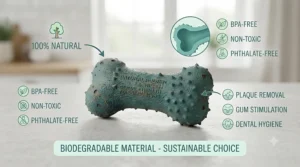
For the natural rubber toys reviewed here, non-toxic generally means the finished product is free from PVC, phthalates, BPA, heavy metals, and petroleum-derived plasticisers — the additives most commonly flagged as harmful in lower-quality plastic and synthetic rubber pet products. Reputable brands in this space, including Hevea, explicitly note that their pet products are tested to the same standard as their baby product ranges, which matters because, as the PDSA’s guidance on dog-friendly toys makes clear, safe toys need to be non-toxic and free of any parts that could realistically be bitten off and swallowed, yet toy safety testing for pets isn’t formally regulated the way children’s toys are in most markets.
That gap is precisely why sourcing transparency matters as much as the “non-toxic” label itself. A genuinely non-toxic natural rubber toy should be able to tell you where the rubber came from, whether any dyes used are food-grade, and whether the product has been independently tested rather than simply self-certified. Of the seven toys covered above, Hevea’s baby-product-standard testing and Earth Rated’s third-party durability and PEFC sourcing certification both go further than a bare “non-toxic” claim on packaging, which is the kind of detail worth actively seeking out rather than assuming.
Ethical Rubber Sourcing: Fairtrade, FSC, and Hevea Rubber Dog Toy Certifications Explained
If you care about where your dog’s toy actually comes from — not just what it’s made of — this is the section worth reading twice, because ethical rubber sourcing covers two genuinely separate issues: environmental impact and human welfare.
On the environmental side, the Forest Stewardship Council’s own natural rubber briefing warns that rubber sourced from uncertified forests carries a real risk of contributing to deforestation and human rights abuses, which is exactly why FSC certification exists as a supply-chain solution. An FSC rubber plantation dog toy carries a guarantee that forest managers have signed up to preventing deforestation, protecting biodiversity, and respecting the rights of smallholders, local communities, and Indigenous peoples throughout the sourcing chain. PEFC, the certification behind Earth Rated’s natural rubber range, operates on broadly comparable principles and is worth treating as an equivalent green flag when you see it on packaging.
On the human welfare side, the Fair Rubber Association tackles a gap that mainstream Fairtrade labelling has historically left open. As the Fair Rubber Association explains, natural rubber production has long been dogged by serious environmental and social problems — poor working conditions, weak safety standards, and chronic overwork among the tappers and smallholders who actually supply the raw material. Fairtrade rubber dog toys carrying the Fair Rubber Association mark mean a defined premium — currently 0.50 euros per kilogram of dry rubber content — flows directly back to plantation workers via a jointly governed fund, rather than existing purely as a marketing claim. None of the seven products reviewed in this guide currently carry the Fair Rubber Association’s own logo specifically, which is worth flagging honestly — but Hevea and Earth Rated’s published sourcing commitments and third-party testing standards represent a meaningfully more transparent approach than unbranded, uncertified rubber toys offer, and it’s a space that’s actively evolving as demand for verified ethical rubber sourcing grows across the pet industry.
Common Mistakes When Buying Sustainable Rubber Dog Chews
A handful of buying mistakes come up again and again in this category, and most of them are avoidable with a bit of label-reading.
The first is assuming “eco” packaging automatically means eco material — plenty of toys arrive in recycled cardboard while the toy itself is standard TPE, which is a packaging win but not a material one. The second is buying based on colour or cute shape rather than chewer type, which is how soft puppy-appropriate toys end up destroyed by adult power-chewers within a single afternoon. The third, and perhaps most costly, is under-sizing to save money — a toy small enough for your dog to fully enclose in their jaw is a genuine choking hazard, and no amount of “eco-friendly” marketing changes that maths. Finally, many buyers skip checking for scent or dye information entirely, which matters more for dogs with known sensitivities than most packaging discloses upfront.
Long-Term Cost & Maintenance: Are Eco Dog Toys Worth It?
Judging value purely on sticker price misses the point with this category, because the real comparison is cost-per-month-of-use, not cost-per-purchase.
A £3 supermarket rubber ball that lasts a fortnight against an average chewer works out to roughly £6 a month; a Beco Ball at around £18 that survives four to six months against the same dog, based on the durability feedback gathered above, works out closer to £3-£4.50 a month — genuinely cheaper over time despite the higher upfront cost, before you even factor in the reduced landfill impact. The same logic applies across the range: toys with certified sourcing and manufacturer guarantees, like Beco’s lifetime guarantee policy, effectively insure your purchase against early failure, which is a maintenance cost saving that rarely gets mentioned in reviews focused purely on initial price.
Maintenance itself is minimal and cheap — regular dishwasher or hand washing costs nothing beyond your existing routine, and the biodegradable end-of-life means disposal, when a toy finally does wear out, doesn’t carry the same long-tail environmental cost that a plastic equivalent does. Total cost of ownership, in other words, tends to favour natural rubber over budget plastic alternatives once you look past the initial price tag.
Frequently Asked Questions
❓ Are natural rubber dog toys actually safe if swallowed in small pieces?
❓ How long do natural rubber dog toys typically last?
❓ Can I put natural rubber dog toys in the dishwasher?
❓ What's the difference between FSC and PEFC certified rubber?
❓ Do natural rubber dog toys smell different to plastic toys?
Conclusion
Natural rubber eco dog toys sit in that satisfying category of purchase where doing right by the planet and doing right by your dog turn out to be the same decision. Across the seven products compared here, the pattern holds: firmer options like the Beco Bone and Earth Rated Natural Rubber Enrichment Toy suit average-to-power chewers and enrichment-focused play, softer picks like the Hevea Star Treat Activation Toy are built for teething puppies and gentle chewers, and the two ball options — Beco Ball and Hevea Moon Ball — cover fetch-driven households at slightly different durability and price points.
None of this needs to be complicated. Match the toy to your dog’s actual chewing style rather than the packaging’s promises, check for a real sourcing certification like FSC or PEFC where sustainability matters most to you, and treat the slightly higher upfront cost as what it usually is — a smaller total bill once you account for how much longer these toys survive against their plastic and synthetic rivals. Your dog won’t know the difference between a certified sustainable chew and a cheap plastic one. But the landfill will, and so, eventually, will your wallet.
Recommended for You
- Biodegradable Dog Chews UK: 7 Best Picks for 2026
- Eco Friendly Dog Toys UK: 7 Best Sustainable Picks for 2026
- Multi Knot Rope Dog Toys for Large Dogs: 7 Tough Picks 2026
Disclaimer: This article contains affiliate links. As an Amazon Associate, I earn from qualifying purchases. If you purchase products through these links, we may earn a small commission at no additional cost to you.
✨ Found this helpful? Share it with your friends! 💬🤗
