
In This Article
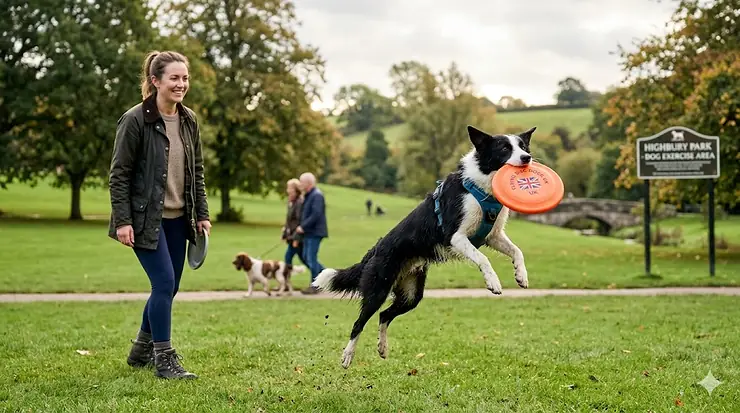
Choosing a proper disc dog training frisbee isn’t just about grabbing any old flying disc from the garden shed. If you’ve ever watched a Border Collie soar two metres into the air to snatch a perfectly thrown disc, you’ll understand why professional handlers invest in purpose-built equipment rather than using those flimsy plastic things that shatter on the first catch.
The British disc dog scene has grown remarkably over the past decade, with regional clubs from Edinburgh to Brighton hosting regular training sessions and competitions. Disc dog as an organised sport traces its roots to 1974 when Alex Stein and his Whippet, Ashley, famously interrupted a baseball game at Dodger Stadium to demonstrate the thrilling potential of canine disc catching. What most newcomers overlook is that the disc itself determines whether your dog develops proper catching technique or picks up bad habits that plague their performance for years. A competition-grade disc dog training frisbee features precise weight distribution, puncture-resistant materials, and aerodynamic design that standard pet shop discs simply cannot match. These elements matter especially in British conditions — our unpredictable weather means you need discs that perform consistently whether you’re training on a crisp March morning in the Cotswolds or during a drizzly August evening in Manchester.
In this comprehensive guide, I’ll walk you through seven professional disc dog training frisbee options available on Amazon.co.uk, each suited to different skill levels and training objectives. From competition-approved models used at the Skyhoundz World Championship to budget-friendly options for puppies just learning the basics, you’ll discover exactly which disc matches your dog’s needs and your training goals.
Quick Comparison: Top Disc Dog Training Frisbees UK 2026
| Product | Size | Material | Best For | Price Range |
|---|---|---|---|---|
| Hyperflite K-10 Jawz | 22 cm | Puncture-resistant polymer | Competition & aggressive chewers | £18-£25 |
| KONG Flyer Medium/Large | 23 cm | Natural rubber | All-round training & durability | £8-£14 |
| Chuckit! Paraflight Large | 25 cm | Nylon/rubber | Water training & soft catch | £12-£18 |
| Hyperflite Competition Standard | 22 cm | Competition polymer | Advanced freestyle | £14-£20 |
| XUBX 7-Piece Set | 18 cm | Natural rubber | Beginners & variety training | £10-£16 |
| Hyperflite Pup | 18 cm | Lightweight polymer | Small dogs & puppies | £12-£18 |
| Chewtopia Throw Ring | 23 cm | Recycled UK plastic | Eco-conscious UK buyers | £8-£13 |
From the comparison above, the Hyperflite K-10 Jawz emerges as the top choice for serious competitors who need puncture resistance during intensive training sessions. However, if you’re working with a young dog still developing bite control, the KONG Flyer offers better value under £15 whilst providing the durability needed for daily practice. Budget-conscious handlers should note the XUBX 7-Piece Set delivers excellent variety for the price — having multiple discs on hand proves invaluable when training recall and building drive, as you can keep throwing fresh discs rather than waiting for your dog to return the same one repeatedly.
💬 Just one click — help others make better buying decisions too! 😊
✨ Don’t Miss These Exclusive Deals!
🔍 Take your disc dog training to the next level with these carefully selected products. Click on any highlighted item to check current pricing and availability on Amazon.co.uk. These picks will help you find exactly what you need!
Top 7 Disc Dog Training Frisbees: Expert Analysis
1. Hyperflite K-10 Jawz – The Championship Standard
The Hyperflite K-10 Jawz represents the pinnacle of competition disc dog equipment, officially approved for the Skyhoundz World Canine Disc Championship Series. At 22 cm diameter and weighing approximately 155 grams, this disc strikes the perfect balance between flight stability and catchability that separates amateur gear from professional equipment.
What sets the K-10 Jawz apart is its revolutionary puncture-resistant formulation. Whilst it’s not marketed as indestructible — no disc genuinely is — this model withstands the gnashing teeth of even the most enthusiastic Border Collies and Belgian Malinois far better than standard competition discs. The secret lies in Hyperflite’s proprietary polymer blend that maintains elasticity without sacrificing structural integrity. In practical terms, this means your £20-odd investment lasts through hundreds of training sessions rather than being relegated to the bin after a fortnight.
The X-Flash Anti-Glare Technology deserves particular mention for UK handlers. Our variable weather creates situations where bright winter sun reflects off glossy disc surfaces, temporarily blinding dogs mid-catch. The K-10 Jawz features a frosted texture that scatters sunlight, eliminating that disorienting flash. I’ve watched handlers transition from standard discs to the Jawz and immediately notice their dogs tracking catches more confidently, especially during those low-angle throws on bright February mornings.
UK buyers should note this disc doesn’t float, which matters if you’re training near water features or coastal areas. The patented low-profile grip surface works brilliantly in damp conditions though — rather important when British drizzle is a near-constant companion from October through April.
Pros:
✅ Competition-approved for professional events
✅ Exceptional puncture resistance extends lifespan
✅ X-Flash technology improves tracking in bright conditions
Cons:
❌ Doesn’t float in water
❌ Premium price point around £18-£25
Customer feedback from UK buyers consistently highlights the disc’s longevity, with multiple reviewers noting their K-10 Jawz lasting 6-12 months of regular use — exceptional value when you calculate cost-per-session. Available on Amazon.co.uk with Prime delivery, making it accessible across England, Scotland, Wales, and Northern Ireland. Around £18-£25 depending on colour selection.
2. KONG Flyer Medium/Large – Durability Meets Affordability
The KONG Flyer brings KONG’s legendary durability philosophy to the disc dog training frisbee category. Constructed from KONG’s signature natural rubber compound at 23 cm diameter, this disc offers something rare in the market: genuine all-weather reliability at a mid-range price point of £8-£14.
Natural rubber behaves differently from plastic polymers, particularly in British weather conditions. Where plastic discs become brittle in winter cold and overly flexible in summer heat, the KONG Flyer maintains consistent performance across our typical temperature range of 0-25°C. This temperature stability proves crucial if you’re training year-round rather than just during pleasant weather months. The material also provides a forgiving catch surface that’s gentler on developing teeth — particularly valuable for dogs between 12-18 months who are still building jaw strength and catch confidence.
Flight characteristics lean toward stability over distance. You won’t achieve the 40-50 metre throws possible with competition-specific discs, but for training purposes within a typical British park or garden (where space constraints often limit throw distance anyway), the 25-30 metre range proves perfectly adequate. The dynamic rebound feature means missed catches result in entertaining bounces that keep dogs engaged rather than the disc simply dropping dead to the ground.
What most buyers overlook is the KONG Flyer’s value for households with multiple dogs. The rubber construction withstands tug-of-war sessions and rough play between dogs far better than rigid plastic alternatives. If you’re running group training sessions or have siblings who compete for the disc, this durability prevents the frustration of constantly replacing damaged equipment.
Pros:
✅ Natural rubber gentle on teeth and gums
✅ Consistent performance across UK temperature ranges
✅ Excellent value under £15
Cons:
❌ Shorter flight distance than competition discs
❌ Heavier weight (around 170g) requires adjustment for small handlers
UK reviewers particularly appreciate how the bright colours remain visible in grass, crucial for those inevitable searches through British parkland. The medium/large size suits most breeds from Cocker Spaniels upward. Prime-eligible on Amazon.co.uk, typically £8-£14.
3. Chuckit! Paraflight Large – Water Training Specialist
The Chuckit! Paraflight stands out as the only major disc dog training frisbee specifically engineered to float, making it indispensable for handlers training near British waterways, beaches, or for dogs competing in water-based disc events. At 25 cm diameter, it’s slightly larger than competition standards, but this size contributes to the buoyancy that defines its purpose.
Construction combines multilayer nylon interior with soft rubber edges — a hybrid approach that delivers surprising benefits for UK conditions. The nylon core sheds water and mud far more effectively than solid rubber or plastic alternatives. After a session on a soggy British pitch (and let’s be honest, most of them are), you can rinse the Paraflight under a tap and it dries within an hour, whereas rubber discs can harbour moisture and develop that musty smell familiar to any British dog owner.
The soft rubber edge deserves particular attention for trainers working with tentative catchers. Some dogs, especially those new to disc work, hesitate to commit to aerial catches because rigid disc edges can bruise gums during mistimed attempts. The Paraflight’s cushioned perimeter provides a psychological safety net that builds confidence more quickly than traditional hard-edge discs. I’ve seen handlers cut training timelines nearly in half by starting nervous dogs on the Paraflight before transitioning to competition equipment.
Aerodynamic performance is adequate rather than exceptional. The gradual descent pattern — marketed as allowing “plenty of opportunities to run and jump” — translates to slower flight speeds and shorter maximum distances compared to competition discs. For building foundational skills and maintaining engagement during training, this characteristic works brilliantly. For serious distance work or competition preparation, you’ll eventually need to supplement with faster-flying alternatives.
Pros:
✅ Floats for water training and beach sessions
✅ Soft edges build confidence in nervous catchers
✅ Easy to clean and quick-drying after muddy sessions
Cons:
❌ Slower flight speed limits distance training
❌ Nylon can separate with aggressive chewing (inspect regularly)
British buyers consistently praise the visibility of bright colour options, particularly the orange and blue combination. The large size at 25 cm suits medium to large breeds; smaller dogs may struggle with the diameter. Available on Amazon.co.uk for around £12-£18, with Prime delivery throughout the UK.
4. Hyperflite K-10 Competition Standard – Pure Performance
The Hyperflite K-10 Competition Standard is the official disc of the Skyhoundz World Canine Disc Championship Series, representing the benchmark against which all other competition disc dog training frisbees are measured. At 22 cm diameter and 115 grams, it embodies decades of refinement in canine disc technology.
Flight characteristics are simply exceptional. The competition standard achieves distances of 50-60 metres with proper technique, whilst maintaining stable flight even in moderate wind — a crucial consideration for British handlers dealing with our notoriously unpredictable weather. The patented low-profile grip surface functions equally well in dry or damp conditions, giving you confidence during those inevitable drizzly training sessions that characterise British springs and autumns.
What competition handlers appreciate most is the disc’s predictability. Once you’ve mastered the throwing technique, the K-10 Competition Standard flies the same arc every single time, removing variables that plague practice with inconsistent equipment. This reliability accelerates skill development because you’re not constantly adjusting for equipment quirks — you can focus entirely on refining technique and timing.
The primary limitation is durability with power chewers. Unlike the Jawz variant, the Competition Standard uses a harder polymer optimised for flight performance rather than bite resistance. Dogs with strong jaws and aggressive catch styles can puncture or crack the disc within weeks. If your dog tends to grab discs and immediately start chomping rather than returning them cleanly, factor in replacement costs — you might need three or four discs per season rather than the single disc a well-trained retriever requires.
For British buyers, the Competition Standard’s X-Flash Anti-Glare Technology proves its worth during those brief but brilliant sunny spells we experience. The frosted surface eliminates the sunflash phenomenon that can cause dogs to lose visual tracking at critical moments.
Pros:
✅ Official competition disc with world-class flight characteristics
✅ Exceptional distance capability (50-60m with technique)
✅ Predictable performance builds consistent skills
Cons:
❌ Not puncture-resistant — unsuitable for aggressive chewers
❌ Requires replacement more frequently than Jawz variant
UK availability through Amazon.co.uk typically ranges £14-£20 depending on colour selection. Many serious competitors purchase multi-packs to ensure consistent practice equipment. Prime delivery available across the UK, including rural Scotland and Wales where specialist pet shops may not stock professional disc dog equipment.
5. XUBX 7-Piece Dog Flying Disc Set – Training Arsenal on a Budget
The XUBX 7-Piece Set offers remarkable value for handlers who understand that effective disc dog training requires multiple discs rather than endlessly retrieving a single one. At 18 cm diameter, these natural rubber discs suit small to medium breeds perfectly, whilst the seven-disc variety (red, orange, yellow, green, blue, purple, black) provides practical training advantages beyond simple aesthetics.
Natural rubber construction delivers two key benefits for British conditions. First, the material remains flexible across our typical temperature range, avoiding the brittleness that afflicts cheaper plastic discs during winter months. Second, the soft composition proves gentle on developing teeth — crucial for puppies and young dogs between 6-18 months who are building jaw strength and catch confidence. The convex design aids dogs in gripping and carrying, reducing the frustration that occurs when flat discs prove difficult to pick up from grass or concrete.
Where this set truly excels is building drive and engagement during early training phases. Having multiple discs allows you to maintain throwing rhythm without waiting for returns — you can throw disc after disc whilst your dog is still racing back with the previous one, keeping arousal and enthusiasm high throughout the session. The colour variety also enables you to test whether your dog shows colour preferences (many dogs do, though it’s often handler technique rather than actual colour causing the preference).
Flight performance is adequate rather than exceptional. These discs achieve 15-20 metre flights with reasonable accuracy, sufficient for garden training and initial park sessions. They won’t match competition equipment for distance or wind stability, but that’s not their purpose. For £10-£16, you’re acquiring a complete training toolkit rather than a single premium disc.
Pros:
✅ Seven-disc variety keeps training sessions dynamic
✅ Natural rubber gentle on developing teeth
✅ Floats in water for versatile training environments
Cons:
❌ Limited distance capability (15-20m maximum)
❌ Smaller 18cm diameter unsuitable for large breeds
British buyers appreciate the floating capability for coastal and lakeside training, whilst the bright colours prove easy to locate in British parkland. Sold by XUB with Amazon Fulfillment, ensuring reliable Prime delivery throughout England, Scotland, Wales, and Northern Ireland. Typically £10-£16 for the complete seven-disc set.
6. Hyperflite Pup Competition Standard – Small Dog Specialist
The Hyperflite Pup Competition Standard addresses a gap in the market that many manufacturers ignore: proper equipment for small breeds and puppies. At approximately 18 cm diameter (30% smaller than the full-size K-10), this disc provides proportionate equipment for dogs under 15 kg who struggle with standard 22-23 cm discs.
Size matters more than most handlers realise. A Cocker Spaniel or young Border Collie attempting to catch a full-size competition disc faces the equivalent of a human trying to catch a dustbin lid — technically possible but awkward and discouraging. The Pup’s reduced diameter allows small-breed dogs to develop proper catching technique rather than compensating with inefficient jaw positioning that becomes habitual over time.
Improved aerodynamics distinguish this from simply being a scaled-down version of the K-10. Hyperflite engineers specifically designed the airfoil and weight distribution to ensure stable flight at the Pup’s lighter weight. The result is a disc that achieves 25-35 metre distances with proper technique — impressive considering the reduced mass — whilst maintaining the predictable flight characteristics that make Hyperflite competition equipment so valued.
The softer polymer formulation deserves mention for UK puppy trainers. Young dogs between 6-12 months are developing adult teeth and jaw strength; overly rigid discs can cause gum soreness that creates negative associations with catching. The Pup’s softer material provides a gentler introduction whilst still offering the durability to withstand repeated practice sessions through our damp British weather.
Pros:
✅ Properly sized for small breeds and puppies
✅ Competition-quality flight characteristics in compact package
✅ Softer material gentle on developing mouths
Cons:
❌ Dogs outgrow it as they mature (factor in eventual replacement)
❌ Less durable than full-size Competition Standard
UK reviewers consistently note the Pup’s value for multi-dog households where size varies. Available through Amazon.co.uk, typically £12-£18 for two-packs (assorted colours). Prime delivery covers all UK regions, making it accessible whether you’re training in central London or the Scottish Highlands.
7. Chewtopia Throw Ring – UK-Made Eco Choice
The Chewtopia Throw Ring offers something unique in this category: a disc dog training frisbee manufactured in the UK from 100% recycled plastics. For environmentally conscious handlers concerned about adding more virgin plastic to landfills, this 23 cm flexible ring provides a viable alternative without sacrificing training functionality.
Construction from recycled UK plastics delivers surprising durability. The material withstands British weather conditions admirably, maintaining flexibility through winter cold and summer heat whilst resisting the UV degradation that causes imported plastics to become brittle over time. The bright colour options (manufactured using safer dyes compared to some international alternatives) remain visible through grass, mud, and typical British gloom.
Flight characteristics lean toward stability over distance. You’ll achieve 20-30 metre throws with practice, adequate for most British parks and gardens where space constraints often prevent longer throws anyway. The ring design creates interesting aerodynamics compared to traditional disc shapes — some dogs find the rotation pattern easier to track, whilst others require adjustment time. It’s worth noting that competition organisations may not approve ring-style designs for formal events, limiting this to training and recreational use.
What British buyers particularly appreciate is supporting local manufacturing whilst reducing environmental impact. Chewtopia’s UK production means lower carbon footprint from transportation, and the company actively works with UK recycling programmes to source materials. For handlers who value environmental responsibility alongside training effectiveness, this consideration matters.
Pros:
✅ Made in UK from 100% recycled plastics
✅ Flexible material gentle on teeth and gums
✅ Supports British manufacturing and reduces carbon footprint
Cons:
❌ Ring design not approved for most competitions
❌ Some dogs require adjustment period for non-disc shape
Available through Amazon.co.uk’s marketplace sellers, typically £8-£13. Whilst not Prime-eligible in all regions, most UK addresses receive delivery within 3-5 working days. The single-ring purchase option suits handlers wanting to trial the design before committing to multiple units.
How to Choose Your Disc Dog Training Frisbee: Decision Framework for UK Handlers
Selecting the right disc dog training frisbee requires matching equipment to your dog’s current skill level, physical characteristics, and your training objectives. British handlers face additional considerations around weather resilience and local training environments that don’t feature in American or Australian guides.
Start with your dog’s age and jaw strength. Puppies under 12 months should exclusively use soft, forgiving discs like the KONG Flyer or XUBX rubber set — the developing teeth and jaw muscles cannot safely handle rigid competition equipment yet. Between 12-18 months, you can begin transitioning to competition-grade materials, but watch for signs of gum soreness or reluctance to catch hard. Dogs over 18 months with established catch confidence can handle any disc type.
Size matching matters more than marketing materials suggest. Small breeds (under 12 kg) struggle with standard 22-23 cm discs; opt for the Hyperflite Pup or XUBX 18 cm options. Medium breeds (12-25 kg) perform well with standard sizes. Large breeds (over 25 kg) benefit from the slightly larger Chuckit! Paraflight at 25 cm, which provides better visual tracking for dogs positioned higher off the ground.
Consider your training environment. Coastal handlers or those near lakes should prioritise floating designs like the Chuckit! Paraflight. Urban handlers working in parks with limited space don’t require maximum-distance equipment — the KONG Flyer or XUBX set provides adequate performance without the premium price. Handlers with access to large open fields and competition ambitions should invest in Hyperflite Competition Standard or K-10 Jawz from the start.
Weather resilience deserves attention in British conditions. Natural rubber options (KONG, XUBX) maintain consistent performance through our damp springs and autumns, whilst competition polymers (Hyperflite range) offer superior wind stability during those breezy sessions common across Scotland, Wales, and coastal England. If you’re training year-round rather than just during pleasant weather, factor in how materials perform across our 0-25°C temperature range.
Finally, evaluate your dog’s chewing tendencies honestly. Power chewers — those who grab discs and immediately start chomping rather than returning cleanly — destroy standard competition equipment within weeks. For these dogs, the Hyperflite K-10 Jawz justifies its premium price through extended lifespan, whereas gentle retrievers can safely use the less expensive Competition Standard without premature damage.
Common Mistakes When Buying Disc Dog Training Frisbees
British handlers new to disc dog sport consistently make several avoidable errors when purchasing their first equipment. Understanding these pitfalls saves both money and training time.
The most prevalent mistake is assuming any flying disc works for dog training. Standard human frisbees — the £3-5 models sold in garden centres and toy shops — feature hard edges, inconsistent weight distribution, and materials that quickly crack under canine jaw pressure. These discs teach dogs to fear catches rather than pursue them confidently, creating training setbacks that require months to overcome. Always purchase dog-specific equipment with cushioned edges and appropriate materials.
Buying a single disc represents another common error. Effective disc dog training requires multiple discs to maintain drive and engagement. When you’re building enthusiasm with a young dog, the ability to throw continuously whilst they’re still returning the previous disc keeps arousal high and prevents the momentum loss that occurs during retrieval waits. Budget for at least three discs initially, preferably five for serious training programmes.
Neglecting UK weather considerations causes frustration among handlers accustomed to sunny American training videos. Competition discs that perform brilliantly in California conditions may struggle in British wind and rain. Prioritise equipment specifically tested in variable weather, and don’t assume American reviewer experiences translate directly to British conditions — our climate demands different material properties.
Incorrect size selection undermines training progress. Small breed owners who purchase standard 22-23 cm discs because “that’s what everyone uses” handicap their dogs with equipment that’s proportionally too large. Similarly, large breed owners who assume bigger is always better may discover their dogs struggle tracking oversized discs during aerial catches. Match disc diameter to your dog’s mouth size and catch style.
Finally, many handlers overlook the importance of material consistency when building skills. Mixing natural rubber training discs with competition polymer equipment during the same session confuses dogs because flight characteristics differ significantly. Once you’ve selected a disc type for your training phase, maintain consistency for several weeks before introducing alternatives.
Building Your Disc Dog Training Programme: A British Handler’s Guide
Establishing a structured training programme transforms casual disc play into genuine skill development. British handlers should adapt American training philosophies to account for our unique conditions and constraints.
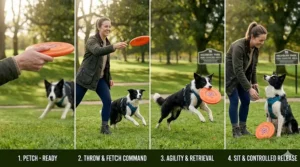
Begin with roller training on wet grass — a technique particularly suited to British parks. Rather than throwing aerial discs immediately, roll the disc along the ground like a wheel. Dogs instinctively chase rolling objects, and wet British grass provides ideal surface friction that prevents rollers from travelling too far too quickly. This foundation builds chase drive without the complexity of aerial catches, suitable for dogs as young as 6 months.
Progress to short upward throws only after your dog consistently catches rollers and returns them cleanly. British gardens, typically smaller than American backyards, actually prove advantageous during this phase — the limited space prevents overthrows whilst building accuracy. Start with 3-5 metre gentle arcs that peak just above your dog’s head height. The KONG Flyer or XUBX rubber discs work brilliantly here because their slower flight speeds give dogs time to judge trajectory.
Weather-adaptive training separates successful British handlers from those who only practise during pleasant conditions. Light rain and damp grass — present roughly 200 days yearly across most of the UK — shouldn’t halt training. Waterproof discs like the Chuckit! Paraflight maintain performance in wet conditions, and dogs actually benefit from learning to track discs against grey skies rather than only bright sunshine. Reserve training cancellations for heavy rain, high winds (above 25-30 mph), or temperatures below 2°C where injury risk increases.
Session timing matters more than duration. Young dogs (6-18 months) benefit from three 10-minute sessions daily rather than single 30-minute marathons. British weather allows this approach — pop out for a quick morning session before work, lunchtime if working from home, and early evening. Mature dogs (over 2 years) can handle 20-30 minute sessions, but watch for signs of fatigue like slower returns or reluctant catches.
Incorporate rest days to prevent overuse injuries. High-impact disc work stresses shoulders, wrists, and spines — particularly during aerial catches where dogs land from heights. British veterinary guidance suggests limiting high-intensity disc sessions to 3-4 days weekly, with gentler activities (walks, swimming, scent work) filling remaining days. This schedule proves especially important for breeds prone to joint issues like Border Collies, German Shepherds, and Labrador Retrievers.
Understanding Competition Standards and UK Disc Dog Events
British disc dog competitions follow international standards whilst accommodating local conditions and regulations. Understanding these frameworks helps handlers select appropriate equipment and set realistic progression goals.
The Skyhoundz World Canine Disc Championship Series represents the premier competition circuit, with UK qualifying events typically held between April and September. These competitions require Hyperflite-approved discs — specifically the K-10 Competition Standard or K-10 Jawz. Using unapproved equipment results in automatic disqualification, making it crucial to verify disc specifications before investing in competition gear.
British competitions typically feature two primary formats: distance/accuracy and freestyle. Distance events award points based on how far your dog catches thrown discs within a 60-second window, with specific scoring zones (usually 20m, 30m, 40m, and 50m-plus). Freestyle combines choreographed routines to music, judged on difficulty, execution, and showmanship. The equipment requirements differ — distance competitors prioritise maximum-flight discs like the Hyperflite Competition Standard, whilst freestyle handlers often use softer options like the K-10 Jawz to reduce injury risk during complex catches.
Weather contingencies feature prominently in UK events compared to international competitions. British event organisers typically establish wind speed thresholds (usually 25-30 mph sustained winds) where competition halts for safety. Rain alone rarely cancels events unless visibility becomes severely compromised or ground conditions create injury risk. This weather tolerance means British competitors gain valuable experience performing in conditions that would postpone American or Australian events.
Local UK clubs affiliated with organisations like Catch the Spirit UK provide entry-level competitions and training workshops. These regional events often allow broader equipment choices compared to international competitions, making them ideal for handlers transitioning from recreational play to competitive performance. Many clubs operate across England, Scotland, and Wales, with growing participation in Northern Ireland.
Registration requirements for UK competitions include insurance coverage (typically £6-8 million public liability) obtained through membership in recognised canine sport organisations. The Kennel Club’s Good Citizen Dog Scheme or Canine Hoopers UK memberships often provide suitable coverage. Additionally, ensure your dog’s vaccinations meet current UK requirements — competitions require proof of current kennel cough, distemper, and parvovirus protection.

Long-Term Cost Analysis: Investment vs Value in British Pounds
Understanding the total cost of disc dog training helps British handlers budget effectively whilst avoiding false economies that increase long-term expenses.
Initial equipment investment ranges from £25-£60 depending on your approach. Budget-conscious starters can begin with the XUBX 7-piece set (£10-£16) plus a single KONG Flyer (£8-£14) for approximately £20-£30 total. This provides adequate variety for foundational training through your dog’s first 6-12 months. Competition-focused handlers should budget £50-£60 initially: three Hyperflite K-10 Jawz discs (£55-£75 for three) provides consistency whilst accounting for occasional loss in parks and fields.
Annual replacement costs vary dramatically based on your dog’s chewing habits and training frequency. Gentle retrievers using competition-grade equipment may spend just £30-£40 yearly replacing worn discs. Power chewers working through standard competition discs could spend £80-£120 annually. The Hyperflite K-10 Jawz significantly reduces replacement frequency — handlers report 6-12 month lifespans compared to 6-12 weeks for standard competition discs with aggressive chewers. Calculate cost-per-month rather than purchase price to identify genuine value.
Training venue costs in the UK typically remain minimal. Public parks across England, Scotland, Wales, and Northern Ireland generally permit disc dog training without fees, though some councils require permits for organised group sessions. Private training facilities charge £5-£15 per session, worthwhile during winter months when daylight and weather limit outdoor options. Annual club memberships (£30-£60 typically) provide structured training, social opportunities, and competition eligibility.
Competition entry fees range from £15-£35 per event depending on format and organisation. Local club competitions typically charge £15-£20, whilst larger regional and national events command £25-£35. Factor in £20-£40 for petrol if travelling beyond your immediate area — British events often require 50-150 mile journeys to reach venues. Budget £200-£300 annually if competing regularly (8-12 events yearly).
Hidden costs deserve attention. Quality training treats cost £8-£15 monthly if using food motivation extensively. Veterinary care for minor training injuries (strains, pad abrasions) averages £45-£80 per incident; budget £100-£150 annually for unexpected vet visits related to disc activities. Consider pet insurance that covers sporting injuries — premiums increase £5-£15 monthly for policies including canine sports coverage, but this protects against catastrophic injury costs.
Total first-year cost for recreational handlers: £250-£400 including equipment, occasional training sessions, treats, and minor medical care. Competitive handlers should budget £600-£900 including quality equipment, regular club sessions, competition entries, travel, and appropriate insurance coverage. These figures assume moderate participation — serious competitors investing in advanced coaching, travelling to international events, or maintaining multiple competition dogs should expect annual costs approaching £1,500-£2,000.
Maximising Disc Lifespan in British Weather Conditions
British climate presents specific challenges for disc dog training equipment longevity. Understanding proper maintenance and storage extends disc lifespan whilst maintaining performance characteristics.
Post-session cleaning proves crucial in wet British conditions. Mud, grass stains, and moisture accumulate rapidly during typical training sessions across British parks and fields. Rinse discs under lukewarm tap water immediately after sessions, using a soft brush for stubborn mud. Avoid harsh detergents that degrade polymer materials over time — plain water removes 95% of contamination adequately. For discs used in coastal areas, thorough freshwater rinsing removes salt deposits that accelerate material degradation.
Drying technique matters more than most handlers realise. Never store discs whilst still damp — this promotes material degradation and creates musty odours particularly problematic with natural rubber options. Pat discs dry with an old towel, then air-dry completely before storage. During British winter when indoor drying becomes necessary, avoid placing discs directly on radiators or near heat sources — rapid temperature changes cause warping that affects flight characteristics permanently.
Storage location significantly impacts disc longevity in British homes. Garage storage, common across UK properties, exposes discs to dramatic temperature fluctuations and moisture that degrade materials prematurely. Instead, store discs indoors at stable room temperature, away from direct sunlight that causes UV degradation. A dedicated kit bag in a hall cupboard or under-stairs storage provides ideal conditions whilst keeping equipment organised and accessible.
Inspect discs regularly for damage requiring retirement. Small nicks and tooth punctures that don’t compromise structural integrity remain usable, but cracks extending more than 2-3 cm indicate retirement time. British weather accelerates crack propagation — the freeze-thaw cycles common across Scotland, northern England, and Wales cause small cracks to expand rapidly. Replace compromised discs promptly rather than risking injury from disc failure mid-flight.
Rotation strategy extends collective disc lifespan. Rather than using one disc exclusively until it fails, rotate between three or four discs throughout each training session. This distributes wear evenly whilst giving individual discs recovery time between intensive use — polymers actually benefit from rest periods that allow molecular structure to relax and maintain elasticity.
Safety Considerations for British Disc Dog Training
British handlers must account for specific environmental and regulatory factors that don’t feature prominently in American or Australian training resources.
Ground surface selection dramatically affects injury risk. British parks and fields feature varying terrain — from well-maintained cricket pitches to rutted football fields with drainage channels. Avoid uneven ground, rabbit holes, and areas with exposed tree roots that create trip hazards during high-speed chasing. Coastal training requires particular caution around concealed rocks in grass and tidal wash zones where loose sand creates unstable footing.
Weather-related injury risks increase during British winter months. Shortened daylight hours mean many handlers train during twilight or darkness — consider high-visibility LED collar lights (£8-£15 on Amazon.co.uk) and reflective gear for both handler and dog. Frost creates slippery conditions that increase muscle strain risk; postpone training when ground frost persists into mid-morning. British rain itself rarely warrants cancellation, but wet grass reduces traction — adjust throw distances by 30-40% during very wet sessions to prevent slipping injuries.
Age-appropriate activity levels require strict adherence. The Kennel Club’s canine activities guidelines emphasise that dogs must only undergo training matching their physical capabilities and level of maturity. British veterinary guidance suggests avoiding high-impact disc catches for dogs under 12 months — their growth plates haven’t fully closed and repetitive jumping stresses developing joints. Between 12-18 months, limit aerial catches to waist-height or lower. Full competition training should wait until 18-24 months depending on breed. Large, slow-maturing breeds like German Shepherds benefit from waiting until 24 months for intensive training.
Public space regulations vary across UK regions. Most English, Scottish, and Welsh councils permit disc dog training in public parks, but verify local bylaws regarding organised group sessions — some areas require permits. Livestock grazing areas demand particular caution; even well-trained dogs can trigger chasing instincts around sheep or cattle, creating legal liability under British agricultural protection laws. Always maintain voice control in areas where livestock may be present.
Insurance requirements deserve serious attention. Standard pet insurance policies often exclude sporting injuries — verify your coverage specifically includes canine disc activities before assuming protection. The Kennel Club’s Activity Card (£25-£30 annually) provides £6 million public liability coverage suitable for training and competition. This protection proves crucial if your dog accidentally collides with another park user or causes property damage during training sessions. The UK government’s Animal Welfare Act 2006 establishes baseline duty of care requirements that extend to sporting activities.

Frequently Asked Questions
❓ Can I use regular human frisbees for disc dog training?
❓ What size disc dog training frisbee suits Border Collies in the UK?
❓ Are disc dog competitions available in Scotland, Wales, and Northern Ireland?
❓ How do I train my dog to catch discs in typical British rain and wind?
❓ What's the difference between competition-approved and recreational disc dog frisbees?
Conclusion: Selecting Your Perfect Disc Dog Training Frisbee
The British disc dog scene offers something for every handler — from casual weekend players seeking quality time with their dogs to serious competitors chasing championship titles. Your choice of disc dog training frisbee fundamentally shapes that journey, influencing everything from injury risk to skill development pace.
For handlers just beginning disc work with puppies or young dogs, start with softer, forgiving options like the KONG Flyer or XUBX rubber set. These provide gentle introduction to catching whilst building enthusiasm and confidence. As your dog matures and demonstrates consistent catch technique, transition to competition-grade equipment like the Hyperflite K-10 Jawz for dogs with strong chewing tendencies, or the Competition Standard for gentle retrievers.
British conditions demand equipment that performs reliably through our notoriously variable weather. Prioritise discs tested across temperature ranges and moisture conditions rather than those optimised solely for California sunshine. The investment in quality equipment proves worthwhile — proper disc dog training frisbees last 6-12 months with regular use, whilst cheap alternatives fail within weeks and teach poor technique that requires months to correct.
Remember that disc dog sport fundamentally celebrates the partnership between handler and dog. The equipment facilitates that bond but doesn’t create it. Whether you’re working with a £15 KONG Flyer in your local park or a £22 Hyperflite K-10 Jawz at a championship event, success comes from consistent training, patience, and genuine enjoyment of time spent with your canine partner. Choose equipment that matches your current needs and budget, train regularly regardless of British weather, and watch your dog’s skills develop over the coming months and years.
Recommended for You
- 7 Best Competition Dog Frisbees UK 2026
- 7 Best Hard Frisbee for Dogs UK 2026
- 7 Best Soft Rubber Frisbee for Senior Dogs UK 2026
Disclaimer: This article contains affiliate links. As an Amazon Associate, I earn from qualifying purchases. If you purchase products through these links, we may earn a small commission at no additional cost to you.
✨ Found this helpful? Share it with your mates! 💬🤗
