
In This Article
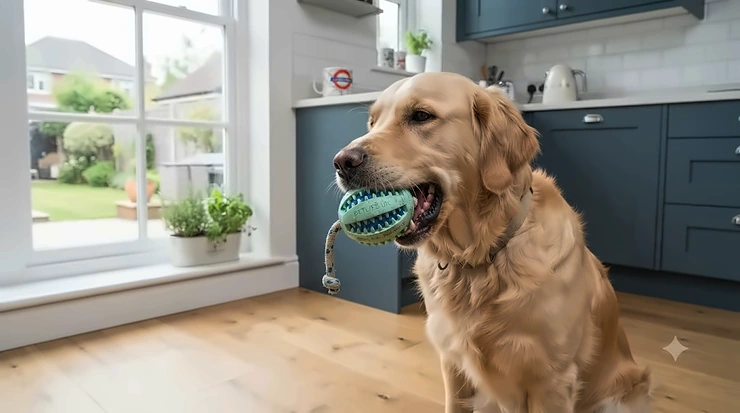
Somewhere in your house right now, there’s probably a suspiciously chewed-up slipper, and your dog is looking at you with an expression that says “what slipper?” That’s not naughtiness, by the way — it’s biology. Dogs are hardwired to chew, and if you don’t give that instinct somewhere useful to go, it goes to your furniture instead. Dental chew balls for dogs exist precisely because of this gap: they’re rubber toys, usually studded with nubs, ridges or grooves, designed to double up as a fetch toy and a low-key dental workout every time your dog gnaws on one.
Here’s the honest 40-second version: a dental chew ball is a solid or semi-hollow rubber ball with a textured surface that scrapes gently against the tooth enamel and gum line as a dog bites and rolls it in their mouth, helping to loosen soft plaque before it hardens into tartar. It’s not a toothbrush substitute — nothing chew-based fully is. UK veterinary charity PDSA’s dental care guidance for dogs is clear that brushing remains the single most effective way to keep a dog’s mouth healthy, positioning chew toys as a helpful extra between brushing sessions rather than a replacement for it. That’s the honest framing this whole guide sticks to.
This isn’t going to read like a rewritten Amazon listing. Instead, you’re getting genuine spec comparisons, real aggregated review patterns, and honest verdicts on seven actual products you can buy right now on amazon.co.uk — spanning budget, mid-range and premium — plus practical guidance on choosing, using and maintaining a rubber chew ball so your dog actually benefits from dental chew balls for dogs rather than just destroying another toy by Tuesday.
Quick Comparison Table
| Product | Best For | Chew Level | Price Range |
|---|---|---|---|
| KONG CoreStrength Ball | All-round dental enrichment | Moderate–strong | £10-£14 range |
| Chuckit! Rugged Ball | Fetch-and-chew combo | Moderate | £8-£14 range |
| Nylabone Moderate Flexible Dental Ball | Gentle/moderate chewers | Light–moderate | £6-£9 range |
| Trixie Denta Fun Rugby Ball | Budget gum massage | Light–moderate | £5-£8 range |
| West Paw Zogoflex Jive Ball | Power chewers, eco-conscious owners | Strong | £12-£18 range |
| Rosewood Tough Twist Dental Ball | Simple UK budget pick | Light–moderate | Under £6 |
| KONG Squeezz Dental Ball | Seniors, puppies, soft mouths | Gentle | £7-£10 range |
Looking at the spread above, there’s no single “best” dental chew ball — there’s a best one for your dog’s jaw strength and your budget. The KONG CoreStrength Ball and Chuckit! Rugged Ball sit in the sensible middle ground most owners land on, while the West Paw Zogoflex Jive Ball earns its higher price with genuinely tougher construction reviewers consistently praise for surviving determined chewers. If you’ve got a puppy still losing milk teeth or a senior dog with worn enamel, skip straight to the KONG Squeezz Dental Ball rather than assuming “tougher is always better.”
💬 Just one click — help others make better buying decisions too! 😊
Top 7 Dental Chew Balls for Dogs: Expert Analysis
1. KONG CoreStrength Ball — multi-layered core built for enrichment chewing
The standout here is the two-layer construction: a softer textured outer shell wrapped around a firmer inner core, so the ball behaves differently depending on how hard your dog bites down.
In practice, that layered build means light chewers get a springy, mouth-friendly surface while more enthusiastic chewers work through to a firmer core that holds up rather than collapsing. The textured nubs across the surface are the actual dental mechanism — every clamp and release drags them across the tooth surface, which is the same mechanical action vets rely on when they recommend chew-based plaque control. Based on the spec comparison with KONG’s own Classic range, the CoreStrength line is pitched specifically at dogs who both chew and fetch, rather than dogs who mainly just carry toys around.
Reviewers consistently report that it holds up well to daily use for small-to-medium dogs, though KONG’s own product notes flag that small pieces of the outer layer may break off under extended aggressive chewing — worth knowing if your dog is a committed destroyer rather than a casual gnawer, and worth supervising the first few sessions to see which category yours falls into.
Pros:
- ✅ Layered build suits mixed play and chew styles
- ✅ Textured surface gives genuine mechanical plaque action
- ✅ Doubles neatly as a fetch ball for active dogs
Cons:
- ❌ Outer layer can shed small pieces under heavy chewing
- ❌ Not rated for the most extreme power chewers
At around £10-£14, this sits mid-range, and the value case stacks up well: you’re getting a toy that earns its keep on two fronts — enrichment chewing and outdoor fetch — rather than a single-use dental stick that gets abandoned after a week.
2. Chuckit! Rugged Ball — ridged surface built for the fetch-obsessed
The standout is right there in the name: this is fundamentally a fetch ball first, with teeth-cleaning ridges bolted onto the design as a genuine secondary function rather than an afterthought.
The unique ridge pattern that separates the Rugged Ball from Chuckit’s plainer Ultra Ball line is what actually does the dental work — the raised sections catch against tooth surfaces during retrieval and carry sessions, not just deliberate chewing. Specced with a thick natural rubber core, it’s built to survive being caught mid-air and dropped repeatedly on hard ground, which incidentally also makes it durable enough for moderate chewing between throws. What most buyers overlook about this one is that it’s compatible with Chuckit launchers, so if your dog’s exercise routine already revolves around a launcher, this becomes a genuine multitasker rather than a toy that competes for attention with the ball you already own.
Aggregated review sentiment across Chuckit’s ball range is strongly positive on bounce, visibility and durability, with owners of persistent chewers noting the rubber resists tearing far better than tennis-ball style alternatives, though a handful of reviews mention very determined chewers can eventually work through the rubber with sustained effort.
Pros:
- ✅ Doubles as a genuine outdoor fetch toy, not just a chew
- ✅ High-visibility colours make it easy to spot outdoors
- ✅ Compatible with Chuckit launchers for active dogs
Cons:
- ❌ Dental action is secondary to its fetch design
- ❌ Determined power chewers may eventually wear it down
Priced around £8-£14 depending on pack size, it represents strong value for owners who want one toy that covers both the exercise and dental boxes rather than buying separately.
3. Nylabone Moderate Flexible Dental Ball — flexible nodules for gentler jaws
The standout feature is flexibility — this ball gives under bite pressure rather than staying rigid, which changes who it actually suits.
That give matters more than it sounds: a rigid rubber ball relies on the dog’s bite force to do the scraping work, but a flexible one bends and rebounds against the tooth surface with every chew, extending contact time on the nodules that run across its surface. Nylabone specifically pitches this as their “Moderate” tier, sitting below their Power and Extreme lines — here’s what to weigh: it’s the right call for dogs who chew steadily rather than aggressively, but it’s genuinely the wrong pick for a determined power chewer who’ll have it flattened within a session.
Reviewer feedback on Nylabone’s Moderate range is consistently positive for small and medium breeds with average chew strength, with owners noting dogs enjoy the flexible give and the chicken-flavoured coating encourages engagement, though several reviews note it’s unsuitable for anything approaching a strong chewer.
Pros:
- ✅ Flexible material is genuinely gentle on teeth and jaws
- ✅ Nodule pattern offers real surface contact for plaque action
- ✅ Chicken flavour coating encourages reluctant chewers
Cons:
- ❌ Not built to survive determined power chewers
- ❌ Softer flex means it needs replacing sooner than firmer balls
At roughly £6-£9, it’s one of the more accessible entries here, and honestly the right budget call if you know your dog is a gentle-to-moderate chewer rather than guessing.
4. Trixie Denta Fun Rugby Ball — mint-flavoured gum massage in an oval shape
The standout is the shape itself: an unconventional rugby-ball oval rather than a perfect sphere, which changes how it moves and how a dog’s jaw engages with it.
That oval profile means it doesn’t roll predictably, which keeps some dogs more engaged during independent chew sessions than a standard round ball would. On paper this means more varied jaw movement per session, which in turn spreads the gum-massaging contact across more of the mouth rather than repeatedly hitting the same spot. The mint flavouring baked into the natural rubber is a genuine point of difference from most of this list — it’s there to freshen breath during chewing rather than just to encourage initial interest, and reviewers do note dogs seem to actively seek this one out over plainer balls.
Aggregated feedback on Trixie’s Denta Fun range skews positive on durability for the price point, with several reviewers specifically praising how the toy holds up despite heavy daily chewing, though one recurring theme is that the flavour and scent fade faster than the toy’s structural integrity.
Pros:
- ✅ Unusual oval shape keeps chewing sessions more varied
- ✅ Mint flavour genuinely helps with fresher breath
- ✅ Strong durability reported for a budget-tier toy
Cons:
- ❌ Mint flavour fades well before the toy wears out
- ❌ Smaller size may not suit very large or giant breeds
Sitting around £5-£8, it’s one of the cheapest genuinely purpose-built dental balls on this list, and the value case is solid provided your dog isn’t a giant breed needing something more substantial.
5. West Paw Zogoflex Jive Ball — recyclable, near-indestructible bounce toy
The standout is sheer resilience — this is the toy repeatedly singled out by owners of dogs that have destroyed everything else they’ve tried.
Made from West Paw’s proprietary Zogoflex material rather than standard natural rubber, it’s engineered specifically to resist the tearing and chunking that defeats softer rubber balls under sustained pressure from large or determined dogs. Here’s what most buyers overlook: because it’s dishwasher-safe and made from a single recyclable material rather than layered rubber, it’s genuinely easier to keep hygienic over months of daily use than multi-material toys that trap bacteria in seams and grooves — a real practical advantage for dog gum health that rarely gets mentioned in spec sheets. It’s not marketed as a dedicated dental toy in the way KONG or Trixie’s ranges are, but its erratic bounce and textured grip do generate the same chew-and-grind action that supports gum stimulation during active play.
Reviewers consistently and specifically call out its durability against dogs that have previously destroyed Kong sticks and other “tough” toys within minutes, with several owners reporting toys still intact after a year or more of daily use — a genuinely unusual pattern in this category, where most reviews mention replacement within months.
Pros:
- ✅ Exceptional durability confirmed repeatedly by long-term owners
- ✅ Recyclable, non-toxic material with dishwasher-safe cleaning
- ✅ Erratic bounce keeps fetch sessions genuinely engaging
Cons:
- ❌ Premium price compared with most balls on this list
- ❌ Not purpose-built or marketed specifically as a dental toy
At around £12-£18, it’s the priciest entry here, but the cost-per-use argument is compelling: if it genuinely lasts years rather than months, it likely works out cheaper long-term than replacing a £6 ball every few weeks.

6. Rosewood Tough Twist Dental Ball — a simple, no-frills UK high-street option
The standout is straightforward accessibility — this is the sort of dental ball you’d find on the shelf of a UK pet shop without needing to research niche American brands.
It’s a deliberately simple design: a twisted rubber ball shape intended to clean teeth and massage gums through basic mechanical contact rather than elaborate nodule patterns or flavour coatings. What most buyers overlook is that “simple” here isn’t a criticism — Rosewood has built a long-standing UK reputation on unfussy, functional pet products, and this ball delivers exactly what it promises without unnecessary extras that inflate the price. Reviewers consistently note it does the basic job of engaging dogs for chewing and light gum stimulation reasonably well for light-to-moderate chewers.
Aggregated review sentiment is more mixed on durability than several other entries here: some owners of smaller, gentler-chewing breeds report good longevity, while others — particularly with larger or more determined chewers such as huskies — report it wearing through or fraying within weeks. That split is a genuinely useful signal: this one’s suitability depends heavily on matching it to a dog’s chew strength rather than assuming a universal fit.
Pros:
- ✅ Genuinely budget-friendly UK high-street pricing
- ✅ Simple design does the basic dental job for light chewers
- ✅ Widely stocked and easy to find as a replacement
Cons:
- ❌ Durability is noticeably inconsistent for stronger chewers
- ❌ Fewer distinguishing features than pricier competitors
At under £6, it’s the cheapest entry on this list, and honestly a sensible low-risk way to test whether your dog even takes to a dental ball before spending more on a premium option.
7. KONG Squeezz Dental Ball — a flexible, gentle option for soft mouths
The standout is its deliberately soft flex, engineered for dogs whose gums or jaw strength rule out firmer rubber altogether.
Where most of this list is calibrated for moderate-to-strong chewers, the Squeezz Dental range flexes noticeably under light pressure, spreading contact more gently across the gum line — reviewers consistently note this makes it a favourite for older dogs with worn or sensitive teeth and puppies still cutting their adult set. The textured nubs reward even gentle, exploratory chewing rather than requiring real bite force to engage, which is exactly the profile a nervous or physically limited chewer needs. What the spec sheet won’t tell you, but owners report, is that this softness is a genuine trade-off, not a compromise: it’s specifically not intended for anything approaching an aggressive chewer, and using it that way defeats the purpose of choosing the gentler option in the first place.
Aggregated feedback consistently highlights it as one of the better choices for senior dogs and gentle chewers specifically, with reviewers noting their older dogs engage with it more readily than firmer rubber toys they’d previously stopped using.
Pros:
- ✅ Genuinely gentle on ageing or sensitive gums
- ✅ Encourages engagement from nervous or reluctant chewers
- ✅ Good stuffing capacity for treat-based motivation
Cons:
- ❌ Unsuitable for moderate-to-strong chewers
- ❌ Softer material wears faster under any real bite pressure
At around £7-£10, it’s mid-budget, and the value case is specific rather than universal: it’s excellent value if your dog genuinely needs a gentle chew, and poor value if bought for a strong chewer who’ll flatten it within days.
Top 7 Dental Chew Balls: Full Specification Comparison
| Product | Material | Flavour/Scent | Ideal Chew Strength | Best For |
|---|---|---|---|---|
| KONG CoreStrength Ball | Layered rubber | Unflavoured | Moderate–strong | All-round dental enrichment |
| Chuckit! Rugged Ball | Natural rubber | Unflavoured | Moderate | Fetch-and-chew combo |
| Nylabone Moderate Flexible Dental Ball | Flexible rubber | Chicken | Light–moderate | Gentle/moderate chewers |
| Trixie Denta Fun Rugby Ball | Natural rubber | Mint | Light–moderate | Budget gum massage |
| West Paw Zogoflex Jive Ball | Zogoflex material | Unflavoured | Strong | Power chewers |
| Rosewood Tough Twist Dental Ball | Rubber | Unflavoured | Light–moderate | Simple UK budget pick |
| KONG Squeezz Dental Ball | Soft flex rubber | Unflavoured | Gentle | Seniors and soft mouths |
Read across this table and a pattern emerges: chew strength, not price, is genuinely the deciding factor here. The West Paw Zogoflex Jive Ball costs three times what the Rosewood Tough Twist Dental Ball does, but that gap only makes sense if your dog’s a genuine power chewer — for a gentle senior, that premium buys durability nobody needs. Flavour is the other quiet differentiator: the Trixie Denta Fun Rugby Ball‘s mint coating and Nylabone‘s chicken flavour both exist specifically to pull reluctant chewers toward the toy in the first place, which matters more than material spec for dogs who currently ignore chew toys altogether.
✨ Don’t Miss These Exclusive Deals!
🔍 Take your dog’s dental routine to the next level with these carefully selected chew balls. Click through on any highlighted product to check current pricing and availability. A few minutes now could save your dog’s teeth years of avoidable plaque.
Practical Usage Guide: Getting the Most From a Dental Chew Ball
Buying the right dental chew ball is only half the job — how you introduce and manage it matters almost as much as which one you pick. Start slowly with a new toy: offer it during a calm moment rather than tossing it into a group play session, and let your dog investigate at their own pace for the first few minutes. If it’s a stuffable design like the KONG CoreStrength Ball or KONG Squeezz Dental Ball, a light smear of plain peanut butter or wet food inside dramatically increases early engagement — most reluctant chewers just need a reason to commit to that first bite.
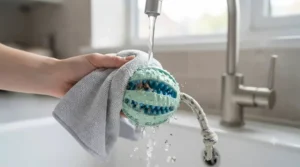
A simple maintenance schedule prevents most of the common problems owners run into. Rinse rubber balls after outdoor use to remove dirt and grass residue, and give them a proper wash in warm soapy water (or the dishwasher, for genuinely dishwasher-safe designs like the West Paw Zogoflex Jive Ball) roughly once a week, more often if your dog drools heavily or chews with food residue on their mouth. Check every toy for cracks, chunks missing, or flattened texture before each use during the first 30 days — this is the window where you’ll learn how hard your specific dog actually chews, regardless of what the packaging predicted.
The most common first-month mistake is buying based on size alone and ignoring bite strength: a Chuckit! Rugged Ball sized correctly for a Labrador will still get flattened fast if that Labrador happens to be an unusually determined chewer. Blue Cross guidance on dog chewing behaviour frames chewing as a genuine mental outlet dogs need rather than simply a habit to be managed or discouraged, so the goal of the first 30 days isn’t to find a toy that survives forever — it’s to find the right toy for your specific dog’s needs and rotate it out for a tougher option if it’s not holding up.
Real-World Scenarios: Which Dental Chew Ball Suits Your Dog?
Consider three genuinely different dogs and how the maths changes for each. A retired greyhound, seven years old, with the sort of worn enamel and gum sensitivity common in the breed, needs something gentle above all else — the KONG Squeezz Dental Ball‘s soft flex and low bite-force requirement fit this profile far better than anything marketed as “extreme” or “power chew,” regardless of how tempting the durability claims are.
Then there’s the young, high-energy working-breed dog — a springer spaniel or collie type who fetches obsessively and chews through everything left unattended for more than ten minutes. Here the calculation flips entirely: durability and dual-purpose fetch capability matter more than gentleness, making the Chuckit! Rugged Ball or the West Paw Zogoflex Jive Ball the sensible picks depending on budget, with the West Paw justified if this dog has already destroyed two or three “tough” toys in the past year.
Finally, picture a first-time puppy owner on a tight budget, unsure whether their pup will even take to a chew ball at all. This is exactly the scenario where the Rosewood Tough Twist Dental Ball or Trixie Denta Fun Rugby Ball earn their place — low-cost, genuine trial options that let you gauge engagement before committing to a premium purchase. If the puppy takes to it enthusiastically, upgrading to something like the KONG CoreStrength Ball as adult teeth come through is a natural next step rather than a wasted first purchase.
How to Choose Dental Chew Balls for Dogs
Picking the right one comes down to seven practical criteria, worked through roughly in this order:
- Assess chew strength honestly. Watch how your dog handles their current toys — flattened squeakers and shredded rope suggest you need something in the “strong” tier like the West Paw Zogoflex Jive Ball, not a gentle option.
- Match size to breed and mouth. Undersized balls pose a genuine choking risk; oversized ones frustrate smaller jaws and get ignored.
- Check the material composition. Natural rubber and purpose-made materials like Zogoflex outperform generic plastic-rubber blends on both safety and longevity.
- Consider texture depth. Deeper nubs and ridges, as on the KONG CoreStrength Ball, generally do more mechanical plaque work than smooth or shallow-textured surfaces.
- Factor in flavour, if your dog is reluctant. A mint or meat-flavour coating, like on the Trixie Denta Fun Rugby Ball or Nylabone Moderate Flexible Dental Ball, can be the difference between a toy that’s used daily and one that’s ignored in the corner.
- Weigh stuffability if you want extra engagement. Hollow, fillable designs extend chew sessions and give you a training tool as well as a dental one.
- Set a realistic replacement budget. Research from the Royal Veterinary College’s VetCompass programme has found dental disease to be among the most widespread health issues in UK dogs, and one that owners frequently fail to recognise as a welfare concern in its own right — which makes budgeting for a replacement toy every few months, rather than expecting one purchase to last forever, a genuinely worthwhile ongoing cost rather than a failure of the product.
Common Mistakes When Buying Dental Chew Balls for Dogs
The single most frequent mistake is treating “dental” as a marketing label rather than checking what actually makes a toy dental — texture, flex, and genuine mouth contact matter far more than the word printed on the packaging. A smooth rubber ball with “dental” in the name does little more mechanical work than a plain tennis ball; you want visible nubs, ridges, or a textured surface doing the scraping.
A second common error is buying the cheapest option repeatedly for a genuine power chewer, assuming durability doesn’t matter because “they’re all just balls.” In practice, this often costs more over a year than one premium purchase like the West Paw Zogoflex Jive Ball, once you tally up repeated £5-£8 replacements. Conversely, some owners overspend on premium “extreme” toys for a gentle senior or small breed that never needed that level of toughness — the KONG Squeezz Dental Ball would have served just as well for a fraction of the price.
Finally, plenty of owners skip supervision entirely once a toy’s proven “safe” a few times. Rubber degrades with UV exposure, heat, and repeated washing cycles, so even a toy your dog has used safely for months deserves periodic rechecking for cracks or weakening, particularly after time left outdoors.
Rubber Dental Chew Balls vs Traditional Dental Chews
Traditional edible dental chews — the rawhide-style or compressed treats sold in the same aisle — work on a different mechanism entirely: they’re consumed, so the “cleaning” happens through the chewing motion before the treat disappears, and their calorie content counts toward daily intake. Rubber dental chew balls, by contrast, aren’t consumed at all; they deliver the same mechanical scraping action repeatedly, session after session, with zero calorie impact and no risk of the swallowing-related choking hazards that come with softer edible chews breaking into large pieces.
| Factor | Rubber Dental Chew Balls | Traditional Edible Dental Chews |
|---|---|---|
| Reusability | Reusable for months or years | Single-use, consumed each time |
| Calorie impact | None | Counts toward daily calories |
| Ongoing cost | One-off purchase, occasional replacement | Recurring purchase, every use |
| Choking risk profile | Lower if correctly sized | Higher if swallowed in large pieces |
| Best For | Long-term, low-cost daily use | Occasional treat-based dental support |
The practical upshot: rubber balls like the Trixie Denta Fun Rugby Ball or Chuckit! Rugged Ball work out significantly cheaper per month of use once you account for repeat purchases of edible chews, and they carry none of the weight-management concerns that come with daily treat-based dental products. That said, edible chews still have a place — particularly for dogs who show little interest in rubber toys — so many owners reasonably use both rather than treating them as competing choices.
Textured Dental Ball Toys: What the Nubs and Ridges Actually Do
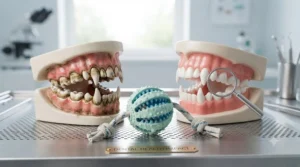
It’s worth being specific about what “textured” actually means mechanically, because it’s the single feature that separates a genuine dental toy from a plain rubber ball with a dental sticker on the box. Raised nubs, ridges, and grooves create pressure points that concentrate bite force onto smaller contact areas of the tooth surface, rather than spreading it evenly the way a smooth ball would. That concentrated contact is what actually dislodges soft plaque before it mineralises into tartar — the mechanical equivalent of a scrubbing brush versus a flat sponge.
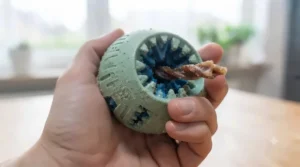
Deeper, more angular textures, like those on the KONG CoreStrength Ball, generally do more of this work per chew than the shallow, rounded nubs found on gentler toys like the KONG Squeezz Dental Ball — which is precisely why the softer options are marketed at gentler chewers rather than as a straight downgrade. What most buyers overlook is that texture depth and material softness are usually inversely related by design: a toy soft enough for sensitive gums typically can’t support deep, aggressive texturing without collapsing under normal use, so the “gentler but less texturally aggressive” trade-off is a deliberate engineering choice, not a shortcoming.
Dental Ball Toy Price: What You’re Really Paying For
Across this list, prices span roughly £5 to £18, and that spread isn’t arbitrary marketing — it maps fairly closely onto three genuine cost drivers: material durability, brand-specific manufacturing (Zogoflex versus generic rubber, for instance), and added features like flavour coatings or stuffable cavities.
| Price Band | What You’re Typically Getting | Example |
|---|---|---|
| Under £6 | Simple design, single material, light-moderate chewers | Rosewood Tough Twist Dental Ball |
| £6-£10 | Added features (flavour, flex, stuffability) | Nylabone Moderate Flexible Dental Ball, KONG Squeezz Dental Ball |
| £10-£18 | Advanced material or layered construction, strong-chewer rated | KONG CoreStrength Ball, West Paw Zogoflex Jive Ball |
The cost-per-use maths genuinely favours the higher price bands for strong chewers specifically: if a £6 ball needs replacing monthly while an £18 one lasts a year, the premium option is actually cheaper over twelve months, not more expensive. For gentle chewers, that maths reverses entirely, since a budget ball may realistically last just as long without ever being subjected to the bite force that would test a premium one’s durability.
Fetch and Chew Combo Toys: Two Jobs, One Toy
There’s a genuine practical case for prioritising toys that do double duty, and the Chuckit! Rugged Ball is the clearest example on this list of what that looks like done well — a toy built primarily for retrieval games that happens to deliver real dental benefit as a byproduct of its ridged surface catching against teeth during carry and chew. The KONG CoreStrength Ball works similarly in reverse: primarily a chew toy that’s robust and bouncy enough to double as fetch equipment for dogs who enjoy both activities.
The advantage isn’t just convenience, though that matters for owners managing a crowded toy box. It’s that combo toys naturally get used more often — a ball that only comes out for dedicated “chew time” gets forgotten far more easily than one that’s part of the daily walk or garden routine, and more frequent, incidental use is exactly what supports consistent dental benefit over the sporadic use pattern a single-purpose toy often falls into.
Durable Rubber Toys for Power Chewers: Safety & Longevity
For genuinely strong chewers, durability isn’t a luxury feature — it’s a safety issue. A toy that shreds or chunks under heavy bite pressure creates swallowing hazards that a slower-wearing, tougher toy simply doesn’t. This is where material choice genuinely separates the field: the West Paw Zogoflex Jive Ball‘s single-material Zogoflex construction resists the tearing and chunking that layered or lower-grade rubber toys are prone to under sustained pressure, which is precisely why it’s the toy reviewers repeatedly single out for dogs that have destroyed everything else tried.
Safety practice matters as much as toy selection here. Always size up rather than down for genuinely strong chewers — a toy that’s slightly too small for a determined power chewer’s mouth is at real risk of becoming a lodged or swallowed hazard rather than a chew toy. Inspect durable rubber toys after any session where you notice unusually aggressive chewing, and retire anything showing deep gouges, splits, or missing chunks immediately, regardless of how “indestructible” its marketing claimed it to be — no rubber toy is genuinely indestructible, and the goal is minimising risk, not eliminating it entirely.
Dog Gum Health: Why Chewing Matters Beyond Fresh Breath
It’s easy to think of dental chews purely in terms of breath and visible tartar, but gum health is arguably the more serious long-term concern hiding underneath. Royal Veterinary College epidemiological research has identified clear breed patterns in periodontal disease risk, with breeds like the Toy Poodle, Greyhound and Cavalier King Charles Spaniel showing notably higher rates than breeds such as the German Shepherd, French Bulldog or Staffordshire Bull Terrier — a genuinely useful data point if you own one of the higher-risk breeds and are deciding how seriously to prioritise dental chewing as part of a wider routine.
The gum-massaging action a textured chew ball provides — repeated gentle pressure and release against the gumline — supports blood circulation in the gum tissue in the same broad way that brushing does, though it’s genuinely not a substitute for it. Reviewers across several products on this list, particularly the mint-flavoured Trixie Denta Fun Rugby Ball, note dogs seem to actively engage with the gum-adjacent chewing motion rather than just biting through the centre of the toy, which is a promising sign of genuine gum contact rather than incidental chewing. Regardless of which chew ball you choose, treating it as one part of a wider dental routine — alongside regular brushing where your dog will tolerate it, and annual vet checks — remains the honest, evidence-backed approach rather than expecting any single toy to carry the full weight of your dog’s oral health.
Long-Term Cost & Maintenance
Total cost of ownership for a dental chew ball rarely stops at the purchase price. Factor in replacement frequency realistically: a light-to-moderate chewer might genuinely get six months to a year from a well-chosen budget ball, while a determined power chewer could work through a poorly matched cheap toy in days, making the higher-tier options like the West Paw Zogoflex Jive Ball the more economical long-run choice despite the steeper upfront price.
Maintenance costs are minor but worth planning for: regular washing (either by hand or, for dishwasher-safe designs, in the dishwasher) keeps bacteria from building up in textured grooves, and this small ongoing habit does more for hygiene than any single product feature. Budget mentally for replacing any dental chew ball the moment it shows structural damage rather than trying to extend its life past that point — the marginal saving isn’t worth the increased choking or ingestion risk that comes with a degrading toy.
Frequently Asked Questions
❓ How often should I replace a dental chew ball for my dog?
❓ Are rubber dental chew balls safe for puppies?
❓ Do dental chew balls actually work as well as brushing?
❓ What's the best dental chew ball for aggressive chewers?
❓ Can dental chew balls cause choking?
Conclusion
There’s no single “best” dental chew ball for dogs — there’s only the right one for your specific dog’s jaw strength, age, and chewing habits, matched against a budget you’re comfortable repeating every few months. What every option on this list shares, from the budget Rosewood Tough Twist Dental Ball to the premium West Paw Zogoflex Jive Ball, is that none of them replace brushing or professional dental checks; they’re a genuinely useful supplement, not a shortcut. Start with an honest read of how your dog currently treats toys, pick accordingly from the seven reviewed here, and keep an eye on wear and tear as you go — that combination does far more for your dog’s teeth and gums than chasing the single “best-rated” product on a spec sheet ever will.
Recommended for You
- Dental Chew Toys Under £10: 7 Brilliant Budget Picks (2026)
- Sustainable Wood Dog Chews: 7 UK Picks That Won’t Cost the Earth (2026)
- Natural Rubber Eco Dog Toys: 7 Genuinely Sustainable Picks (2026)
Disclaimer: This article contains affiliate links. As an Amazon Associate, I earn from qualifying purchases. If you purchase products through these links, we may earn a small commission at no additional cost to you.
✨ Found this helpful? Share it with your friends! 💬🤗
